Evidence checked: 23 September 2026 at 09:00 Nepal time.
Check again: before any trek departure, and whenever an official warning or route notice changes.
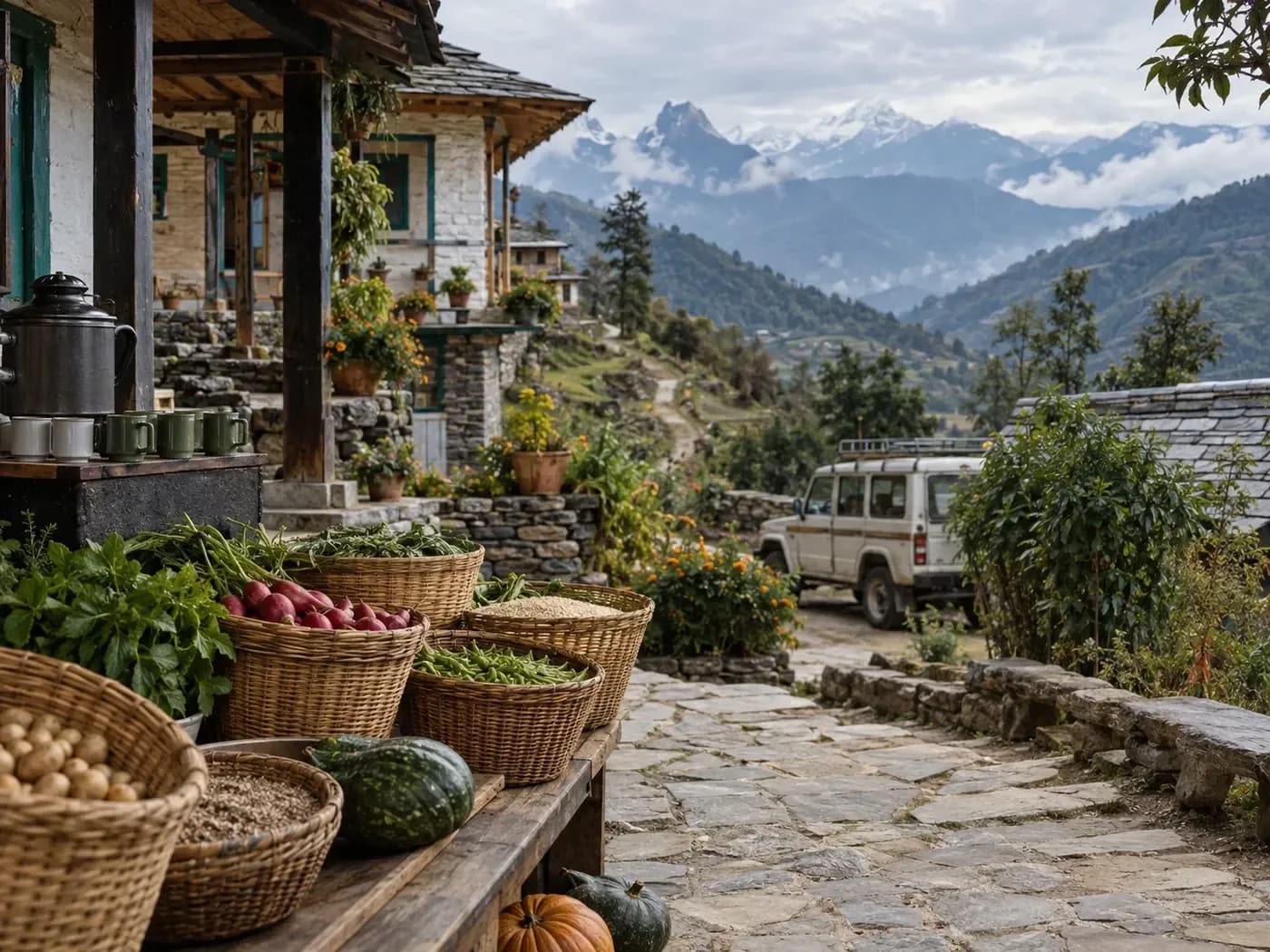
Hero image note: Editorial illustration. It does not show an affected area or establish that any route is open.
Nepal needs two kinds of support after a disaster. It needs urgent relief for people whose homes, health, roads and livelihoods have been hit. It also needs responsible visitors to keep ordinary work moving in places that are verified as ready to receive them.
Those needs are not rivals. A donation can pay for rescue, shelter, medicine, clean water and reconstruction. A journey can pay people for real work: driving, guiding, carrying, cooking, hosting, farming and supplying a trek. But travel helps only when the destination wants visitors, access is verified and the traveler does not compete with the emergency response.
This is why two strong phrases need careful handling. "Donations are temporary" points toward the value of continuing livelihoods, but it understates what relief and reconstruction must do. "Manaslu is ready" should reflect both the rapid local recovery and the current checks that support a responsible departure. The honest case for visiting Nepal is stronger when it makes those distinctions clear.
The short answer
Donate for urgent relief. Travel responsibly where routes are verified. Do not enter the disaster area. If your planned route is not ready, change it or postpone it rather than treating all of Nepal as either safe or closed.
What happened on 26 August 2026?
On the morning of 26 August, a surge of water, mud and rock entered Nepal at Rasuwagadhi on the Nepal-China border and ran down the Bhote Koshi and Trishuli corridor. The World Health Organization's Nepal emergency overview records serious damage to homes, markets, roads, bridges, health services and hydropower across parts of Rasuwa, Nuwakot, Dhading, Chitwan, Gorkha and Tanahun.
Scientists have described a glacier and rock collapse that blocked the Lhende Khola before the water broke through. The Kathmandu Post reported that Nepal's Department of Hydrology and Meteorology pointed to an ice avalanche, permafrost movement and a rockslide, with a full technical assessment still pending. The Guardian and Associated Press documented the early scientific explanation. This article found no final official report on the cause, so it does not state one.
The scale of loss is now clearer, though the numbers are still moving. At 20:00 on 22 September, Nepal Police reported 1,452 bodies recovered and 4,718 people still missing. It also reported that 1,333 bodies had been managed after DNA samples were collected, showing how much identification work was still underway.
The flood zone is not a tourism backdrop. People are grieving, responders are working, infrastructure is damaged and conditions may change quickly. No traveler should enter an affected area to sightsee, make disaster content or conduct an independent search.
Nepal is open, but not every corridor is
Nepal's government has said the country remains open to foreign travelers. At a briefing on 29 August, the Ministry of Foreign Affairs said areas outside the disaster continue to operate normally, Tourism Times reported. A disaster in one river system does not automatically close a whole country. It also does not mean that every road, trail, bridge or lodge is operating normally.
Official travel advisories show why the distinction matters. The United States advisory keeps Nepal at Level 2, exercise increased caution, and tells travelers not to go to the Rasuwagadhi, Timure and Syafrubesi area. United Kingdom travel advice, updated on 11 September, describes widespread damage in Rasuwa and the border area. Australia's Smartraveller advice widened on 8 September to flood-affected areas along both rivers in seven districts, while Canada, whose page was last modified on 17 September, advises against non-essential travel to Rasuwa and Nuwakot.
These systems use different boundaries and risk scales. A health-response map, a district warning and a road closure report answer different questions. None should be stretched into a claim that all of Nepal is safe, affected or closed.
| Question | What can be said | What still needs checking |
|---|---|---|
| Is Nepal under a nationwide tourism closure? | No blanket closure appeared in the official sources checked on 23 September. | The traveler's own government advice and exact itinerary. |
| Are the Bhote Koshi and Trishuli disaster corridors suitable for tourism now? | No. Active relief, damage and hazard warnings take priority. | Future official reopening and restoration notices. |
| Can a destination outside that corridor receive visitors? | Possibly, if local access and services are working and authorities do not advise against travel. | Roads, bridges, weather, transport, accommodation and emergency support on the actual date. |
| Does an open airport prove a trek is ready? | No. Tribhuvan International Airport stayed open while the Prithvi Highway was closed. The highway reopened at Krishnabhir on 17 September; after one-lane restrictions on 20 September, Nepal Police's obstruction list current to 08:00 on 22 September no longer named it. | Every road transfer, trail section, lodge chain, pass and exit. |
For changing conditions, use the separate current Nepal flood travel update. This page focuses on how tourism can support recovery; route-by-route status remains in the dated travel update.
Why tourism matters to Nepal's economy
Tourism is not Nepal's whole economy, but it is a large network of work spread across cities, roads, conservation areas and mountain settlements. A World Bank policy document estimates that tourism contributed 6.1 percent of Nepal's gross domestic product in 2023 and supported about 1.2 million direct and indirect jobs, around 15.2 percent of total employment.
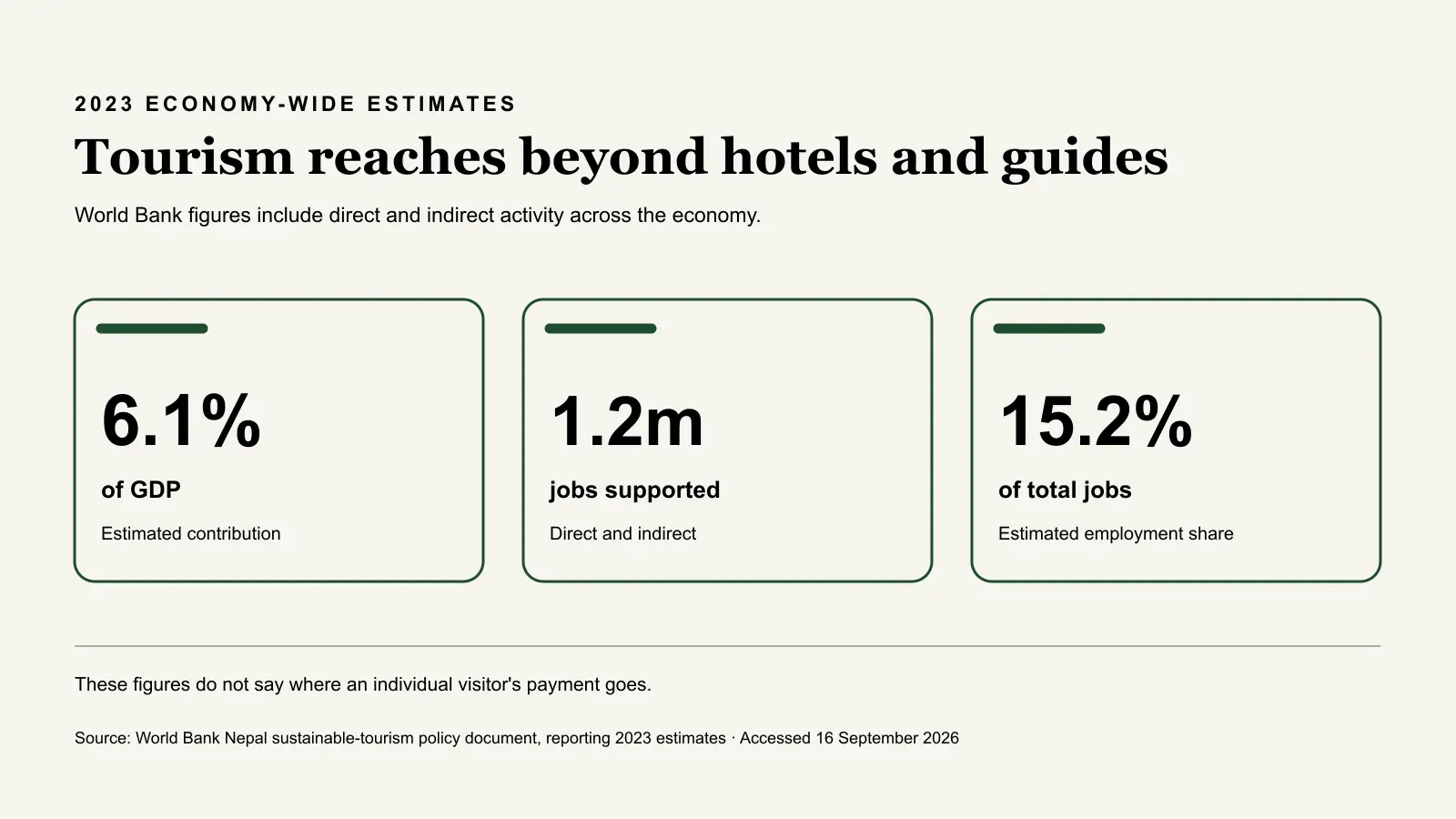
Those are broad estimates, not a claim that one in every six people is a trekking employee or that every visitor dollar stays in Nepal. Direct and indirect figures include activity beyond hotels and guides. That wider reach is exactly the point: travel demand moves through transport, food, agriculture, equipment, construction, craft, communications and other services.
The World Bank also reported that revived tourism helped Nepal's economic rebound in the 2024 fiscal year. Its work on nature-based tourism in Nepal connects visitor activity with jobs, local income and conservation finance.
The flood struck just before Nepal's main autumn season. Within days, businesses far from the damage were losing bookings. The Kathmandu Post reported that one Kathmandu hotel lost 20 percent of its bookings in a week, and the tourism ministry launched a #NepalCalling campaign in response. The Pacific Asia Travel Association said coverage had not consistently shown how concentrated the damage was.
For a mountain community, tourism demand can be highly seasonal. A lodge may earn much of its cash during a few trekking months. A porter, guide or driver may depend on a limited number of departures. A farmer may sell potatoes, vegetables, eggs or dairy products through a lodge rather than directly to a traveler. When a whole country is treated as closed, even places far from the damaged corridor can lose their season.
That does not mean travelers owe Nepal a holiday. It means decisions should match the evidence. Avoid the places that need space and relief. Do not cancel an unrelated, verified itinerary simply because a national headline makes every valley appear the same.
"Donations are temporary." What the line gets right and wrong
The sentence captures one useful truth: emergency generosity is often concentrated immediately after a disaster, while families and businesses may need income for months or years. It also creates a misleading contrast if it suggests that aid is brief, inferior or no longer needed.
The numbers show how long the need runs. The UN Flash Appeal seeks US$49.6 million to help 84,270 people until 31 December, and its 8 September situation report says that appeal covers humanitarian action, not reconstruction. Nepal's Ministry of Foreign Affairs has put the cost of reconstruction and recovery at about US$4.78 billion, ABC News reported. Medical care, shelter, water systems, debris removal, bridge repair and public infrastructure cannot be replaced by a trek booking.
Tourism has a different function. It is not aid. It is an exchange in which a visitor pays for a place to stay, a meal, a ride, a guide's judgment or a porter's work. When the service is locally delivered and the route is ready, that exchange can continue beyond the first news cycle.
The clearest version of the idea is this:
Relief answers urgent needs. Tourism supports ordinary work over time. Nepal needs both, directed to the places where each can actually help.
| Stage | Main need | What can help | What travel cannot replace |
|---|---|---|---|
| Rescue and immediate relief | Safety, medical care, shelter, food, water and communications | Government response, trained humanitarian organizations and verified cash support | Search and rescue, emergency medicine or public relief distribution |
| Rehabilitation | Restoring homes, roads, bridges, health services and livelihoods | Public funding, humanitarian recovery, technical work and local employment | Large infrastructure repair or assistance based on household need |
| Verified visitor return | Demand for lawful, operating tourism services | Responsible trips, local purchasing and longer stays where capacity exists | Direct compensation for people who lost family, property or income elsewhere |
| Long-term resilience | Safer systems, stronger infrastructure and diversified livelihoods | Public investment, responsible business, conservation and sustained tourism | Disaster preparedness and public institutions |
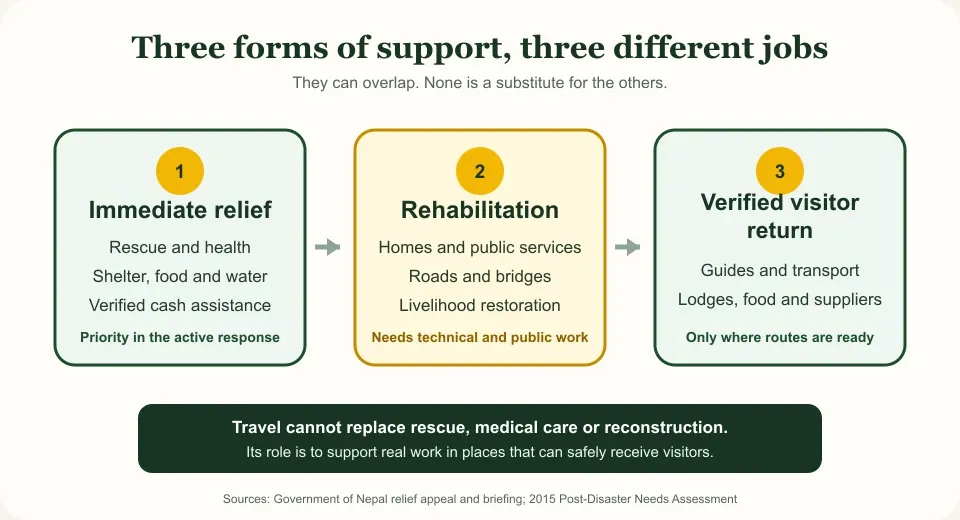
The United Kingdom's public guidance on helping after the flood recommends trusted cash channels rather than unsolicited goods that can obstruct logistics. That is practical humanitarian advice. A traveler who also wants to visit later can do both, without turning either choice into a moral performance.
How spending moves through a real Nepal trip
The value of tourism becomes clearer when it is described as a chain of real services rather than a promise to "save Nepal."
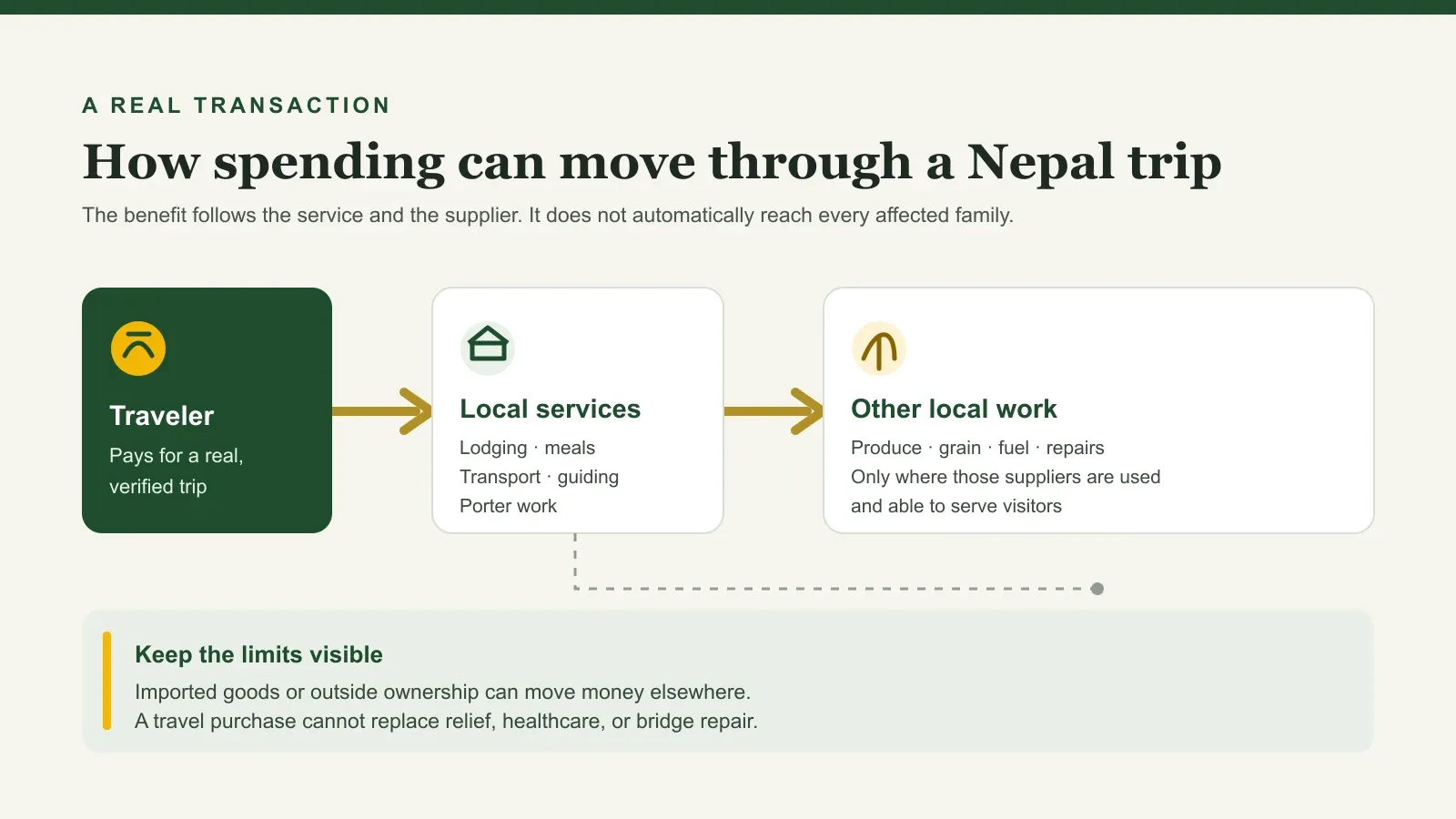
Before a trek begins, a traveler may pay for accommodation, meals, ground transport, equipment, permits and planning. On the route, money may go to a guide, porter, lodge owner, cook, mule operator, local transport provider or small shop. The lodge may buy fuel, vegetables, grain or maintenance work from other households. Conservation and permit systems may fund administration and protected-area functions.
This chain has limits. Some payments leave the destination through imported goods, international booking platforms or outside ownership. A traveler cannot assume that money spent in Kathmandu reaches a flood-affected family in Rasuwa, or that a Manaslu booking repairs a bridge near Syafrubesi. The honest claim is narrower: buying a real service from a locally rooted operator supports the people and suppliers who provide that service.
Travelers can improve the local share of their spending:
- Use licensed Nepali guides and operators with clear employment practices.
- Stay in locally owned accommodation when it meets the route's safety and hygiene needs.
- Buy meals, supplies and crafts from operating local businesses rather than demanding free extras.
- Pay agreed rates on time and tip for good service without using charity language.
- Ask who actually provides transport, accommodation and guiding before booking.
- Avoid bargaining that treats a disaster as leverage for a discount.
The goal is not to prove that every rupee reaches the most vulnerable person. It is to make the transaction visible: who receives the payment, where, for what service, and whether that community is asking for visitors now.
What Nepal learned after the 2015 earthquake
The 2015 earthquake offers a useful lesson because Nepal faced two risks at once: real damage in some places and a wider collapse of confidence across the country.
The government-led Post-Disaster Needs Assessment reported that planned foreign arrivals fell sharply after the earthquake and identified tourism losses beyond the physically damaged areas. Its recovery sequence was not simply "tell everyone Nepal is safe." It called for identifying and assessing unaffected destinations, developing a safer trekking system, rebuilding damaged infrastructure and restoring confidence with evidence.
That sequence matters. In July 2015, Reuters reported that the Annapurna Circuit reopened after an engineering assessment gave it clearance. At the same time, The Guardian's route-by-route recovery reporting noted that assessment of Manaslu was still awaited. One route's clearance did not become proof for another.
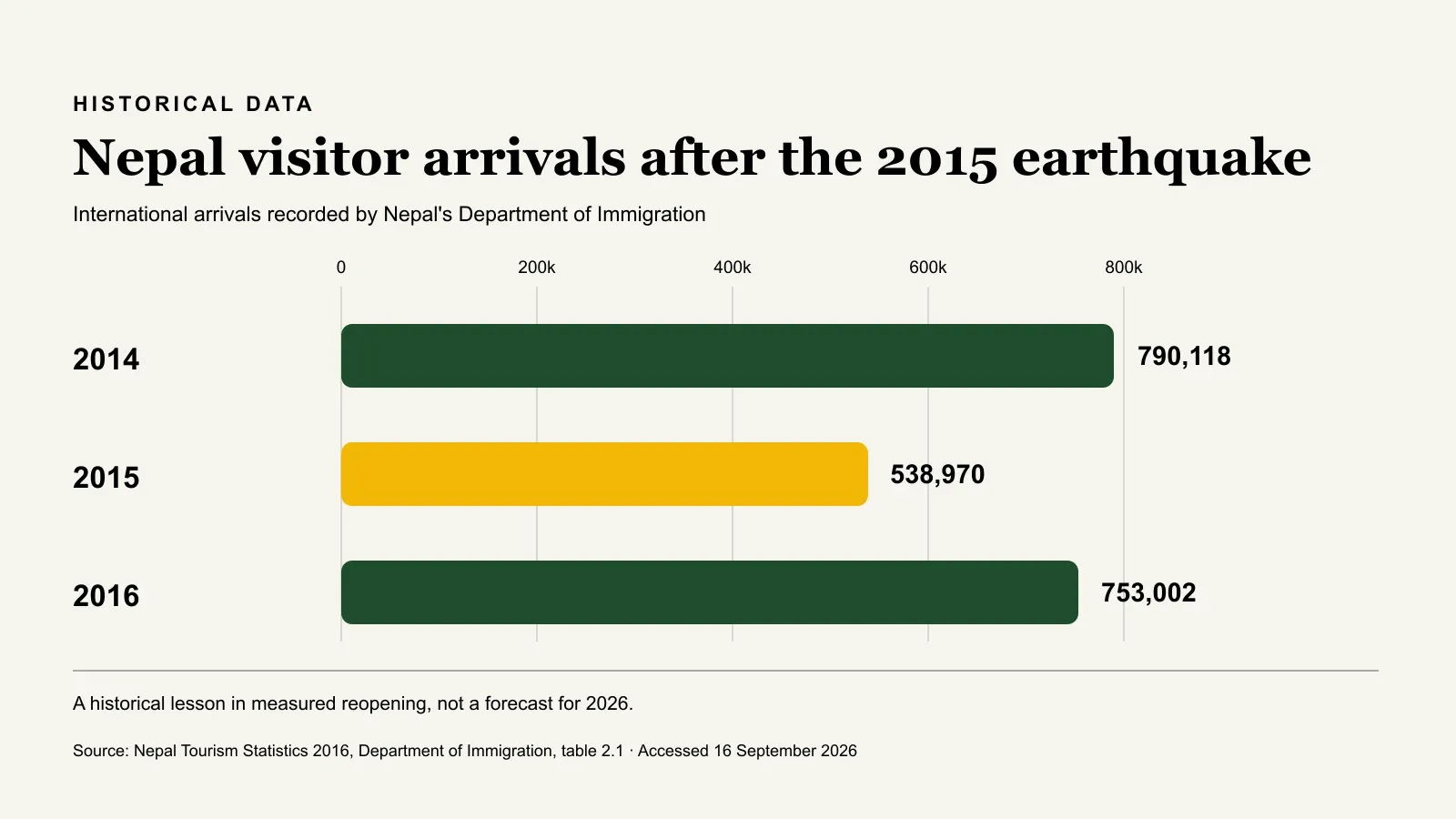
The official tourism statistics show the scale and the return. International arrivals fell from 790,118 in 2014 to 538,970 in 2015, then recovered to 753,002 in 2016, according to Nepal Tourism Statistics 2016. The Guardian's reporting one year after the earthquake described individual lodge owners rebuilding and serving returning trekkers. These stories show how visitor return can support recovery, but they do not erase the need for assessment or prove the same outcome for every community.
The durable lesson is simple:
Assess first. Clear the exact route. Reopen honestly. Keep checking.
That is more credible than either panic or reassurance.
Manaslu: local recovery and responsible route planning
The Manaslu Circuit is not the Rasuwagadhi, Timure and Syafrubesi corridor. The Nepal Tourism Board describes the Manaslu route as following the Budhi Gandaki through northern Gorkha toward the Gorkha-Manang border. That geographic distinction matters: Manaslu is not part of the main Rasuwagadhi disaster corridor.
For context, Manaslu experienced a separate local disruption in September. At about 3:30 on the morning of 6 September, a flood on the Therang Khola at Namrung washed away two bridges on the circuit and four houses, Nepal News reported. As a precaution, the District Administration Office in Gorkha temporarily asked trekkers not to start or continue Manaslu and Larke Pass journeys, according to Tourism Times.
Local people and authorities then led a rapid recovery. Residents, their ward chair and the Manaslu Conservation Area Project built a wooden bridge and an alternative trail within days, the rural municipality said. On 11 September the district office said the section had reopened after restoration, Nepal News reported. Because the crossings are temporary, Explorersweb's reporting supports keeping them in the local condition check after heavy rain while longer-term infrastructure work continues.
Other route sections are also part of the normal update cycle. On 10 August, Tourism Times reported a warning from the Trekking Agencies' Association of Nepal after heavy rain damaged the Budebagar section near Tilche and a suspension bridge over Surkhi Khola. This review did not locate a later public repair update. For the road approach, the association published alternatives through Galchhi or Benighat after the Malekhu bridge closure. These are route-planning details, not evidence that all of Manaslu is inaccessible.
Applications and planning for Manaslu can continue. Authorities have reopened the affected Namrung section, and local recovery work is continuing. LHJ confirms the final departure after a dated check of the complete journey, which is how responsible trekking operations protect visitors and local communities without writing off the whole region.
| Route section | Latest public status | LHJ confirmation before departure |
|---|---|---|
| Kathmandu to Machha Khola approach | Alternative approaches via Galchhi or Benighat were published after the Malekhu bridge closure | Same-day road, bridge, vehicle and transfer confirmation for the selected approach |
| Machha Khola to Jagat | No disruption specific to this section was identified in the sources reviewed | Named local checks for trail, river crossings, bridges and lodges |
| Jagat to Namrung, Samagaun and Samdo | Local crossings were established and the Namrung section reopened on 11 September | Current condition of the restored crossings and adjoining trail |
| Larkya La crossing | No disruption specific to the pass was identified in the sources reviewed | Current pass, snow, weather and descent conditions |
| Bimthang to Tilche and Dharapani | A 10 August notice recorded damage near Tilche and Surkhi Khola; a later public repair update was not located | Current local confirmation of the section and crossing |
| Exit transport | No separate disruption was identified in the public sources reviewed | Current Dharapani road and onward vehicle status |
| Weather and emergency support | DHM forecast increasing rainfall from 23 September, with heavy to very heavy rain possible in parts of Gandaki from 25 to 27 September | Department of Hydrology and Meteorology bulletins, local notices and a workable response plan for the selected departure |
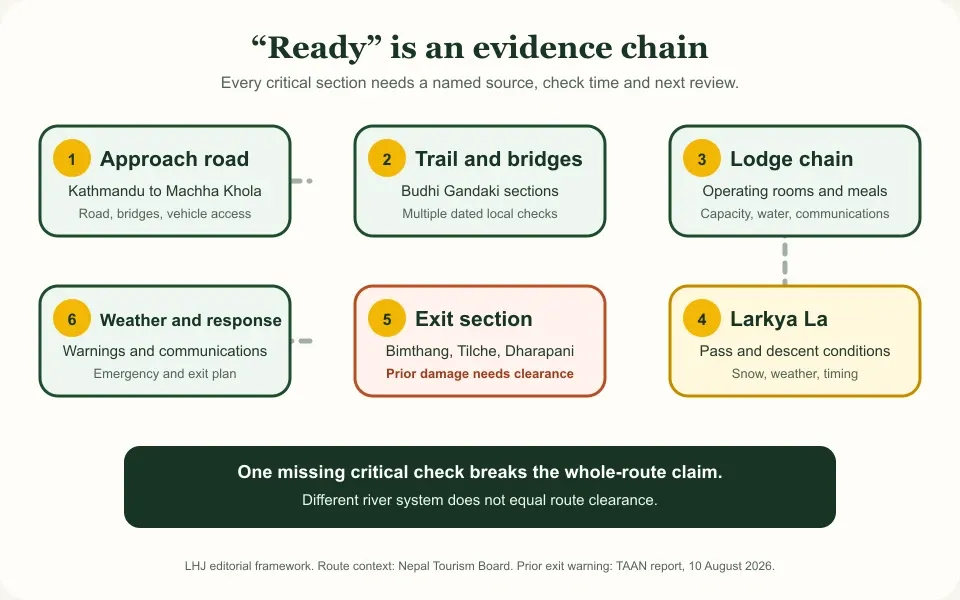
This is what responsible Manaslu readiness means at LHJ: recognising the work already completed by local people and authorities, then confirming the remaining route details for the chosen date. Great Himalayan Walk applications can remain open while final departure confirmation stays tied to current evidence.
For evergreen route context, see the Manaslu region guide and Manaslu Circuit itinerary. For legal access, read the Nepal trekking permits guide. LHJ pairs these evergreen resources with current local checks before confirming a departure.
When travel does not help
Travel is not automatically supportive because money changes hands. It can add pressure or cause harm when the basic conditions are wrong.
Do not travel into an active rescue or relief area. Do not use scarce rooms, vehicles, fuel, food, medical services or communications that responders and displaced residents need. Do not enter a closed or strongly warned-against corridor because a social-media post says it looks quiet.
Travel also does not help when:
- the approach, route or exit cannot be verified;
- the traveler's official advisory or insurer excludes the itinerary;
- local authorities or communities are asking visitors to stay away;
- a guide or porter is being pressured to accept a risk the guest would not accept;
- the purpose is to photograph destruction, grief, shelters or funerals;
- an unqualified volunteer takes work from trained responders or creates another person to supervise;
- a booking message implies that refusing to travel is abandoning Nepal.
Ethical tourism begins with consent and capacity. A community that is ready to host visitors can benefit from business. A community managing loss may need privacy, assistance and time.
How to visit Nepal responsibly after a disaster
Responsible travel is less about a slogan and more about a series of checks and behaviors.
1. Check the exact itinerary, not the country name
Write down every road transfer, trek section, overnight stop, pass and exit. Compare that route with current government notices, the travel advice for your nationality, hydrology and weather bulletins, transport reports and named local evidence. A destination can be open while its approach road is not.
2. Ask for evidence with a date and owner
Ask the operator who checked each section, when they checked it, what they observed and when they will check again. "The area is fine" is not enough. A good answer identifies a road, bridge, village, trail section or lodge and separates confirmed facts from what is still unknown.
3. Keep the plan reversible
Use flexible arrangements where possible. Build buffer days into the itinerary. Understand what happens if a route is changed, a pass cannot be crossed or an official warning changes. Insurance should cover the actual altitude, activity, evacuation needs and disruption conditions, not just a generic Nepal holiday.
4. Use qualified local services
The United Kingdom's trekking safety guidance recommends a reputable agency or guide and appropriate insurance. For restricted areas such as Manaslu, legal permit and guide requirements also apply. Qualification does not remove mountain risk, but it improves planning, communication and accountability.
5. Spend with respect
Pay fairly for real services. Choose locally rooted accommodation, transport and food where practical. Do not ask for disaster discounts or describe normal wages as charity. If you want to donate, make a separate verified donation rather than turning an employee's pay into a public act of generosity.
6. Protect privacy and dignity
Ask before photographing people. Do not film relief queues, damaged homes, grieving families or children for travel content. A disaster survivor is not evidence that a trip is meaningful.
7. Accept rerouting or postponement
Changing a trip is not a failure. A verified alternative destination can keep spending in Nepal without adding pressure to an affected corridor. If no responsible alternative fits, postponement is the correct decision.
For broader planning, see what to know before travelling to Nepal and how LHJ approaches trek safety.
How to support Nepal if you are not traveling
You do not need to book a trip to be useful.
For immediate needs, Nepal's Ministry of Foreign Affairs directs donations to the Prime Minister's Disaster Relief Fund. You can also give through an established humanitarian organization with a clear Nepal response. Check the organization, destination of funds and current appeal before sending money. Cash is usually more adaptable than unsolicited goods because responders can buy what is needed and avoid unnecessary transport and storage.
If you already have a Nepal trip booked, ask for evidence before cancelling. A move to another verified route or a postponement may preserve more value for local workers than an immediate cancellation. It may also be the safer choice. The correct answer depends on the itinerary, terms, advisory and date.
You can also support Nepal by sharing accurate, dated information. Link to official sources rather than dramatic clips without location or time. Correct the claim that all of Nepal is closed, but do not replace it with the equally careless claim that all of Nepal is safe.
Later, when a route has been assessed and a community wants visitors, travel can become part of a longer recovery. It should arrive as respectful demand, not as rescue theatre.
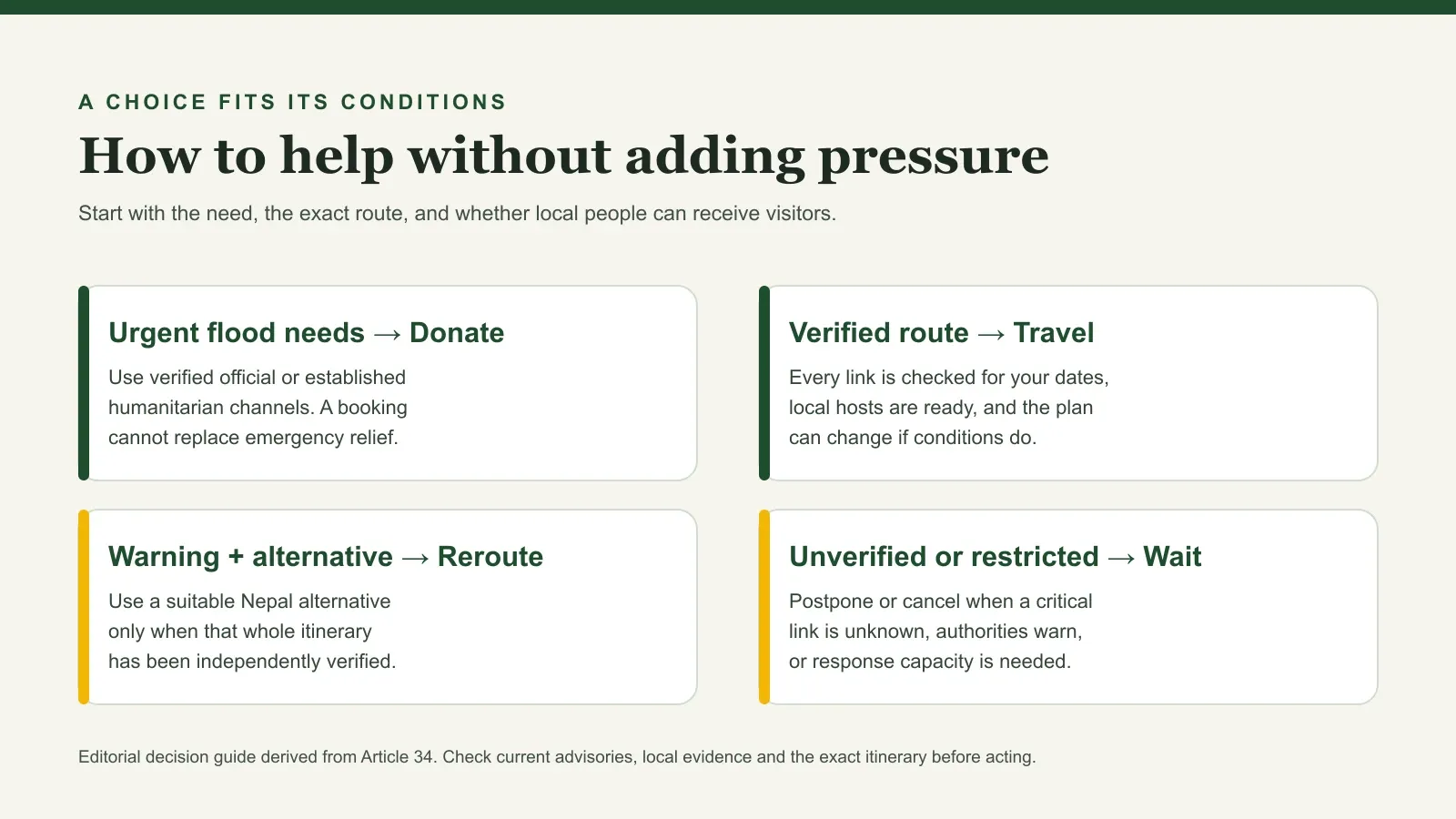
Should you donate, travel, change route, postpone or cancel?
| Situation | Best next step | Why |
|---|---|---|
| You want to help with urgent flood needs | Donate through a verified official or established humanitarian channel | Relief can address immediate needs that tourism cannot |
| Your itinerary is outside the affected corridor and every section is currently verified | Travel with flexibility and continue monitoring | Responsible demand can support operating local services |
| Your original route has a warning, but a suitable Nepal alternative is verified | Change route | It avoids the affected area while keeping the trip viable |
| A critical road, bridge, trail, pass or exit is unverified | Postpone or choose a verified alternative | Absence of a closure is not proof of readiness |
| Authorities advise against the route or local capacity is needed for relief | Cancel or postpone that itinerary | Safety and response needs come first |
| You cannot travel but want to support longer-term livelihoods | Donate now, consider future travel, and buy from verified Nepali businesses | Different forms of support can operate at different times |
A stronger way to support Nepal
Nepal does not need empty reassurance, and it does not need fear applied to the whole country. It needs accuracy.
The affected corridors need relief, reconstruction, privacy and time. Places that are genuinely ready can benefit when visitors arrive with current information, flexibility and respect. Mountain workers do not need to be presented as recipients of pity. They need safe conditions, honest businesses and customers who value their work.
So keep both ideas, but make them precise. Donations answer urgent and recovery needs. Tourism can provide continuing work. Manaslu's communities and authorities have already shown recovery in action, and responsible operators support that effort with current checks before each departure.
That is the promise behind "Visit Nepal, Support Nepal": help the places that need relief, visit the places that are ready, and never confuse hope with evidence.
Sources and update policy
This article draws on official Nepal government, WHO, UN, World Bank, foreign-government advisory and established media sources.
Current disaster, advisory, weather and route statements were last checked at 09:00 Nepal time on 23 September 2026. They were checked against Nepal Police, the Nepal Tourism Board's current Manaslu update, the Department of Hydrology and Meteorology, WHO, UN OCHA and the official United States, United Kingdom, Australian and Canadian travel advisories linked above.
Economic and recovery analysis uses the World Bank, the government-led 2015 Post-Disaster Needs Assessment and official Nepal tourism statistics. Reported context uses the Kathmandu Post, Associated Press, Reuters, The Guardian, ABC News, Explorersweb and Tourism Times. None of those sources is used as a substitute for current route clearance.
A correction names the changed fact, its source and the new check time. For the latest status of an individual itinerary, use the dated travel update rather than an evergreen statement.
Frequently asked questions
Is Nepal safe to visit after the August 2026 flood?
There is no responsible country-wide yes or no answer. The advisories checked on 23 September do not impose a blanket closure on Nepal, but they contain strong warnings for named flood-affected areas, and major roads remain vulnerable to closure or restriction. Check the exact route, date, transport, weather, local capacity, your government's advice and insurance before deciding.
What is the current Manaslu trekking status?
Local residents, the ward chair, the Manaslu Conservation Area Project and district authorities restored access through the Namrung section after the 6 September flood. Gorkha officials reported the section reopened on 11 September using temporary crossings. Applications and trip planning can continue while LHJ confirms the complete route, including the approach and Dharapani-Larke side, for each departure date.
Are donations temporary?
Some emergency appeals are time-limited, but relief and reconstruction needs can continue for years. Donations and tourism do different jobs. Verified aid can meet urgent and needs-based priorities. Responsible tourism can support ordinary work over time in places that are ready to receive visitors.
Is traveling better than donating?
No. A trip cannot replace rescue, medical care, shelter or infrastructure repair, and spending in one region does not automatically reach people affected elsewhere. Donate if you want to support urgent needs. Travel where the route is verified if the trip suits you. Doing both is also possible.
Should I cancel a Nepal trip because of the flood?
Do not decide from a national headline alone. Compare your exact itinerary with current official advice and route evidence. Keep a verified trip, change to a suitable route, postpone or cancel according to the facts and your own risk limits.
How can I make more of my spending local?
Use licensed Nepali guides and locally rooted providers, pay agreed prices fairly, stay and eat locally where practical, buy genuine local goods and ask who supplies the services in your package. Treat wages and purchases as payment for work, not as charity.
Can I volunteer in the disaster area?
Do not volunteer informally or enter the response area independently. Untrained help can consume transport, accommodation and supervision. Work only through a verified organization that has requested your relevant skills and has a lawful, coordinated role.
How does LHJ confirm a Manaslu departure?
LHJ combines current local confirmation of the Kathmandu approach, the Budhi Gandaki trail, the restored Namrung crossings, lodges, Larkya La, the Bimthang-Tilche-Dharapani exit, onward transport, weather monitoring and the emergency plan. This route-by-route process lets planning continue while the final departure reflects the latest local conditions.
Something here out of date or wrong? Tell us and we will check it.