Nepal trekking permits in 2026 depend on the exact route, not simply the region name. A trek may require a national park or conservation-area entry permit, a TIMS card, a municipal trek card, a restricted-area permit, or a combination of them. Nepal Tourism Board's current page links TIMS to a licensed guide and registered trekking agency on listed routes, but the underlying guideline contains exemptions and the Everest region remains the subject of an unresolved disagreement between NTB and the Khumbu local government.
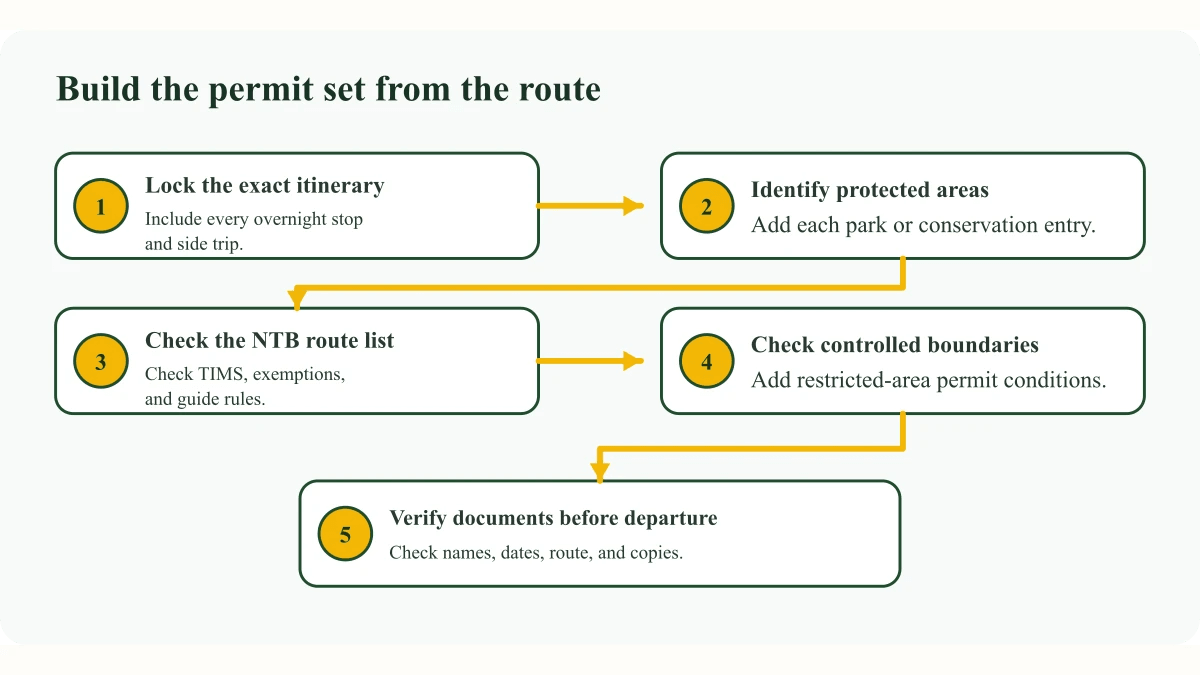
The safest planning method is therefore route-first: confirm every overnight stop, check which protected or controlled areas the trail enters, and have the final document set verified before leaving Kathmandu or Pokhara.
The short answer
- Everest Base Camp: Sagarmatha National Park entry and the Khumbu municipal Trek Card apply. NTB also lists EBC under TIMS, while the Khumbu local government has publicly rejected that requirement. LHJ checks the live requirement and arranges TIMS when required.
- Annapurna Circuit: Annapurna Conservation Area entry applies, and Nepal Tourism Board lists the Annapurna Circuit under the revised TIMS and guide provision.
- Langtang Valley: Langtang National Park entry applies, and Nepal Tourism Board lists Langtang routes under the revised TIMS and guide provision.
- Manaslu Circuit: A restricted-area permit and Manaslu Conservation Area entry apply; ACAP also applies when the itinerary enters the Annapurna Conservation Area. Section 9(b) of the TIMS guideline exempts a traveler carrying the immigration-issued restricted-area permit.
- Upper Mustang: Annapurna Conservation Area entry and a restricted-area permit apply. Section 9(b) of the TIMS guideline provides the same restricted-permit exemption from mandatory TIMS.
These summaries are based on the current Nepal Tourism Board TIMS route list, Nepal Tourism Board park and conservation-area fees, NTNC online permit terms, Department of Immigration route and fee table, and Khumbu Pasang Lhamu Rural Municipality Trek Card page.
Nepal trekking permit requirements by route
The table below is a planning matrix, not a permit itself. It uses published authority pages and highlights where a final route check is still needed.
| Trek or route | Protected-area entry | TIMS status | Other local requirement | Restricted-area permit |
|---|---|---|---|---|
| Everest Base Camp and Gokyo | Sagarmatha National Park: NPR 3,000 for most foreign visitors | NTB lists both routes; Khumbu disputes the rule. LHJ arranges TIMS when required. | Khumbu Trek Card: NPR 3,000 for visitors outside SAARC and China | Not for the standard EBC or Gokyo route |
| Annapurna Circuit | Annapurna Conservation Area: NPR 3,000 for most foreign visitors | Required by NTB for the listed route; agency-issued | None identified on the standard circuit | Not for the standard circuit, but controlled side routes differ |
| Langtang Valley | Langtang National Park: NPR 3,000 for most foreign visitors | Required by NTB for the listed route; agency-issued | None identified on the standard valley route | Not for the standard valley route |
| Manaslu Circuit | MCAP; ACAP also applies where the confirmed itinerary enters ACAP | Not mandatory while carrying the DOI restricted-area permit; optional under TIMS guideline section 9 | Route and season check required | Yes, for the controlled Manaslu area |
| Jomsom-Muktinath | Annapurna Conservation Area: NPR 3,000 for most foreign visitors | Not named separately; check whether the exact itinerary forms part of an NTB-listed route | None identified for the standard route | Not for the standard route |
| Upper Mustang | Annapurna Conservation Area: NPR 3,000 for most foreign visitors | Not mandatory while carrying the DOI restricted-area permit; optional under TIMS guideline section 9 | Route and boundary check required | Yes: current DOI table lists USD 50 per person per day |
Reading the matrix: Appearance on NTB's route list is the starting point, not the whole TIMS decision. Section 9 of the underlying guideline exempts specified travelers, including those carrying a Department of Immigration restricted-area permit. Everest is a separate authority conflict explained below. For protected-area amounts, see the NTB entry-fee page and NTNC e-permit portal. For restricted areas, use the current Department of Immigration fee table.
Why one trek can require several documents
Nepal's permit system has layers because different authorities manage different responsibilities.
- Protected-area entry funds or regulates entry to a national park or conservation area. Examples include Sagarmatha National Park, Langtang National Park, and the Annapurna and Manaslu conservation areas.
- TIMS is the Trekkers' Information Management System. Nepal Tourism Board's revised provision applies to a published list of routes and is tied to a licensed guide and a registered trekking agency.
- Local cards or fees may apply inside a municipality. The Khumbu Trek Card is the clearest example for Everest-region visitors.
- Restricted-area permits apply to controlled areas identified by the Department of Immigration. These are handled through a registered trekking agency and have route, date, and fee conditions.
TIMS in 2026: the rule, exemptions, and Everest conflict
What the current NTB page says
Nepal Tourism Board says its revised TIMS provision took effect on 31 March 2023. Its current page says trekkers on the listed routes need a licensed trekking guide and an agency-issued TIMS card. The list includes Everest Base Camp, Gokyo, Langtang Valley, Manaslu Circuit, Annapurna Circuit, Poon Hill to Annapurna Base Camp, Mardi Himal, and Upper Mustang.
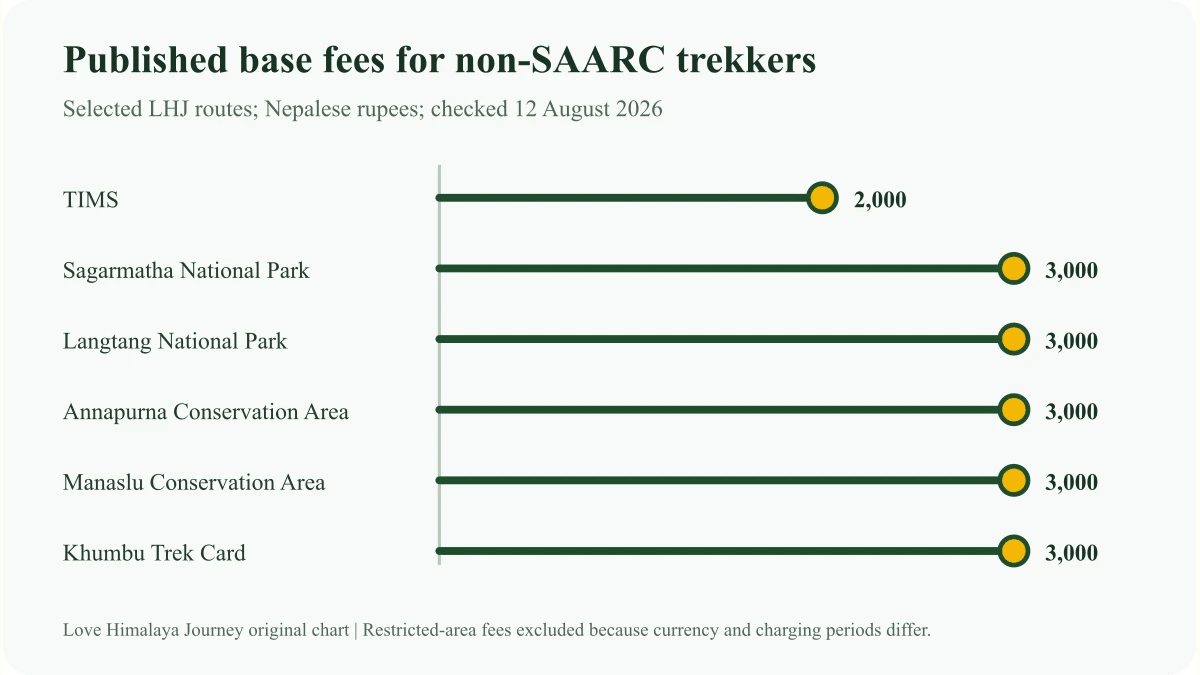
The same official TIMS page publishes a charge of NPR 2,000 for most foreign visitors and NPR 1,000 for SAARC visitors. Because route labels can be broader than a traveler's itinerary, confirm the exact line of travel rather than assuming that a region-wide answer applies.
Who is exempt under the TIMS guideline
The original 14-page TIMS guideline is more specific than the summary webpage. Section 9 says TIMS is not mandatory for several categories, including mountaineers carrying an expedition permit and travelers carrying a Department of Immigration permit for a restricted area. A restricted-area traveler may obtain TIMS voluntarily, but it is not compulsory while the immigration permit is carried. The guideline also exempts children under ten and certain helicopter round trips.
This means Manaslu Circuit and Upper Mustang appear on NTB's route list but do not require an additional TIMS card when the traveler carries the applicable immigration-issued restricted-area permit. This exemption is described in Kathmandu Post's report on the issued guideline and was verified against section 9(b) of the linked original Nepali document during the 12 August 2026 recheck.
Why Everest answers conflict
NTB's current page still lists Everest Base Camp and Gokyo. However, Khumbu Pasang Lhamu Rural Municipality publicly rejected the NTB rule and said Everest trekkers should use its own Trek Card system. Kathmandu Post documented that government-level disagreement, and the municipality continues to publish its Trek Card service.
No later joint government notice resolving the conflict was found during this recheck. Therefore, this guide does not claim that inconsistent checkpoint practice cancels NTB's published rule, and it does not claim that TIMS is uniformly enforced in Khumbu. LHJ's operational policy is to check the live requirement for the exact Everest itinerary and arrange TIMS when required.
Park and conservation-area entry fees
For most foreign visitors, the currently published base entry amount is NPR 3,000 for Sagarmatha National Park, Langtang National Park, Annapurna Conservation Area, and Manaslu Conservation Area. SAARC and Nepalese rates differ. Children under ten are exempt on the cited authority pages, subject to their stated terms.
The Nepal Tourism Board fee page covers national parks and conservation areas. For NTNC-managed conservation areas, the NTNC e-permit portal says an online permit is emailed, carries a 2.9 percent gateway charge, is valid for a single entry, and should be carried during the visit. It also warns that obtaining the permit at a checkpoint costs double the normal fee.
That double-fee warning makes “we will buy it if someone asks” an expensive planning strategy. Arrange the correct entry permit before reaching the checkpoint and retain both a digital copy and a usable printed copy.
Everest permits: EBC, Gokyo, and the Khumbu Trek Card
For a standard Everest Base Camp or Gokyo itinerary, two requirements are clear on current authority pages:
- Sagarmatha National Park entry, currently NPR 3,000 for most foreign visitors; and
- the Khumbu municipal Trek Card, currently NPR 3,000 for visitors outside SAARC and China.
TIMS is the disputed layer: NTB lists the routes, while the Khumbu local government says its system applies instead. LHJ checks the live agency requirement and arranges TIMS when required rather than asking the traveler to interpret the dispute.
The Khumbu Pasang Lhamu Rural Municipality page lists a passport and recent photo and identifies the Tourist Information Center in Lukla. It publishes NPR 2,000 for SAARC visitors and Chinese visitors, and NPR 3,000 for other countries.
An Everest itinerary can enter the region by flight, road, or a longer approach trail, so the practical issue is not just what the card is called. The route plan should identify where each document is issued or checked. Explore LHJ's current Everest-region treks, then confirm the final permit set for the chosen itinerary.
Annapurna permits: circuit, base camp, and side routes
Annapurna Conservation Area entry is the common foundation for classic Annapurna itineraries. The NTNC online portal currently publishes NPR 3,000 for most foreign visitors and NPR 1,000 for SAARC visitors. Nepal Tourism Board's TIMS list includes the Annapurna Circuit and several other familiar routes, including Poon Hill to Annapurna Base Camp, Khopra Ridge, Mardi Himal, and Sikles.
The phrase “Annapurna permit” can still hide important differences. Nar Phu and other controlled side valleys are not interchangeable with the standard Annapurna Circuit. If a side trip crosses into a restricted area, a standard conservation-area permit does not replace the restricted-area authorization.
Start with the Annapurna region overview, then verify the chosen villages and side trips against the current authority lists.
Langtang permits
For the standard Langtang Valley route, Langtang National Park entry and the published TIMS and licensed-guide provision are the main layers. Nepal Tourism Board currently lists Langtang routes under its revised TIMS system and publishes NPR 3,000 as the national park entry charge for most foreign visitors.
Routes that combine Langtang with Gosainkunda, Helambu, or a different exit should be checked as a complete itinerary. See LHJ's Langtang region overview for route context, but use the current NTB pages as the rule source.
Manaslu restricted-area permit and fees
Manaslu Circuit is not simply an MCAP trek. It enters a controlled area, so an immigration-issued restricted-area permit and Manaslu Conservation Area entry apply. The confirmed LHJ route also requires ACAP when it continues into the Annapurna Conservation Area.
Although NTB lists Manaslu Circuit on its TIMS webpage, section 9(b) of the underlying guideline says TIMS is not mandatory for a traveler carrying the Department of Immigration restricted-area permit. The restricted permit does not remove the agency and guide conditions attached to the controlled area.
The current Department of Immigration route and permit fee table lists the Manaslu controlled area in specified wards of Chumnubri Rural Municipality. It publishes:
| Season | First period | Extension |
|---|---|---|
| September to November | USD 100 per person for the first week | USD 15 per person per day beyond one week |
| December to August | USD 75 per person for the first week | USD 10 per person per day beyond one week |
The date and route on the authorization matter. A change to the entry day, exit day, or side valley can change the required duration. Review LHJ's Manaslu region, then have the exact itinerary checked before documents are submitted.
Upper Mustang versus Lower Mustang
“Mustang” is not one permit category. The standard Jomsom-Muktinath corridor and Upper Mustang cross different administrative boundaries.
For Upper Mustang, the Department of Immigration's current fee table lists USD 50 per person per day for the identified controlled area. The route also lies within the Annapurna Conservation Area. Upper Mustang appears on Nepal Tourism Board's TIMS route list, but the guideline's restricted-permit exemption means TIMS is not mandatory while the immigration permit is carried.
Older official pages and many third-party articles still show a different ten-day price structure. For this guide, the current route-and-fee page is treated as the fee authority. Check it again immediately before you book. Compare LHJ's Mustang region with the specific Upper Mustang trek rather than transferring Upper Mustang rules to every Mustang journey.
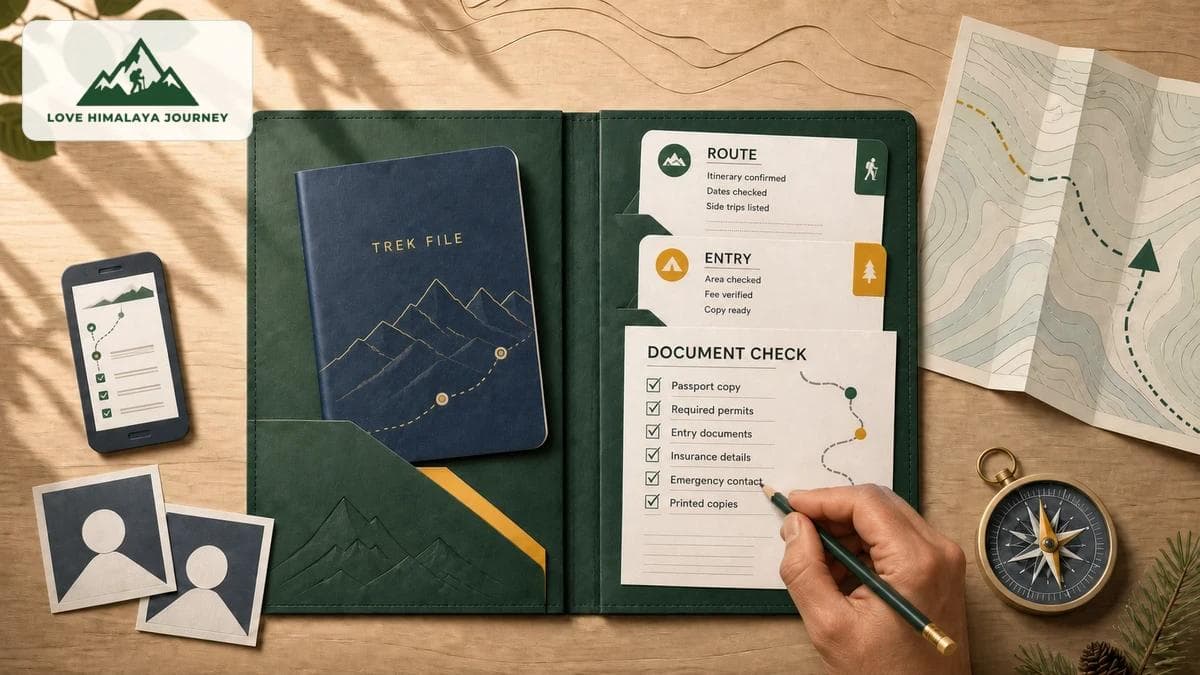
Editorial illustration: fictional planning cards, not replicas of official permits or travel documents.
What the traveler supplies and what the agency arranges
LHJ operations has confirmed the permit-mapping and document workflow below. It remains a planning checklist because authorities, itinerary details, and requested changes must still be checked for each departure.
| Traveler usually supplies | Registered agency usually verifies or arranges | Confirm before payment |
|---|---|---|
| Passport details and clear passport copy | Route-to-permit mapping | Which permits are included in the displayed trek price |
| Valid Nepal visa details, when already issued | TIMS registration when required after exemptions and local rules are checked | Whether originals, printed copies, or digital copies are carried |
| Recent passport-style photographs where requested | Restricted-area submission where required | Processing lead time for the exact route and season |
| Correct personal information and emergency contact | Date, route, and fee calculation | What happens if dates or itinerary change |
| Timely notice of itinerary or flight changes | Copy control and document handover | Who handles an extension or replacement |
LHJ has confirmed that all required permit fees are included in its displayed trek price, and operations has confirmed the route combinations and workflow in this guide. Your final pre-departure check should still name the included documents and identify any additional cost caused by an itinerary or date change you request.
Documents to prepare
Prepare clear, consistent information before the agency begins the permit process:
- a passport valid for the intended trip and a legible passport copy;
- current Nepal visa or application information when the authority accepts it;
- recent passport-style photographs in the requested format;
- the exact entry and exit dates for controlled areas;
- the full route, including side trips and rest days; and
- emergency contact and insurance details requested for the trip file.
Do not alter the spelling or order of names between documents. A mismatch between the passport, booking record, TIMS entry, and restricted-area authorization can create avoidable delays.
What changed for restricted-area travelers in March 2026?
On 22 March 2026, The Kathmandu Post reported that Nepal's Department of Immigration removed the former two-foreigner minimum for restricted-area permits. Telegraph India, reporting the following day through PTI, independently reported the same core change: one foreign traveler can now receive a restricted-area permit, but the application must still go through a registered trekking agency and a guide must be assigned. The reports also state that one guide may lead no more than seven trekkers and that the agency is responsible for emergency rescue and logistics.
This is an important distinction: individual eligibility is not permission to trek independently. A solo traveler may be able to receive a restricted-area permit without a second foreign permit holder, but the agency and guide requirements remain.
Verification status of this change
| Date | Evidence | Status for this guide |
|---|---|---|
| 31 March 2023 | NTB's current TIMS page states the revised provision took effect | Primary source verified |
| 22 March 2026 | Kathmandu Post reports the restricted-area change | Strong secondary source |
| 23 March 2026 | Telegraph India and PTI report the same core requirements | Strong secondary corroboration |
| 23 March 2026 | DOI notice record published (notice 433) | Official record identified |
| 12 August 2026 | Current NTB, NTNC, DOI, and municipal pages rechecked | Current-page verification complete |
| 12 August 2026 | Original 14-page TIMS guideline reviewed, including section 9 exemptions | Primary document verified from the copy linked in reputable reporting |
| 15 August 2026 | DOI notice attachment retrieved and read in full; NTB, NTNC, DOI and Khumbu pages rechecked | Primary source verified; confirms the reported change |
The current Department of Immigration notice record is published in Nepali, while the department's former English notice URL now returns 404. The attachment was retrieved and read in full on 15 August 2026. It confirms the change reported above: a departmental decision dated 8 Chaitra 2082 grants a trekking permit to a single trekker, while keeping the requirements to apply through a registered agency, to assign a trekking guide, and to place emergency rescue responsibility on that agency. The notice additionally sets a maximum of seven trekkers per guide and allows foreign nationals to apply from their own country using a visa submission ID. Nothing in it contradicts the Kathmandu Post and Telegraph India/PTI reports.
Common permit mistakes
Buying the permit before finalizing the itinerary
A permit may name a controlled area, date range, or route. Confirm the itinerary first, particularly for Manaslu and Upper Mustang.
Treating a conservation permit as a restricted-area permit
ACAP or MCAP covers conservation-area entry. It does not replace immigration authorization for a controlled area.
Using an old fee table
Permit pages are frequently copied and rarely retired. Check the authority page and verification date, especially for Upper Mustang and municipal fees.
Hiding an official-source conflict
A traveler's checkpoint experience is not an authority. Everest is different because the conflict is between NTB and the Khumbu local government. A reliable guide should disclose that disagreement, check the live requirement, and carry every document issued for the trip.
Forgetting side trips
Two itineraries sold under the same regional name can enter different valleys or wards. A side trip can add a restricted-area requirement.
Leaving documents until the checkpoint
NTNC says conservation-area permits issued at checkpoints cost double. Last-minute processing may also leave no time to correct a name, date, or route error.
Questions to ask before paying for a trek
- Which named permits and entry cards are required for my exact itinerary?
- Are all published permit fees included in the displayed trek price?
- Does my route appear on the current TIMS and licensed-guide list?
- Does any overnight stop enter a restricted area?
- Who checks passport spelling, entry dates, exit dates, and route details?
- When will I receive copies, and which originals or printouts must I carry?
- What is the process if weather, flights, or health change the itinerary?
- Which fee page and verification date were used for the quotation?
A trustworthy answer should be specific enough to audit. “All permits included” is helpful only when the document names, route, and exceptions are written down.
Plan the route, then verify the paperwork
The permit process becomes manageable when the itinerary is precise. Choose the route first, identify each protected and controlled area, verify the latest authority pages, and make sure the issued documents match the passport, dates, and actual trail.
Explore Love Himalaya Journey's current treks. When requesting a route check, send the intended dates, nationality, full itinerary, and every planned side trip so the permit set can be confirmed before departure.
Verification record
Every fee, rule, and exemption in this Nepal trekking permits 2026 guide was rechecked on 12 August 2026, and again on 15 August 2026, against the following sources. Links are also placed beside the claims they support.
- Nepal Tourism Board: TIMS Card - route list, guide and agency provision, TIMS fees.
- Original TIMS Guidelines 2079, revised 31 March 2023 - section 9 exemptions and the full scheduled route list; document link preserved from reputable reporting.
- Kathmandu Post: NTB issues revised trekking guidelines - reputable reporting that links the original guideline and identifies its exemptions.
- Kathmandu Post: Everest and NTB dispute - documented statements from NTB and Khumbu local officials.
- Nepal Tourism Board: Park Entry Fees - current national park and conservation-area fees.
- National Trust for Nature Conservation: E-permit - conservation-area pricing, issue methods, single-entry term, and checkpoint warning.
- Department of Immigration: Trekking Route and Permit Fee - current controlled-area boundaries and fees.
- Department of Immigration: Trekking Permit - agency process for restricted-area permits.
- Khumbu Pasang Lhamu Rural Municipality: Trek Card - municipal charge, location, and requested documents.
- Kathmandu Post: Immigration eases rules for solo trekkers in restricted areas - secondary reporting on the March 2026 change.
- Telegraph India and PTI: Nepal eases trekking rules for restricted areas - independent secondary corroboration of the March 2026 change.
Frequently asked questions
Do I need a trekking permit everywhere in Nepal?
No single permit applies to every trek. Requirements depend on the protected area, municipality, controlled boundary, and whether the route appears on the published TIMS list.
Can I obtain Nepal trekking permits myself?
Some protected-area entry permits can be obtained online or at designated counters. When TIMS is required, it is issued through a registered trekking agency. Department of Immigration restricted-area permits are also agency-managed, but a traveler carrying that restricted permit is exempt from mandatory TIMS under section 9(b) of the TIMS guideline.
Is TIMS required for Everest Base Camp?
NTB's current page says yes and lists Everest Base Camp. Khumbu Pasang Lhamu Rural Municipality has publicly rejected the NTB rule and operates its Trek Card instead. Because no later joint notice resolving the conflict was found, LHJ checks the live requirement for the exact itinerary and arranges TIMS when required.
Do Manaslu and Upper Mustang require TIMS?
The routes appear on NTB's list, but section 9(b) of the underlying guideline says TIMS is not mandatory for travelers carrying the Department of Immigration restricted-area permit. The immigration permit, conservation-area entry, agency, and guide requirements still apply.
Can I trek alone in a restricted area after the March 2026 change?
The change removes the need for two foreign permit holders, but it does not remove the registered-agency and licensed-guide requirements. The Department of Immigration notice was retrieved and read in full on 15 August 2026 and confirms both points; it also sets a maximum of seven trekkers per guide.
How much do Nepal trekking permits cost in 2026?
There is no safe nationwide total. For most non-SAARC visitors, TIMS costs NPR 2,000 when it applies, while the selected park, conservation-area, and Khumbu Trek Card charges in this guide are NPR 3,000 each when applicable. Restricted-area permits use separate US-dollar pricing and date rules.
Is ACAP the same as a restricted-area permit?
No. ACAP is entry to the Annapurna Conservation Area. Upper Mustang and some Annapurna side routes may also need immigration-issued restricted-area authorization.
Are permit fees included in an LHJ trek price?
Yes. LHJ has confirmed that all required permit fees are included in the displayed trek price. Before you book, ask which documents are included for your chosen route, and whether any change you request to the itinerary would add a cost.
Something here out of date or wrong? Tell us and we will check it.