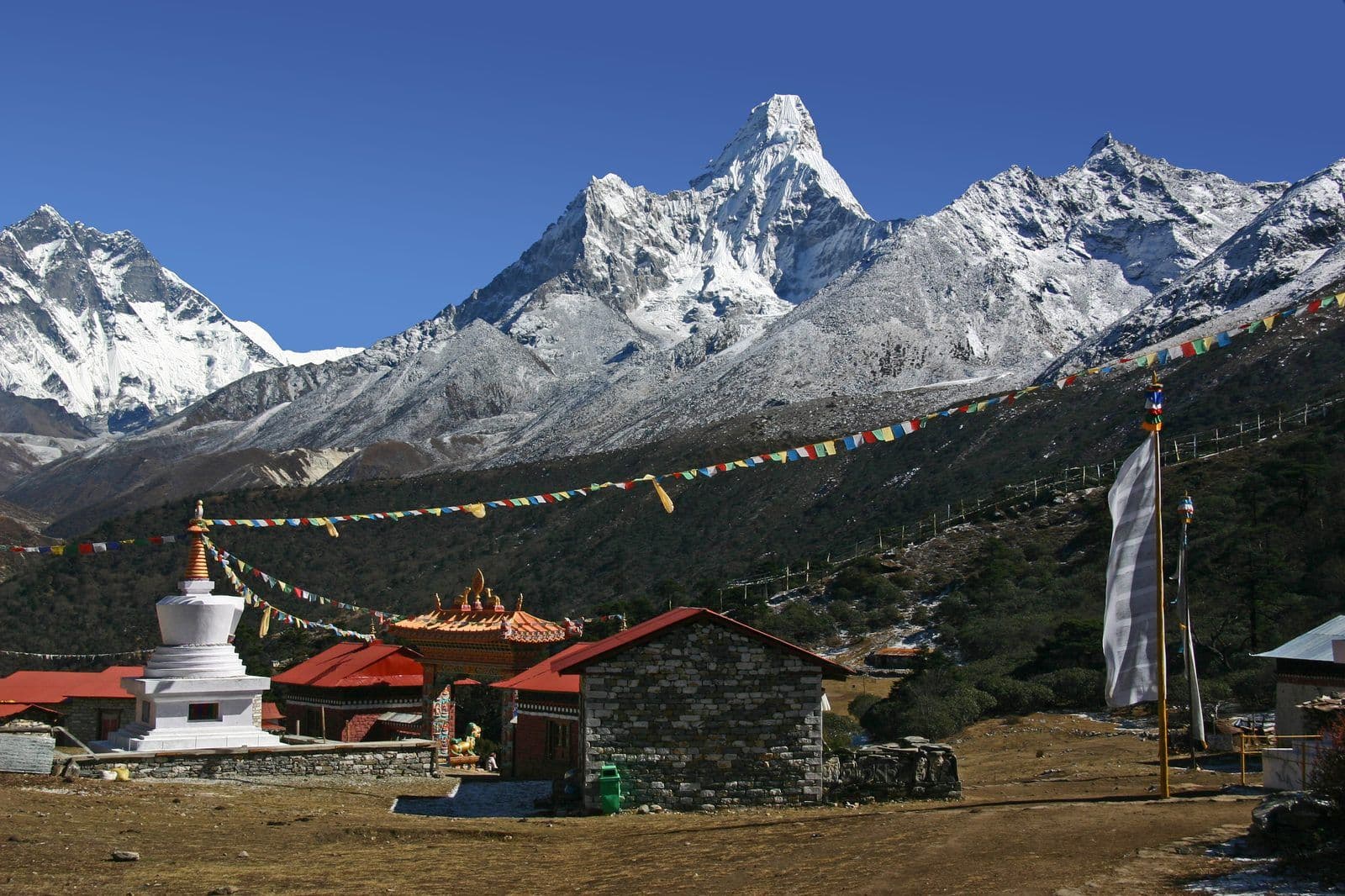
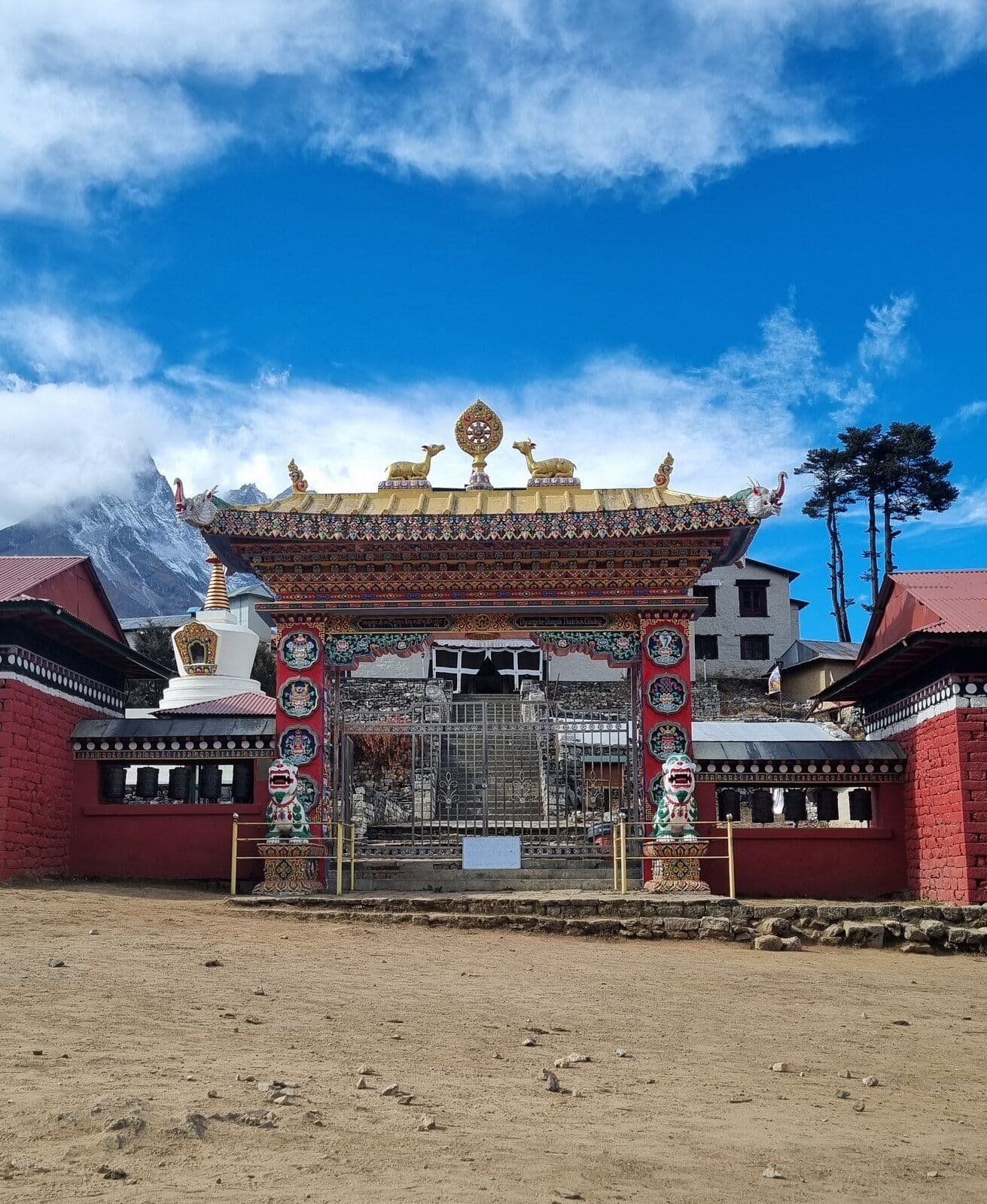
Tengboche Monastery is a living Sherpa Buddhist centre at 3,867 metres on the main walking route from Lukla toward Everest Base Camp. It is also one of the trail's most photographed places, with Ama Dablam rising beyond its ridge. The view is memorable, but it is not the whole reason to stop.
The monastery has been destroyed and rebuilt more than once. It hosts Mani Rimdu, an important religious festival whose dates follow a monastic calendar rather than a trekking company's departure sheet. On an ordinary trekking day, it remains a place of worship and community life, not a museum designed around visitors.
This guide explains where Tengboche fits on the Everest trail, what its rebuilding story tells us, how to understand Mani Rimdu, and how to plan a respectful visit without relying on unverified opening hours or festival dates.
The short answer
Tengboche, also written Thyangboche in some sources, is a Buddhist monastery and settlement in Nepal's Khumbu region. The Nepal Tourism Board places the monastery at 3,867 metres and identifies it as a major stop on the trekking route from Lukla toward Everest Base Camp.
For most Everest Base Camp trekkers, Tengboche is part of the route rather than a separate side trip. The stop matters for three connected reasons:
- It is a living centre of Buddhist practice in the Khumbu.
- Its history records community rebuilding after an earthquake and a fire.
- Its Mani Rimdu festival links monastic ritual, Sherpa community life and the practical realities of planning a trek around a moving date.
If your main goal is the complete route, use the live Everest Base Camp trek itinerary for current days, inclusions and trip terms. Use this guide for the monastery's cultural and place context.
Where Tengboche sits on the Everest trail
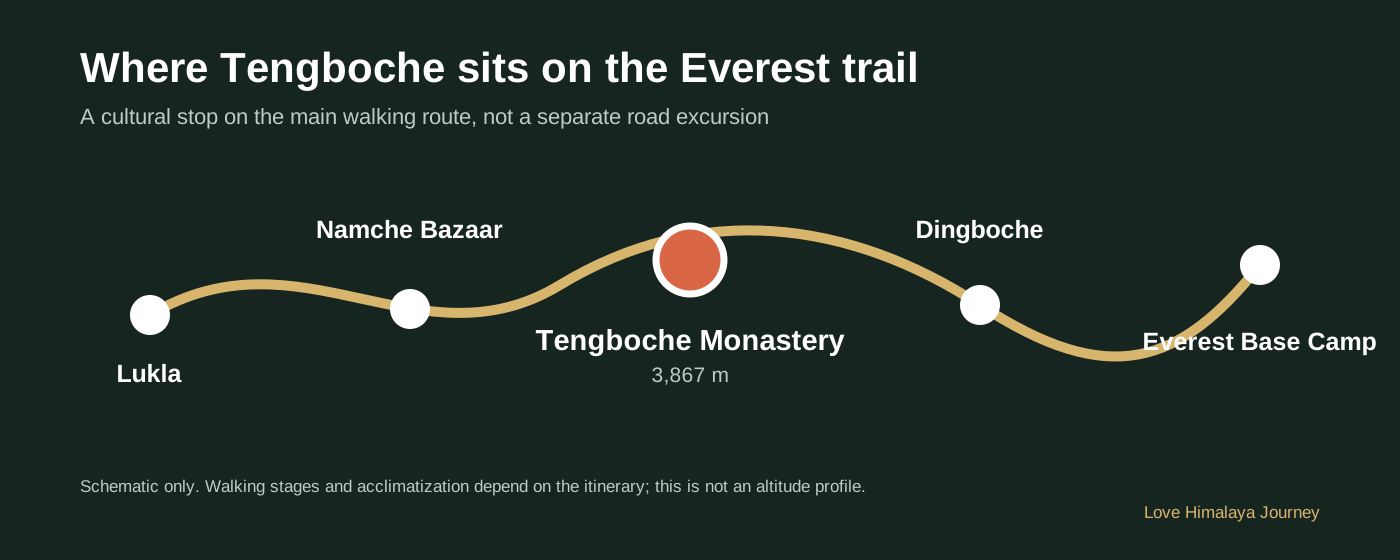
The usual trail reaches Tengboche after Namche Bazaar and continues toward settlements such as Dingboche before the higher approach to Everest Base Camp. The Nepal Tourism Board describes Tengboche as a common overnight halt after Namche and notes views of Everest, Lhotse and Ama Dablam from the area. Its Everest region overview also identifies the monastery as a leading Buddhist centre on the route.
An official page says the monastery can be reached in about three days of walking from Lukla. Treat that as a geographic orientation, not a recommended pace. A responsible itinerary also has to account for acclimatization, weather, flight disruption and the condition of the group. LHJ's altitude and trek safety approach remains the route-planning reference.
The wider setting matters too. Tengboche lies within the cultural landscape of Sagarmatha National Park. UNESCO describes Sherpa culture as integral to the park and its conservation, not as decoration added to a mountain destination. The park was inscribed on the World Heritage List in 1979.
That is the right frame for arrival. Tengboche is not simply a viewpoint between two trekking days. It is a religious place within a lived landscape.
A monastery rebuilt twice
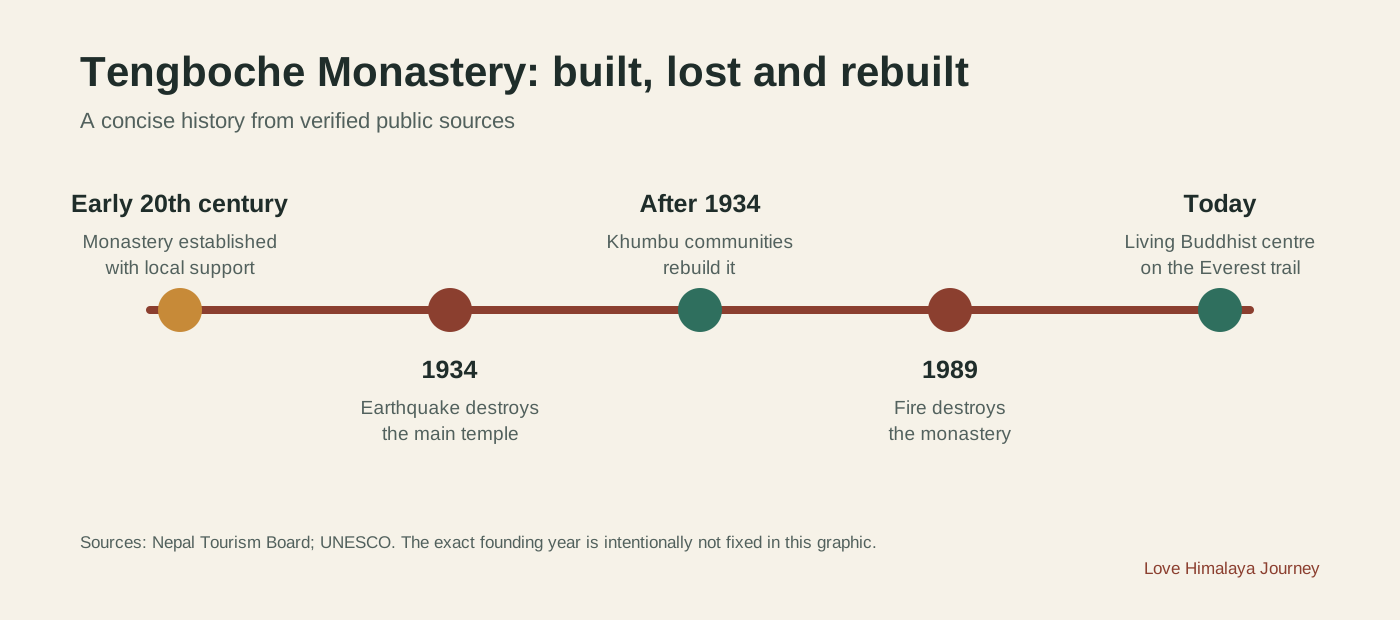
Tengboche Monastery was established in the early twentieth century. A historical account in the Nepali Times archive attributes its foundation to Lama Gulu in 1916, while the Nepal Tourism Board uses the broader wording "constructed in the 20th century." Until the founding date is checked against a monastery or archival primary record, early twentieth century is the most defensible public wording.
The larger history is better established. According to the Nepal Tourism Board's monastery profile, the main temple was destroyed by the 1934 earthquake. Communities in the Khumbu contributed donations and labour to rebuild it. In 1989, a fire destroyed the monastery again, and it was rebuilt again.
This sequence matters because it changes the story from one of a static old monument to one of continuity. The monastery people visit now exists because local communities chose to restore it after loss. Its significance is carried by practice, memory and repeated community effort, not only by the age of the buildings.
What Mani Rimdu means at Tengboche
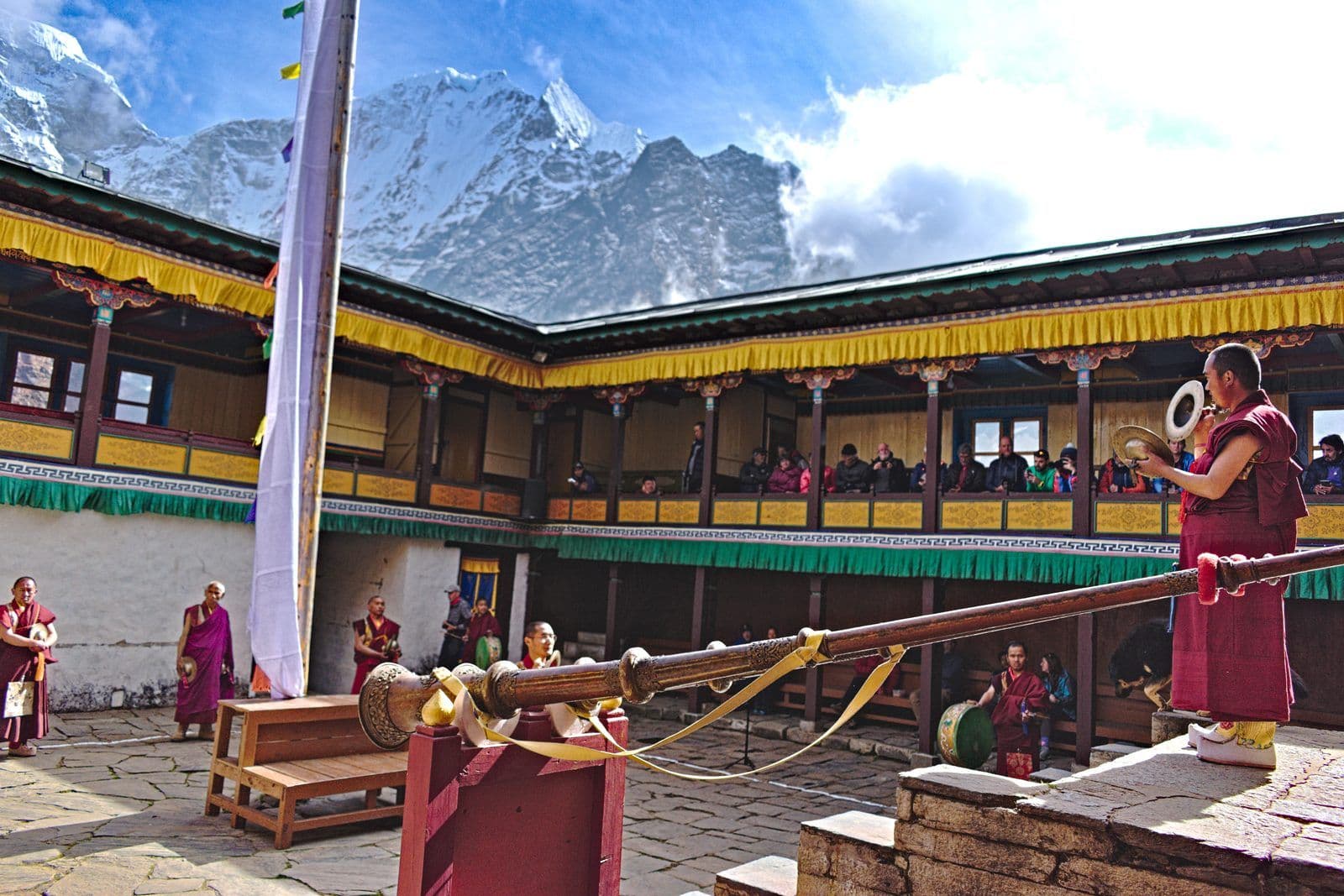
Mani Rimdu is one of the most visible moments in Tengboche's religious calendar, but it should not be reduced to a masked dance arranged for trekkers.
UNESCO's description of Ma-ni Rim-du identifies it as an important monastery festival among the Sherpa community. UNESCO explains that Mani refers to the mantra associated with Chenrezig, the bodhisattva of compassion, while Rimdu or Rildub refers to blessed red pills distributed during the observance. The tradition is connected to Rongbuk Monastery and is celebrated at Tengboche, Thame and Chiwang. UNESCO gives a May or June period for Thame, while Nepal Tourism Board places Tengboche in autumn, so a date for one monastery should not be transferred to another.
One of the festival's public moments is the Wong, or blessing. The public programme also includes ritual dance and music. The Nepal Tourism Board's Tengboche profile says visitors are welcome during the festival and describes masked dances as part of the occasion.
The distinction between religious purpose and visitor experience is essential. A traveller may witness a public ceremony, but the ceremony is not taking place because a trek group arrived. It belongs to the monastery and community. The correct role of a visitor is to observe the instructions given at the time, avoid obstructing participants, and ask before making photographs or recordings.
When does Mani Rimdu happen at Tengboche?
The honest short answer is: usually in the autumn, but the exact Gregorian dates must be confirmed for the year you intend to travel.
Even official tourism pages currently describe the timing differently. The Nepal Tourism Board's general Tengboche page says October, while its monastery page says November. UNESCO records the festival at Tengboche, Thame and Chiwang and gives a different seasonal period for Thame. This makes a date from another monastery, or a fixed annual date copied from an old page, unsafe to use for Tengboche.
For 2026, operator websites publish conflicting dates. LHJ is not using those pages as evidence, and this guide does not present an exact date. The practical planning rule is simple:
- Ask for the monastery-confirmed date for the specific year.
- Record who confirmed it and when.
- Avoid buying a tightly timed trip around an unconfirmed online date.
- Keep enough flexibility that the Everest journey remains worthwhile if the date changes.
If you are comparing Mani Rimdu with other celebrations, use the broader guide to Nepal festivals that reach the trekking trail. Use that page for the multi-festival calendar and this guide for Tengboche itself.
What is an ordinary visit like?
An ordinary day can be the better introduction to Tengboche. The ridge, monastery exterior and surrounding settlement can be experienced without a festival crowd, and the stop fits naturally into the walk through the Khumbu.
The Nepal Tourism Board says afternoon monastery tours are available. However, the public page does not provide a dated operating notice, and religious activity can affect access. Do not turn that sentence into a guaranteed daily opening time. Ask your guide to check locally on the day, and follow any notice or instruction at the monastery entrance.
Also avoid assuming that entering the grounds means every room is open, a ceremony can be joined, or photography is allowed. Current access can depend on religious use and local decisions. LHJ will only add exact hours, fees or ceremony information after a named local or monastery source confirms them with a date.
On a normal trekking itinerary, there is no need to manufacture a special performance around the stop. Time to arrive calmly, understand where you are, and follow the monastery's current guidance is enough.
How to visit respectfully
These are conservative visitor practices, not a claim to reproduce the monastery's complete current rules. Instructions given by monks, staff, signs or your guide take priority.
- Keep voices low near prayer and ceremony spaces.
- Ask before photographing people, ceremonies, murals or indoor spaces.
- Treat permission to enter as separate from permission to photograph.
- Do not block doors, processions, musicians or seated participants while trying to get a photograph.
- Put away the camera immediately if asked.
- Follow any current footwear, seating or movement instructions at the entrance rather than relying on an old travel post.
- Do not describe a blessing, ceremony or meeting as included unless it has been directly arranged and confirmed.
Photography is the point most likely to be misunderstood. A photograph visible online is evidence that one image was made at one moment. It is not proof that the same photograph is permitted today. Ask each time.
How Tengboche fits an Everest Base Camp itinerary
For a standard Everest Base Camp trek, Tengboche normally does not require a separate detour. It sits on the main route after Namche Bazaar. The LHJ Everest Base Camp trek is the current owner of the day-by-day itinerary, while this article explains why the place deserves attention.
Planning becomes different when Mani Rimdu is the primary reason for the journey. A festival-led trip should only be fixed after the monastery's dates are confirmed. Depending on the confirmed programme, the itinerary may need an additional night or a buffer rather than a faster approach. It should never trade away sensible acclimatization to reach a ceremony.
Before booking, also check the current Nepal trekking permit guidance. Permit rules belong to that page and may change independently of the monastery calendar.
Which approach fits your trip?
| Your main goal | Sensible approach | What must be confirmed |
|---|---|---|
| Complete the standard Everest Base Camp route | Keep Tengboche as a meaningful stop on the normal itinerary | Current local access and any same-day ceremony restrictions |
| Witness Mani Rimdu | Build around a monastery-confirmed date and allow schedule flexibility | Exact year-specific dates, public programme and lodging availability |
| Focus on Tengboche rather than Base Camp | Plan an Everest-region journey whose stated goal is the monastery and surrounding trail | A viable route, acclimatization plan and current LHJ operating offer |
| Photograph the monastery landscape | Visit for the place and light, without assuming indoor access | Current photography instructions and weather conditions |
You can compare LHJ's published routes on the Everest region page. If Tengboche or Mani Rimdu is your deciding reason, tell the team before treating any departure as suitable.
Frequently asked questions
What is the altitude of Tengboche Monastery?
The Nepal Tourism Board gives an altitude of 3,867 metres. Small differences may appear on maps or devices, so use one verified itinerary source consistently rather than mixing figures.
Is Tengboche Monastery on the Everest Base Camp route?
Yes. It lies on the main walking route after Namche Bazaar and before the higher approach through places such as Dingboche. It is normally a route stop, not a separate road transfer or distant side trip.
When is Mani Rimdu at Tengboche?
It is held in the autumn, commonly described as October or November. The exact Gregorian dates vary and should come from the monastery for the year of travel. Do not rely on an undated blog post or copy a previous year's schedule.
Is Mani Rimdu only held at Tengboche?
No. UNESCO records the festival at Tengboche, Thame and Chiwang. Their observances are scheduled separately, so a date for one monastery should not be applied to another.
Can trekkers enter Tengboche Monastery?
The Nepal Tourism Board says visitors can tour the monastery, but current access can change around ceremonies and local decisions. Check on the day and follow the instructions at the entrance. This guide intentionally does not promise exact hours or universal access.
Is there an entrance fee or donation?
This guide does not state a current fee or donation rule because it has not been verified from a dated monastery or named local source. Ask your guide to check locally and carry small-denomination Nepalese rupees for normal trail expenses without assuming a particular charge.
Can I take photographs inside or during Mani Rimdu?
Do not assume so. Ask before photographing people, indoor spaces or ceremonies, even if other visitors are using cameras. Current instructions take priority over old photographs and travel reports.
Do I need an extra day for Tengboche?
Not normally on a standard EBC itinerary because Tengboche is already on the route. A festival-led visit may need additional time, but only after the programme dates are confirmed. Do not compress acclimatization to create that time.
Plan a trek that still works if the date moves
Tengboche is worth visiting without a festival. That is the safest foundation for planning. Choose a sound Everest itinerary first, then add a date-led festival plan only when the monastery calendar is confirmed.
Read the Everest Base Camp trek itinerary for the current route, inclusions and trip terms. If Mani Rimdu is central to your decision, contact Love Himalaya Journey and ask for two separate checks: the monastery-confirmed festival dates and the current visitor guidance for your travel window.
Sources
This article uses named, publicly accessible sources and keeps time-sensitive uncertainty visible.
- Nepal Tourism Board: Tengboche Monastery, Solu, accessed 26 September 2026. Used for altitude, route position, twentieth-century construction, the 1934 earthquake, community rebuilding, the 1989 fire and the page's November timing statement.
- Nepal Tourism Board: Tengboche, accessed 26 September 2026. Used for route context, the common halt after Namche, mountain views, visitor access wording and the page's October timing statement.
- UNESCO: Ma-ni Rim-du, updated 13 May 2026 and accessed 26 September 2026. Used for the festival's religious meaning, Sherpa context, the Wong blessing, the three named monasteries and Thame's stated seasonal period.
- UNESCO World Heritage Centre: Sagarmatha National Park, accessed 26 September 2026. Used for World Heritage status and the relationship between Sherpa culture and the park.
- Nepal Tourism Board trade portal: Everest Region, accessed 26 September 2026. Used for regional route and monastery context.
- Nepali Times archive, issue 1035, accessed 26 September 2026. Used only for the attributed 1916 founding account.
What we could not verify yet
- The exact 2026 Tengboche Mani Rimdu dates from a monastery-controlled source.
- Current opening hours, room access, entrance fee or donation practice.
- Current indoor and ceremony photography rules.
- The exact founding year from a monastery or archival primary record.
Operator pages that publish exact dates, hours, fees or counts without a visible primary source were not used as evidence.
Corrections policy
Festival dates and visitor practices can change. If you have a dated notice from Tengboche Monastery or can identify an error in this guide, please contact LHJ. We will check the evidence and record any material correction with a new verification date.
Something here out of date or wrong? Tell us and we will check it.