Four Nepali festivals are worth planning a trek around, and most of the ones you have read about are not. Mani Rimdu in the Everest region, Tiji in Upper Mustang, Yartung in Manang and Mustang, and the Janai Purnima pilgrimage to Gosainkunda all happen on or beside a trekking route. Dashain, Tihar, Holi and the Kathmandu chariot festivals are wonderful, and they are city and village events you reach by road, not by trail.
The harder problem is the date. Nepali festivals move every year, sometimes by weeks, and they are confirmed by monasteries and government notices rather than by tour companies. Before you book a flight around one, it is worth knowing who actually sets the date and how far ahead you can trust it.
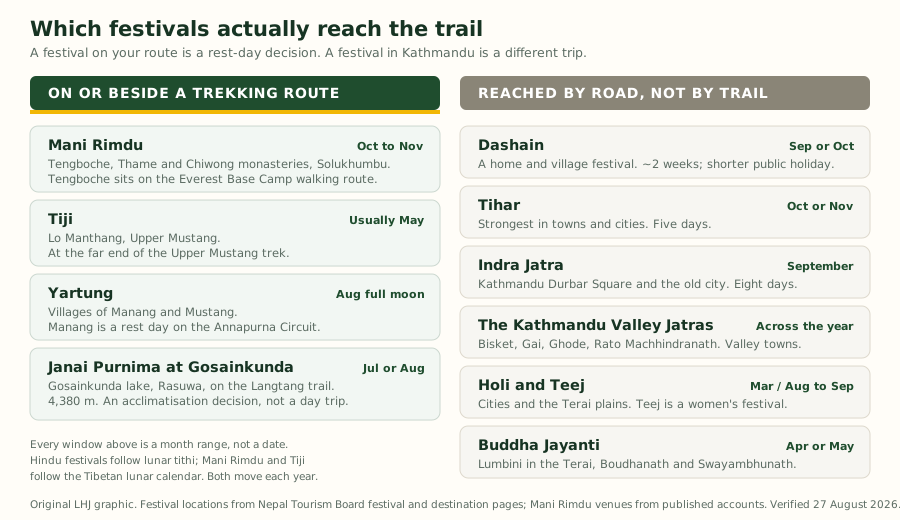
The short answer, in one table
| Festival | Where it actually happens | On a trekking route? | Usual window | Who fixes the date |
|---|---|---|---|---|
| Mani Rimdu | Tengboche Monastery, 3,867 m, Solukhumbu | Yes. Tengboche is the usual night halt after Namche on the Everest Base Camp trail | October or November, three days | The monastery, on the Tibetan lunar calendar |
| Tiji, also called Tenchi | Lo Manthang, Upper Mustang | Yes. At the far end of the Upper Mustang trek | Late May, four days | The monastery, on the Tibetan lunar calendar |
| Yartung | Upper Manang, and separately Mustang around Muktinath | Yes. Manang is a rest day on the Annapurna Circuit | July or August. Four days in Manang, five in Mustang | Local communities. The two are different festivals |
| Janai Purnima at Gosainkunda | Gosainkunda lake, Rasuwa, 4,380 m | Yes. On the Langtang trekking trail | Shrawan full moon, July or August | Hindu lunar calendar |
| Dashain | Nationwide, strongest in family homes | No. It is a home and village festival | September or October. About two weeks of festival, a much shorter public holiday | Hindu lunar calendar, confirmed by government notice |
| Tihar | Nationwide, strongest in towns and cities | No | Five days in October or November | Hindu lunar calendar, confirmed by government notice |
| Indra Jatra | Kathmandu Durbar Square and the old city | No. Kathmandu Valley only | Eight days in September | Hindu lunar calendar |
| Bisket Jatra, Gai Jatra, Ghode Jatra, Rato Machhindranath | Kathmandu Valley towns | No | Spread across the year | Newar ritual calendar |
| Holi | Cities and the Terai plains | No | Around the March full moon | Hindu lunar calendar |
| Teej | Nationwide, and it is a women's festival | No | August or September | Hindu lunar calendar |
| Buddha Jayanti | Lumbini in the Terai, and Boudhanath and Swayambhunath in Kathmandu | No | Around the April or May full moon | Lunar calendar |
The Nepal Tourism Board's own festival index lists most of these, and its individual pages carry the detail behind each one. Read the table as a starting point, then read the section for the festival you care about, because the reason a festival is or is not worth reshaping your trek around is rarely the festival itself. It is the logistics.
Why the dates move, and why that matters to you
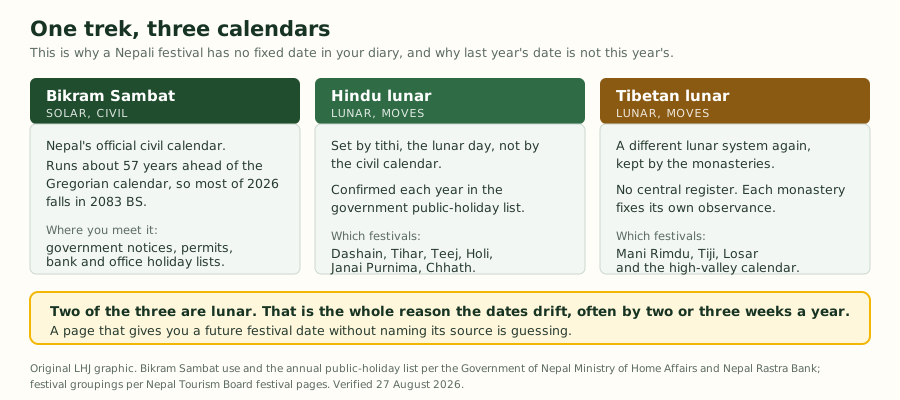
Nepal runs on more than one calendar at once, and a single trek can touch three of them.
The civil calendar is Bikram Sambat. It runs about 57 years ahead of the Gregorian calendar, so 2026 falls mostly in 2083 BS, and it is what appears on Nepali government notices, permits and bank holiday lists.
Most Hindu festivals are set by lunar reckoning rather than by the civil calendar. Dashain, Tihar, Teej, Janai Purnima and Holi all land on a particular phase of the moon, which is why they drift by two or three weeks against the Gregorian calendar each year.
Tibetan Buddhist festivals in the high valleys, including Mani Rimdu and Tiji, follow the Tibetan lunar calendar, which is a different system again, maintained by the monasteries that hold the festivals.
The practical consequence is simple. A Nepali festival does not have a fixed Gregorian date, and any page that gives you one for a future year without saying where it came from is guessing.
You can see the problem in official sources. The Nepal Tourism Board's festival index lists Dashain as running from the 7th to the 15th of October, with no year stated, while its own Dashain page carries a date range that is garbled on the page itself and gives no year either. Its Janai Purnima page heads the festival with an August date, while its Gosainkunda page says pilgrims come "in July". Neither page is wrong, exactly. They are describing a moving festival with a fixed number, in different years.
This is not a criticism of the Tourism Board. It is the reason we do not print a festival date in this article for a year that has not been confirmed.
How to confirm a date before you book
Three sources settle a Nepali festival date. None of them is a trekking blog.
For Dashain, Tihar, Teej, Holi, Chhath and every other public-holiday festival: the Government of Nepal publishes an annual public-holiday list through the Ministry of Home Affairs. The current one is Government and Public Holidays in 2083, covering the Nepali year that runs from April 2026 to April 2027. It is published as a scanned PDF, so you will be reading it rather than searching it.
For the same festivals, in a more usable form: Nepal Rastra Bank, the central bank, publishes a banking holiday list for 2083 BS, which is the practical answer to the question you are actually asking. If the banks are shut, the government permit counters, the money changers and much of the transport office network are shut with them.
For Mani Rimdu, Tiji and the other monastery festivals: the monastery. Choedhe Monastery in Lo Manthang fixes Tiji. The Tengboche, Thame and Chiwong monasteries fix their own Mani Rimdu observances, and they do not all fall on the same days. There is no central register. This is why we will tell you the month and not the date until a monastery has confirmed it.
A test worth applying. Search for the festival you want plus the year. If three trekking companies give you three different date ranges, and none of them cites a monastery or a government notice, you have found three guesses, not three confirmations. We ran exactly that test while researching this article for Mani Rimdu 2026 and got three different answers.
Festivals that reach the trail
Mani Rimdu, Everest region
Mani Rimdu is the one that changes an Everest trek rather than decorating it.
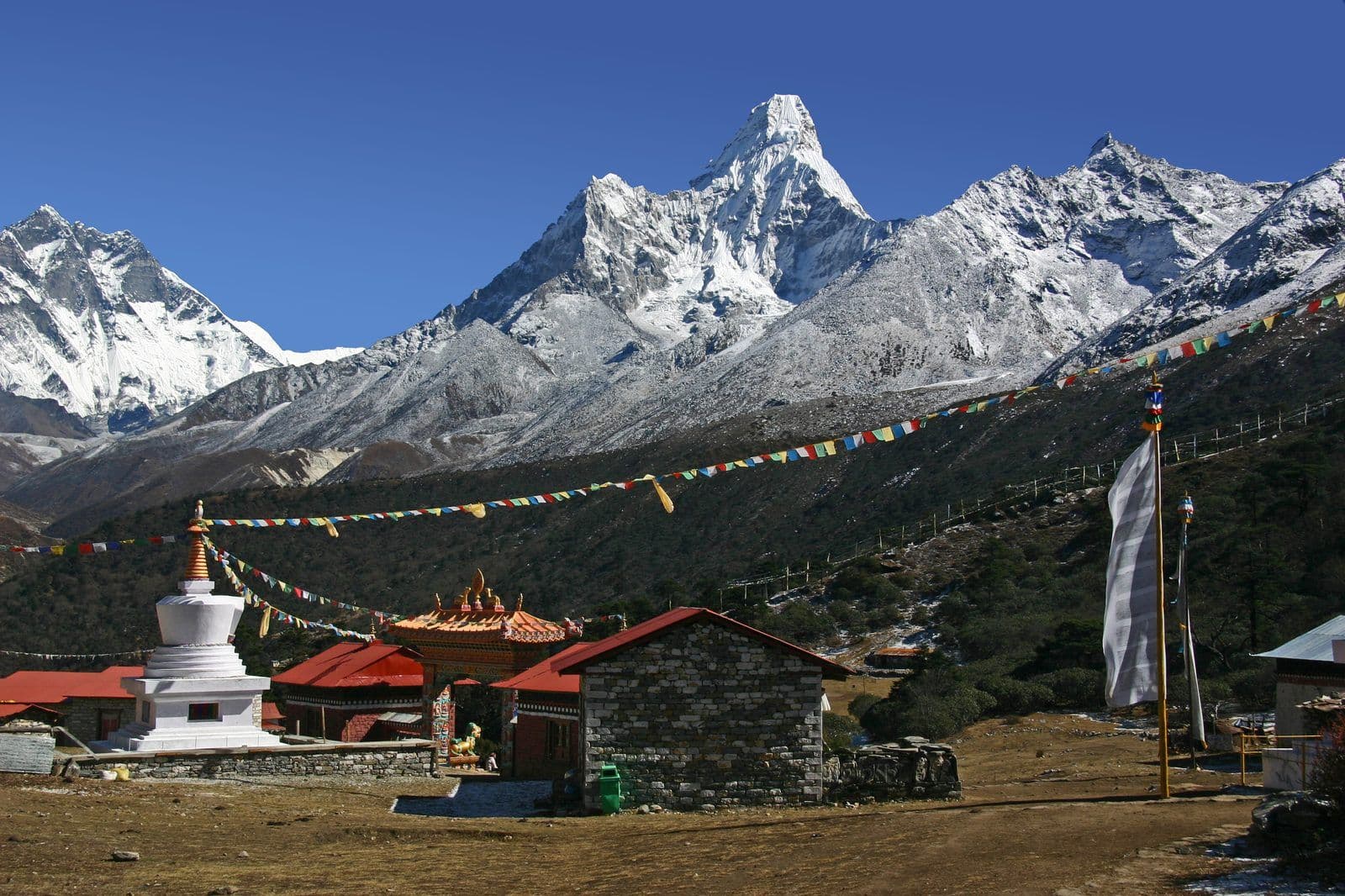
Tengboche Monastery sits at 3,867 m on the main Everest trekking route from Lukla to Everest Base Camp, about three days of walking from Lukla, with Ama Dablam behind it. It is the most common night halt after Namche, which means anyone walking the Everest Base Camp route passes its door. You were going to stop there anyway.
The festival runs three days and is marked by mask dances performed by the monks, depicting the victory of Buddhism over the Bon religion and of good over evil. The Nepal Tourism Board says plainly that visitors are welcome to take part, and that many trekkers book their trek to coincide with it.
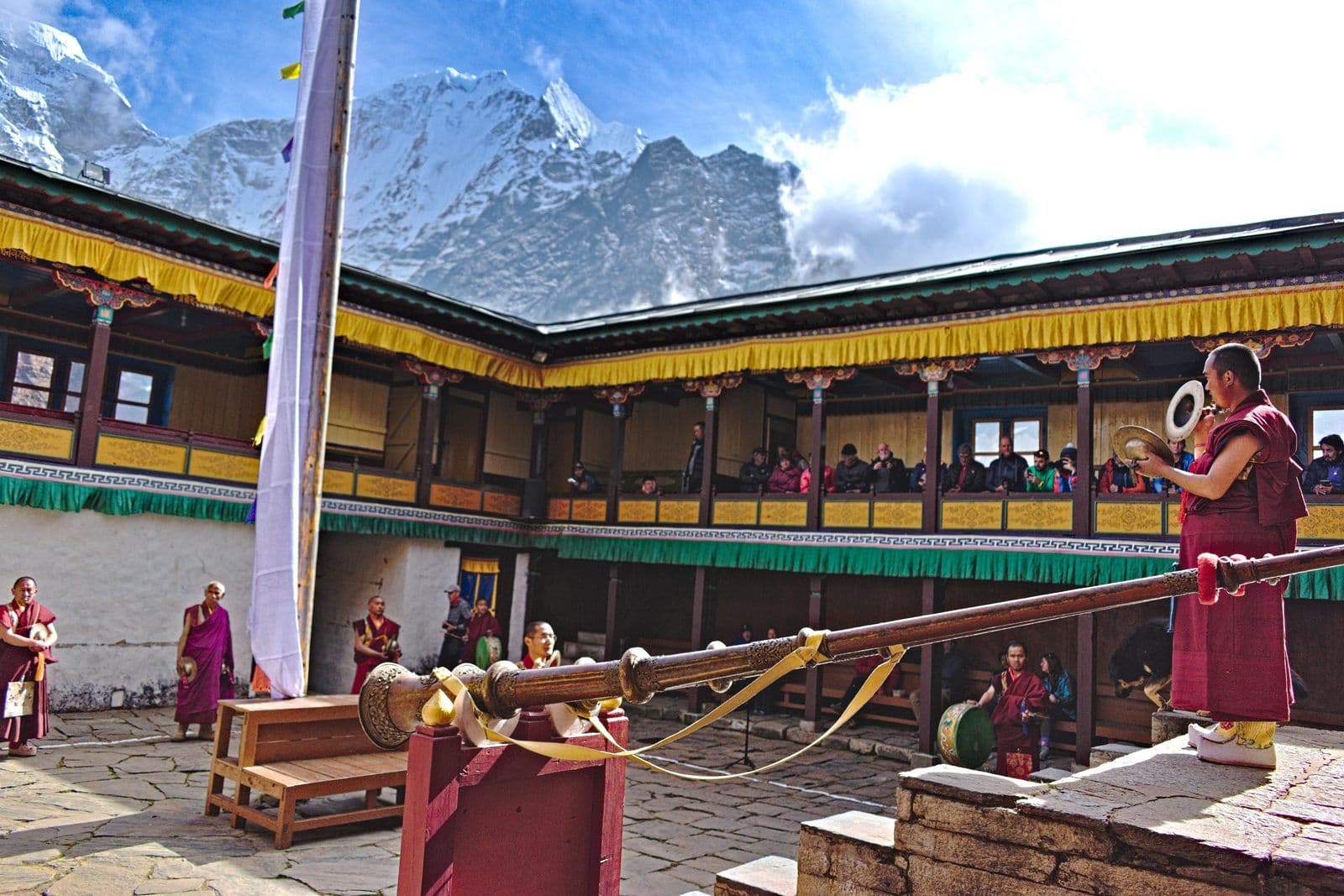
Now the honest part about the date. The Tourism Board's monastery page puts Mani Rimdu in November. Its Tengboche destination page says every October. Both describe the same festival, set on the Tibetan lunar calendar by the monastery, which lands in October some years and November others. If the national tourism body's own two pages cannot agree on the month, treat any specific future date you find online as a guess until the monastery confirms it.
What this means for an itinerary: if the public days land in your window, you build a rest day at Tengboche rather than a lunch stop, and you accept that the acclimatisation profile shifts with it. If they do not, you have lost nothing, because you were walking past anyway. That is the honest reason Mani Rimdu is the best festival to plan a trek around. The trek works without it.
Tiji, Upper Mustang
Tiji, also written Tenchi, is masked ritual dance in the walled town of Lo Manthang. The Nepal Tourism Board describes it as running four days, from the 26th to the 29th of the third month in the Tibetan calendar, which puts it in late May most years. The monks who perform it prepare with three months of retreat beforehand. The dances show Vajrakila defeating negative energies, and the festival closes with religious cakes thrown away to carry the year's bad luck out of the town.
Note the length. The Tourism Board says four days. Most trekking companies selling Tiji departures say three. Same pattern as Mani Rimdu, same instruction: the monastery decides, not the brochure.
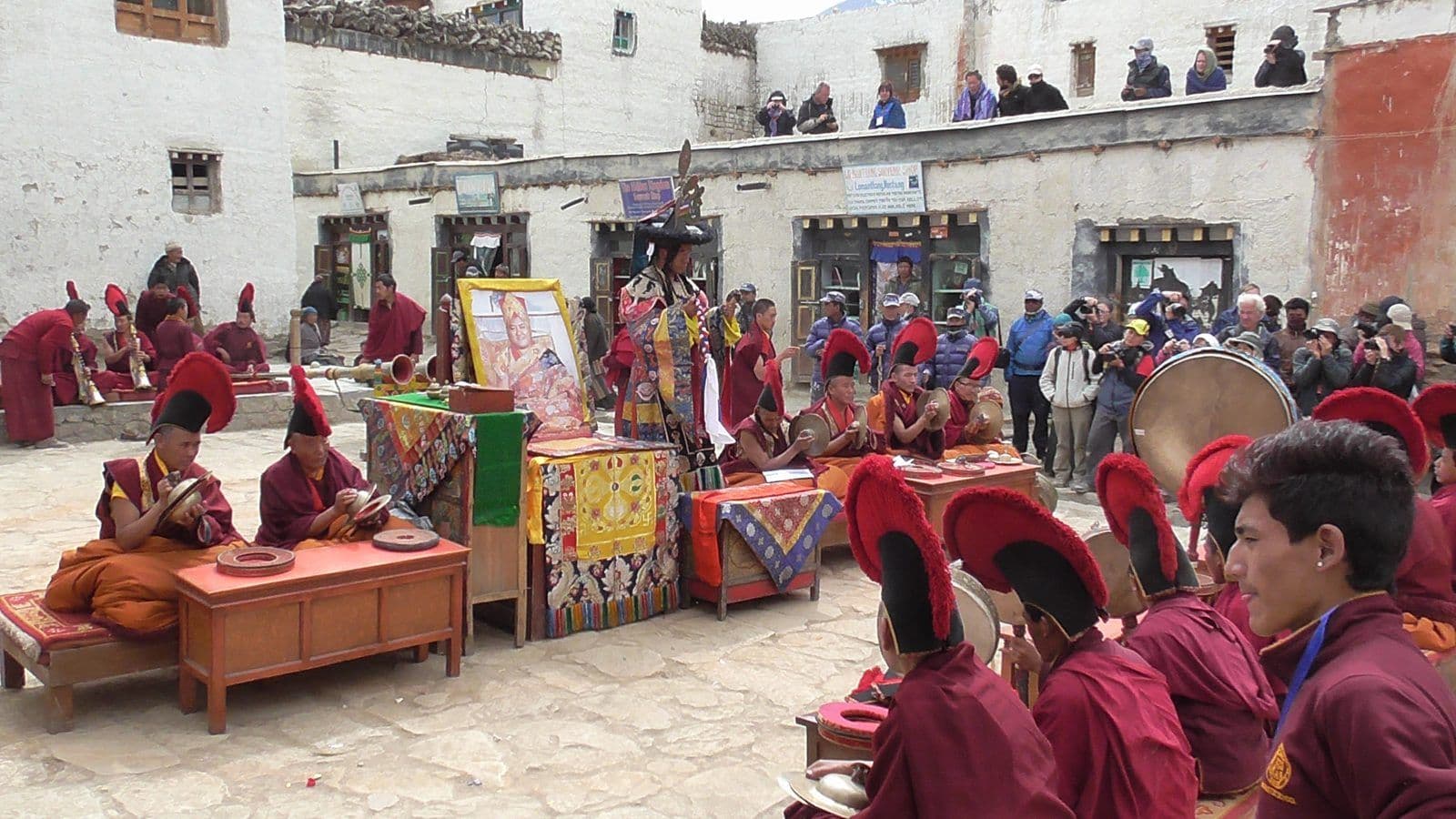
The timing is otherwise convenient. Late May sits inside the window when Upper Mustang is at its best, because the region lies in the rain shadow behind the Annapurna and Dhaulagiri massifs.
Two practical constraints. Upper Mustang is a restricted area with its own permit and group rules, so this is not a trip you assemble in the week before departure. And Lo Manthang has a finite number of beds. A festival that draws visitors into a walled town of that size fills them.
Yartung, Manang and Mustang
Yartung is the one people most often get wrong, because it is not a single festival. Manang and Mustang both hold one, and they are not the same event.
In Manang, The Kathmandu Post reported in 2016 a four-day festival in Upper Manang held after the planting season, with horse racing on the first two days, riders then splitting into groups to visit the Karki and Pocho gumbas for puja, and a closing day at the Manang gumba receiving blessings. Binod Gurung, chair of the local tourism entrepreneur committee, told the paper that "Yar" means summer and "Tung" means festival, and that the point is to shake off the fatigue of planting. That account describes the participants as men aged 16 to 60.
In Mustang, The Himalayan Times reported in 2024 a five-day festival centred on Ranipauwa near Muktinath, timed to Janai Purnima: a blessing ceremony and football, then archery, then horse races on a five-kilometre dirt track, closing with cultural dances and a horse procession to Muktinath Temple. That version is open to competitors aged 18 to 60 including women, and the organisers expected around a thousand people, Nepali and foreign.
Different districts, different lengths, different months, different rules about who rides, and eight years between the two reports. If you want Yartung, you have to say which one.
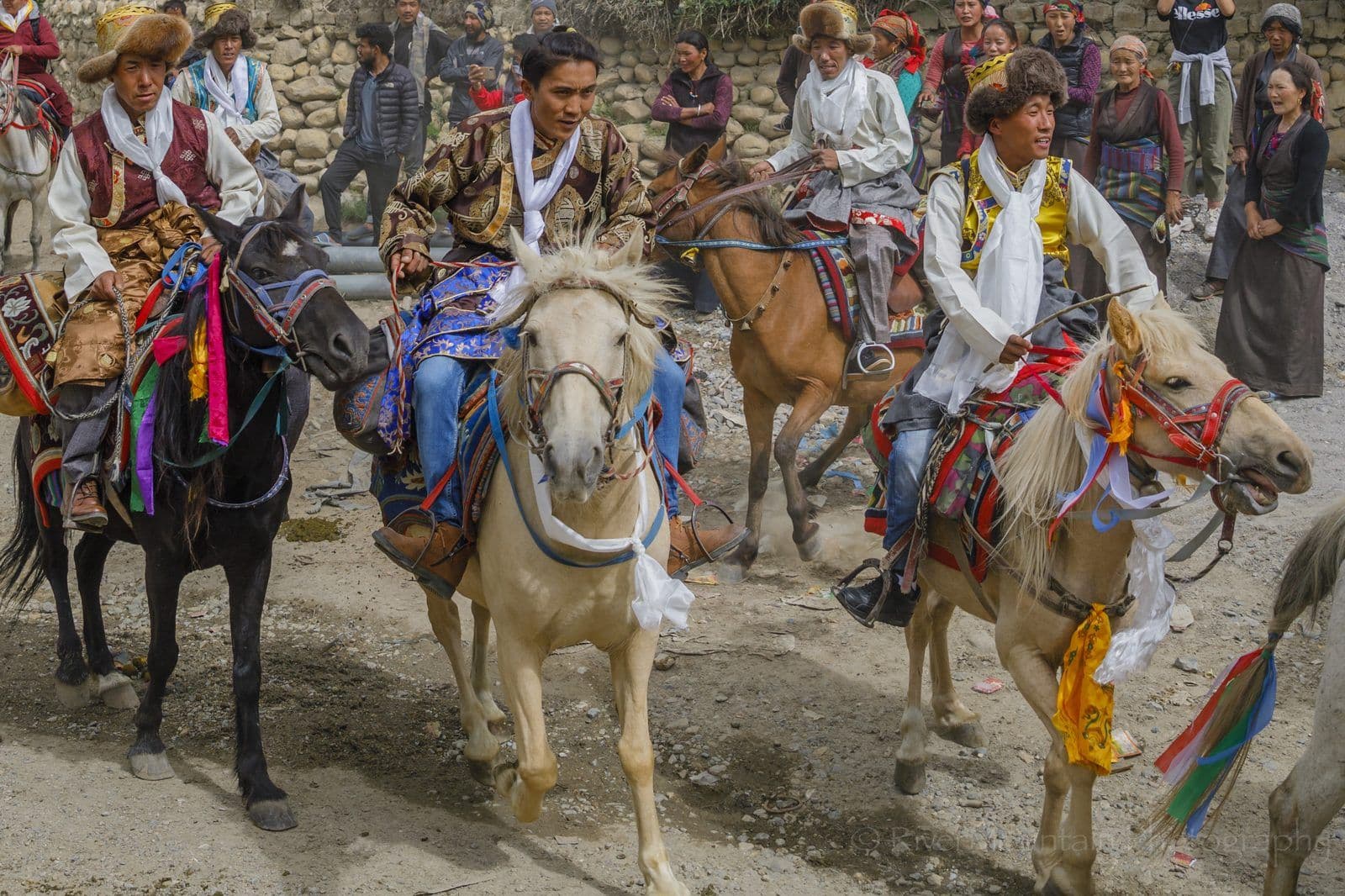
Manang is a standard acclimatisation stop on the Annapurna Circuit, which makes it geographically easy and seasonally awkward. August is monsoon across most of Nepal. Manang and Mustang sit in the rain shadow and are drier than the approach to them, so the festival is reachable, but the walk in and the flights are the monsoon problem, not the destination.
Janai Purnima at Gosainkunda, Langtang
This is the one that needs the most care, because it is a genuine high-altitude event that is not organised as a trek.
Gosainkunda is a lake at 4,380 m in Rasuwa district, on the Langtang trekking trail. The Tourism Board describes the approach honestly: a bus from Kathmandu to Dhunche that takes almost a full day on poor road, then one to two days uphill on foot depending on your fitness and the state of the trail, or a longer walk in from Sundarijal north of the valley.
On Janai Purnima, the full moon of the month of Shrawan, pilgrims come to bathe in the lake.
The scale is significant. The Rising Nepal reported around 10,000 people bathing on a single festival day, with the Nepali Army, Armed Police Force, Nepal Police, Langtang National Park staff and local volunteers mobilised, and mobile health teams stationed at Gosainkunda and at Chyolangpati on the way up. That report carries no publication date, so read it as a description of a typical year rather than a figure for a particular one.
For a dated picture, take 2025. Khabarhub reported that August that the Nepali Army's medical post at Cholangpati treated more than 1,800 pilgrims over the festival, according to the District Public Health Office. The Himalayan Rescue Association recorded five pilgrims needing evacuation for altitude-related illness, and army and armed police personnel carried six seriously ill pilgrims down overnight.
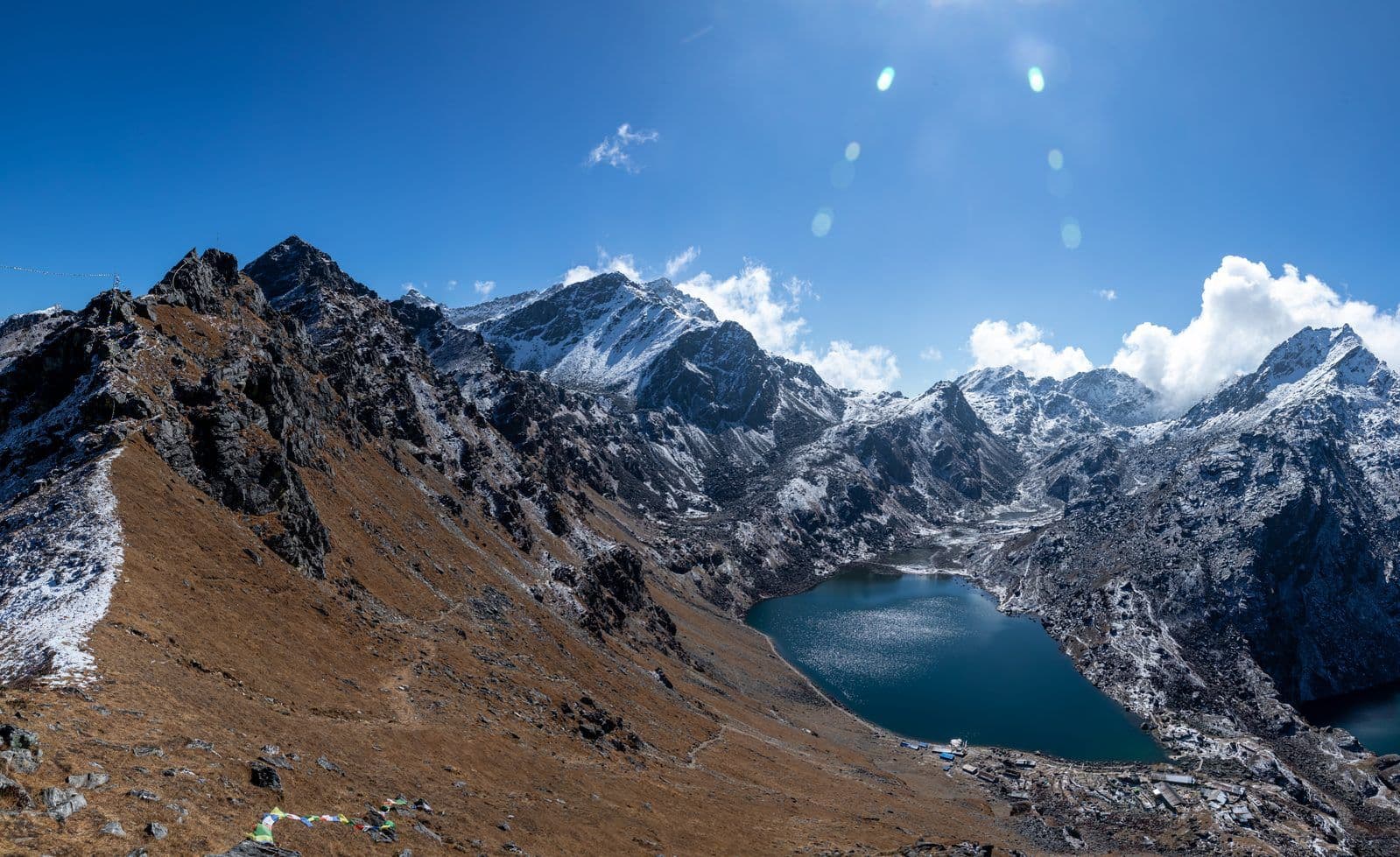
Those numbers are the useful part. Health teams are posted along that route during the festival because 4,380 m is real altitude, and pilgrims often go up fast, in a crowd, in devotional rather than mountaineering mode. Eighteen hundred people treated at one medical post is not a warning about Gosainkunda; it is a measure of how many are walking up.
You do not have to. The whole thing is solved by giving it the days it deserves: walk in at a trekking pace, sleep lower before you go high, and put a spare day in the plan rather than treating the lake as a long weekend from Kathmandu. A sensible acclimatisation profile turns this from a rushed pilgrimage into an ordinary and very beautiful Langtang trek that happens to arrive on a remarkable day.
We do not run a scheduled Gosainkunda departure, so nothing here is us selling you one. If you want to be there for Janai Purnima, it is a trip we would build around the acclimatisation first and the date second.
Dashain and Tihar: what to book early
Nepal's two biggest festivals fall inside the country's best trekking weeks. That is good news, mostly. It is also the one part of festival-season planning worth doing a few weeks earlier than you otherwise would.
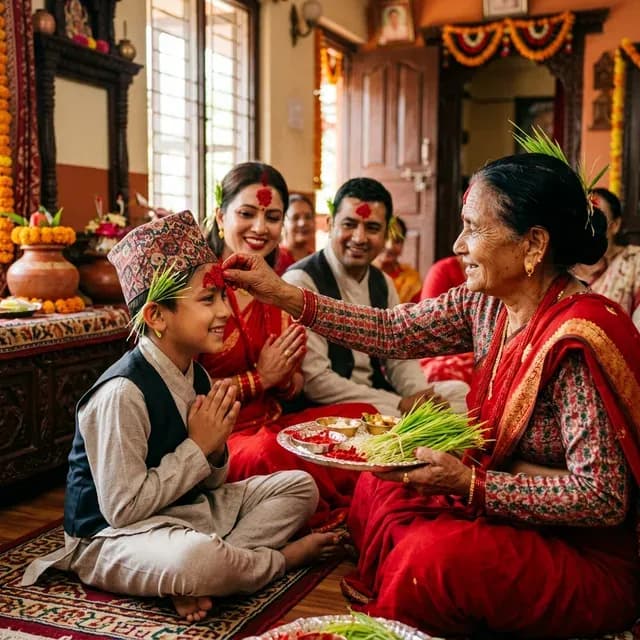
First, a distinction that most articles blur.
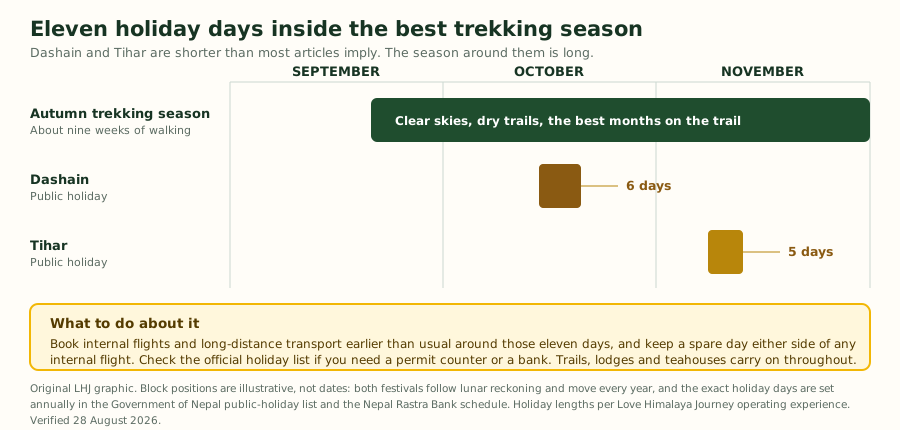
Dashain is the longest Hindu festival in Nepal. The festival season runs about two weeks, from Ghatasthapana through Phulpati, Maha Ashtami and Nawami to Vijaya Dashami, closing at the full moon of Kojagrat Purnima. The public holiday is much shorter than that. In our experience it is at most around six days, and the country does not shut for a fortnight: shops, lodges, teahouses and trails carry on, and the days either side of Tika are the quiet ones. Tihar follows a few weeks later and runs five days, honouring crows, dogs and cows, then Laxmi Puja, then Govardhan Puja with the Newar Mha Puja, and finally Bhai Tika. For Tihar the festival and the public holiday are close to the same thing, which is why five days is the figure that matters. Six for Dashain and five for Tihar is where the eleven days in the chart below comes from.
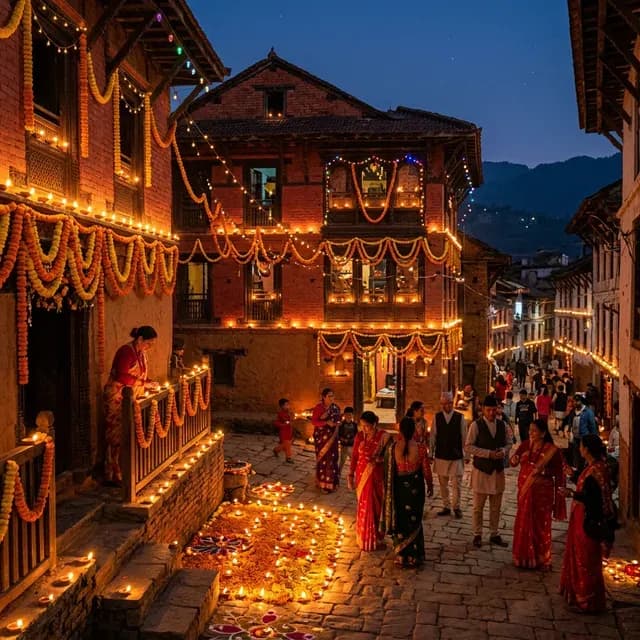
So the picture is not a closed country. It is a busy one. The Tourism Board describes Dashain as the time when the population of Kathmandu is greatly reduced as many head home, and that movement is the thing to plan around. The exact holiday days are set each year in the Government of Nepal list and the Nepal Rastra Bank schedule below, so check those rather than a blog if you need an office open.
Three things to get ahead of:
- Book internal flights and long-distance transport sooner than usual. This is the whole of the advice, really. The Himalayan Times reported in 2023 that around 2.2 million passengers leave Kathmandu over Dashain, and fares rise with the demand: The Kathmandu Post recorded a Kathmandu to Dhangadhi seat going from about Rs 7,900 to Rs 13,300 across the peak days in 2024. That is an old figure on a domestic route, quoted to show the pattern rather than a price you will pay. Advance bus booking opens weeks ahead, staggered by route length and run through the national transport federation, so a seat is there if you ask early.
- Check the holiday list if you need a counter open. Permit offices, banks and money changers follow the official schedule, so the Nepal Rastra Bank holiday list and the government's own list are the ones to check before you plan to collect anything in Kathmandu. In practice most trekking permits are arranged for you in advance, and our guide to Nepal trekking permits covers who does what.
- Keep a spare day either side of any internal flight. Good practice in Nepal in any season, and it costs you nothing in a month this good.
How we handle those weeks
We run departures through Dashain and Tihar.
On the lodges, we do not guess. We work with partner lodges on the main routes and we check directly with them, and with people already staying there, before a festival-period departure goes out. That is confirmed by our own guide team rather than assumed from what other operators write. It is a small thing that removes most of the uncertainty people worry about.
On crew, cover comes from our own team plus guides and porters we work with regularly outside it. Dashain is the week Nepalis travel home to receive tika from their elders, so the pool has to be wider in those days, and some of it is at home. Ask us how your particular departure is crewed. It is a fair question to put to any operator in October, and we would rather answer it than have you assume.
None of this is a reason to avoid October. October is the best trekking month in Nepal for reasons that have nothing to do with festivals. It is a reason to book a little earlier, and then to enjoy walking through a country that is celebrating.
Festivals that do not reach the trail, and are still worth a day
The team version of this article, like most articles on the subject, groups the chariot festivals in with the trekking ones. They belong in a different part of your trip.
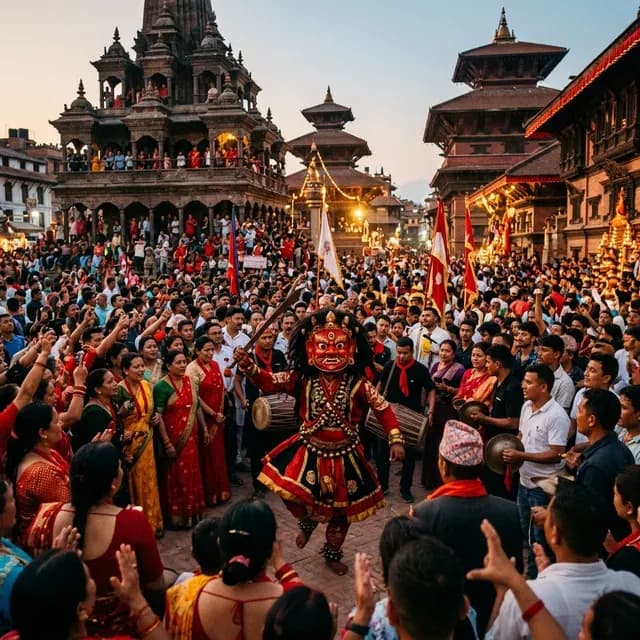
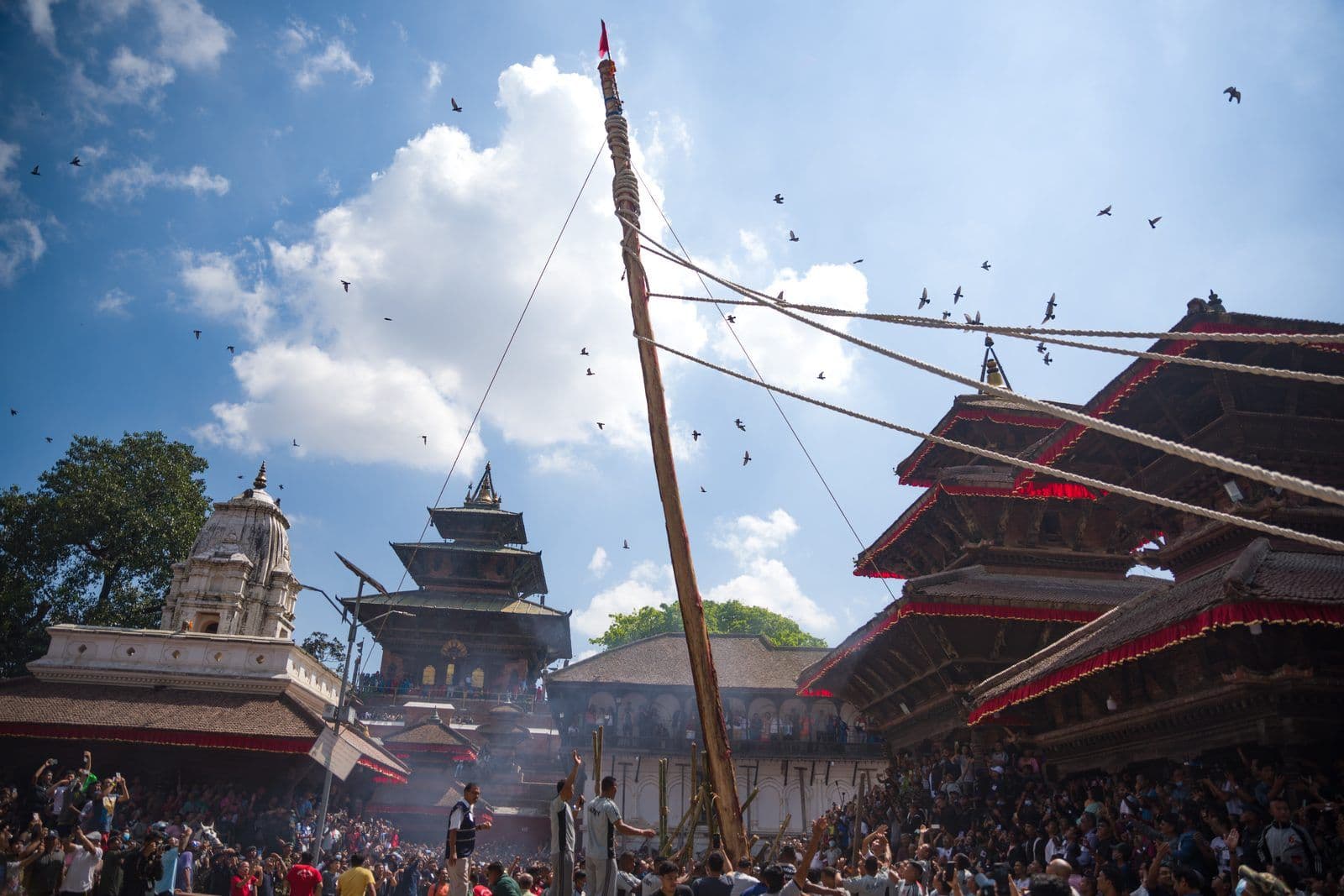
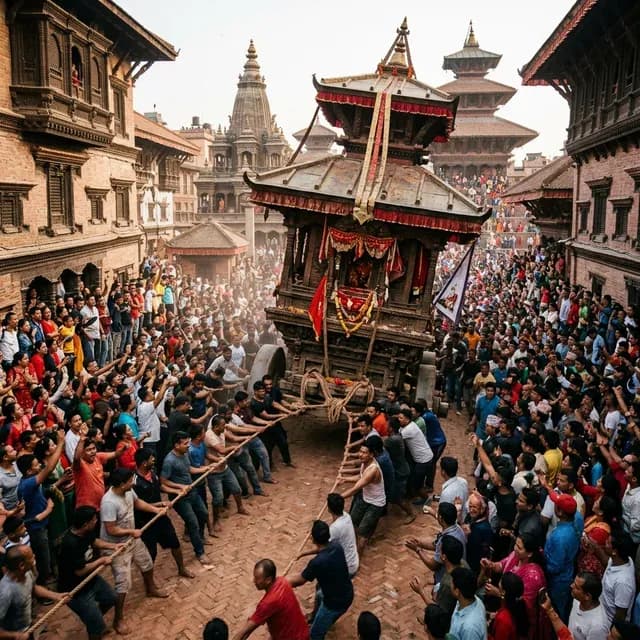
The Jatras are Kathmandu Valley street festivals. Indra Jatra, for example, runs eight days in September and belongs to the Newar community of the valley, with the living goddess Kumari carried through the old city on a chariot and Lakhey masked dancers in the streets in the evenings. Bisket Jatra in Bhaktapur, Gai Jatra, Ghode Jatra and the Rato Machhindranath chariot procession are the same kind of event in the same small geography. You reach them by walking out of your hotel, not by walking for a week.
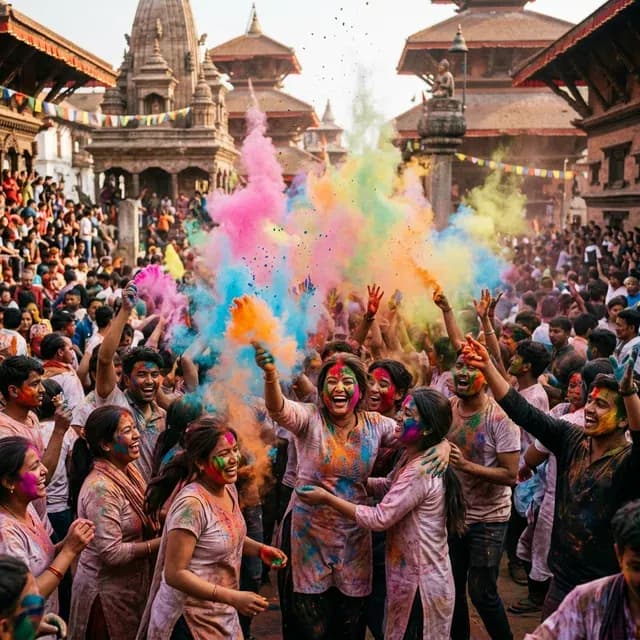
Holi is a spring festival of colour, strongest in the cities and the Terai plains. It is not a trail event.
Teej is a women's festival, marked by fasting, prayer, singing and dancing, with participants dressed in red. It is not a spectacle arranged for visitors, and the difference between respectfully watching and inserting yourself into it matters more here than at almost any other Nepali festival.
Buddha Jayanti marks the Buddha's birth and is observed most visibly at Lumbini in the Terai, where he was born, and at the Boudhanath and Swayambhunath stupas in Kathmandu. Lumbini is a flight or a long drive from Kathmandu, in the plains, in the opposite direction from every trekking region. It is a genuine pilgrimage, and it is a separate trip rather than a trek day.
The practical use of all five is the same: they are a reason to build a Kathmandu day, or a Lumbini side trip, into the front or back of your trek. They are not a reason to reshape the trek.
Building an itinerary around a date that can move
The order in which you commit matters more than usual here.
- Fix the region before the date. Mani Rimdu means Khumbu. Tiji means Upper Mustang. Yartung means Manang or Mustang. Gosainkunda means Langtang. The region decides your season, your permits and your flights.
- Fix the month, not the day. Until the monastery or the government notice is out, you are working with a window.
- Book the international flight last, or book it flexible. It is the most expensive thing to change and the least likely to be refundable.
- Add buffer days on both sides of any internal flight. This is standard advice for Nepal in any season. In festival season it is not optional.
- Treat the festival as an upside, not the reason. If the route is not worth walking without the festival, it is the wrong route.
Being there without taking over
Every festival in this article is somebody's religious practice or somebody's community celebration. None of them is a performance.
A few things worth carrying:
- Ask before photographing people, and accept a no without negotiating. Photography restrictions inside monasteries and around rituals are common and they are not aimed at you personally.
- Watching is welcome in most public settings. Joining in is an invitation, not a default.
- A family tika ceremony during Dashain is a private rite between relatives. If you are invited into one, that is a genuine gift. No operator can put it in an itinerary, and you should be sceptical of any that does.
- Festival crowds move differently from trail crowds. In a procession, the safest place is out of the way.
What nobody can promise you
We will not sell you a departure built on a date we have not confirmed, and we would rather say this plainly than let it be discovered later.
- A monastery can change its dates, and it does not owe a trekking company notice.
- Weather can end the plan anyway. A festival at 3,867 m or 4,380 m is subject to the same conditions as the rest of the route.
- A ritual is not a performance and may not run to a schedule.
- You may not be invited into anything. Attending a festival respectfully often means standing at the edge of it.
- We have not run a festival-dated departure yet. We can build one, and we would rather say that plainly than imply a track record we do not have. What we bring to it is the willingness to check the date with the monastery before we take your money for it.
If an operator promises you a specific ceremony on a specific day, ask them who confirmed it and when. That question is the whole of this article in one sentence.
Frequently asked questions
Is it a good idea to trek in Nepal during Dashain?
Yes, if you book early and build in spare days. The weather in October is the best of the year. The difficulty is not the trail, it is the competition for internal flights, buses and Kathmandu services while the whole country travels home. Check the government holiday list before you plan anything that needs a counter to be open.
Which Nepali festival is best to combine with a trek?
Mani Rimdu in the Everest region, because Tengboche Monastery is already on the route to Everest Base Camp. If the public days fall inside your window you gain something. If they do not, the trek is unchanged.
Why do Nepali festival dates change every year?
Because most of them are set by lunar calendars rather than by the Gregorian one. Hindu festivals follow the Hindu lunar calendar, and Tibetan Buddhist festivals in the high valleys follow the Tibetan lunar calendar. Nepal's civil calendar, Bikram Sambat, is a third system again.
Can I attend Mani Rimdu on a standard Everest Base Camp trek?
Only if the public days fall inside your dates, and that is decided by the monastery on the Tibetan lunar calendar. Tengboche is on the standard route, so the walking does not change. The rest day might.
Is Gosainkunda safe to visit during Janai Purnima?
It is a genuine high-altitude destination at 4,380 m, and health teams are posted along the route during the pilgrimage. Treat it as an acclimatisation problem rather than a day trip, and go up at a trekking pace rather than a pilgrimage one.
Tell us your month, and we will chase the date
Every date in this article is a window rather than a day, and that is deliberate. The fixed dates change every year, and they are settled by monasteries and government notices that publish on their own schedule, not ours.
So the useful thing we can do is chase the date for you. Tell us which festival, which region and roughly when you can travel. We will tell you what the date is likely to be, what we can confirm and what we cannot yet, and whether the route is worth walking if the festival moves.
That last question is the honest test, and it is the one to ask before you book anything. Ask us and we will answer it.
Sources
All sources accessed 27 August 2026.
- Nepal Tourism Board, Festivals of Nepal
- Nepal Tourism Board, Dashain
- Nepal Tourism Board, Tihar
- Nepal Tourism Board, Indra Jatra
- Nepal Tourism Board, Janai Purnima
- Nepal Tourism Board, Gosainkunda, Rasuwa
- The Rising Nepal, Thousands take holy bath in Gosaikunda. Carries no publication date
- The Kathmandu Post, Editorial: Costly festivals, 25 September 2024
- Government of Nepal, Ministry of Home Affairs, Government and Public Holidays in 2083
- Nepal Rastra Bank, List of Holidays for 2083 B.S.
- Nepal Tourism Board, Tengboche Monastery, Solu
- Nepal Tourism Board, Tengboche
- Nepal Tourism Board, Tenchi Festival
- The Kathmandu Post, Manang upbeat with Yarthung festival, 10 July 2016
- The Himalayan Times, Yartung, a testimony to long standing relationship between people of Mustang and horses, 2 August 2024
- The Himalayan Times, Advance ticket booking opens for Dashain from today, 9 October 2023
- Khabarhub, Devotees flock to Gosaikunda for holy Janai Purnima bath, 9 August 2025
Not used as evidence
Competing trekking-operator blogs were read to understand the market and were not used to support a single claim in this article. Nor were content farms, AI-generated encyclopedia pages, or search-engine answer summaries.
Two specific things were found and rejected. Three operators publish three different date ranges for the same 2026 Mani Rimdu, and two publish different dates for the same Tiji, none citing a monastery or a government notice. And the widely repeated claim that teahouses run reduced menus through Dashain has no source behind it anywhere we looked; what appears in this article about lodges is our own practice, not that claim.
An encyclopedia entry was used early in research to locate the Mani Rimdu monasteries and was then replaced entirely by the Nepal Tourism Board's own pages before publication.
Verification notes
- Two dates appear on this page, and both are correct. Every external source was accessed and checked on 27 August 2026, which is the date on the source list and on two of the graphics. The page as a whole was last verified on 28 August 2026, and the Dashain and Tihar chart was rebuilt that day, which is why it carries the later date. Nothing was verified only once and then restated.
- Festival dates change every year. Nothing in this article gives a date for a future year, deliberately. The month windows were checked on 27 August 2026.
- The Nepal Tourism Board's own pages disagree about the month of Mani Rimdu and the month of Janai Purnima. Both readings are quoted as observed on 27 August 2026 rather than resolved.
- Public-holiday days are set annually in the Government of Nepal list and the Nepal Rastra Bank schedule. Both are linked. The 2083 BS editions were current when this was written.
- Three statements rest on Love Himalaya Journey's operating experience rather than on a document: the length of the public holiday within Dashain, our practice of checking with partner lodges before a festival-period departure, and how our crews are arranged across those weeks. They are written in the first person so you can tell them apart from the cited facts.
- Every reported figure carries its year in the sentence that uses it, with one exception noted in the next bullet, so a reader almost never has to check the source list to know how old a number is. The 2024 airfare, the 2023 passenger count, the 2023 bus-booking dates, the 2016 Manang and 2024 Mustang Yartung reports and the 2025 Gosainkunda medical figures are historical illustrations of recurring patterns, not current prices, counts or dates.
- One source carries no publication date at all. The Rising Nepal report of around 10,000 bathers at Gosainkunda is undated on the publisher's page. It is used for the scale and the agencies deployed, labelled as undated in the text, and the dated 2025 figures beside it carry the load.
Corrections policy
If something here is wrong, we would rather fix it than defend it. Tell us and we will correct the page and say what changed. Time-sensitive material is reviewed at least once a year, and sooner if a source, a holiday list or a monastery's schedule changes.
Something here out of date or wrong? Tell us and we will check it.