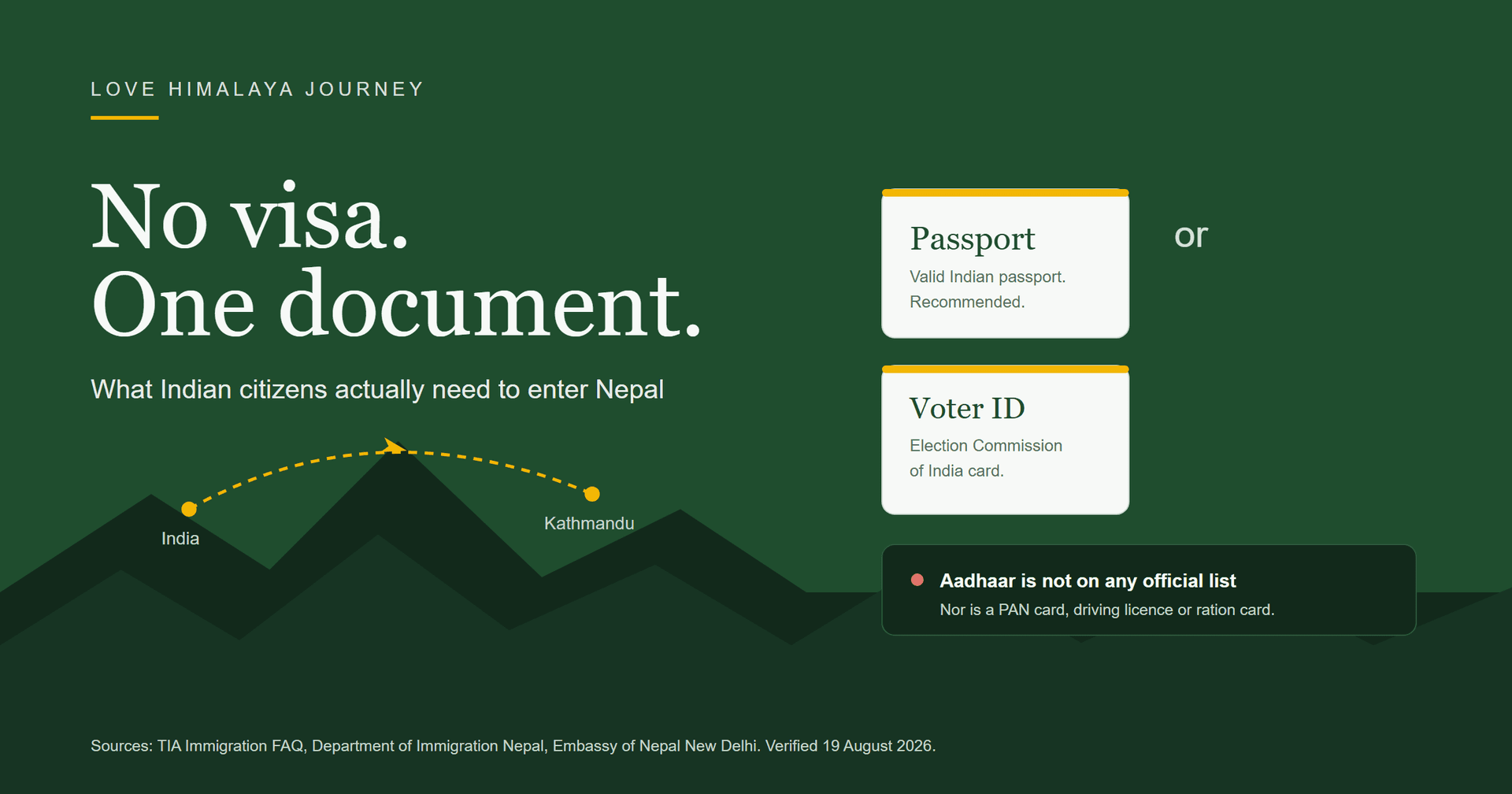
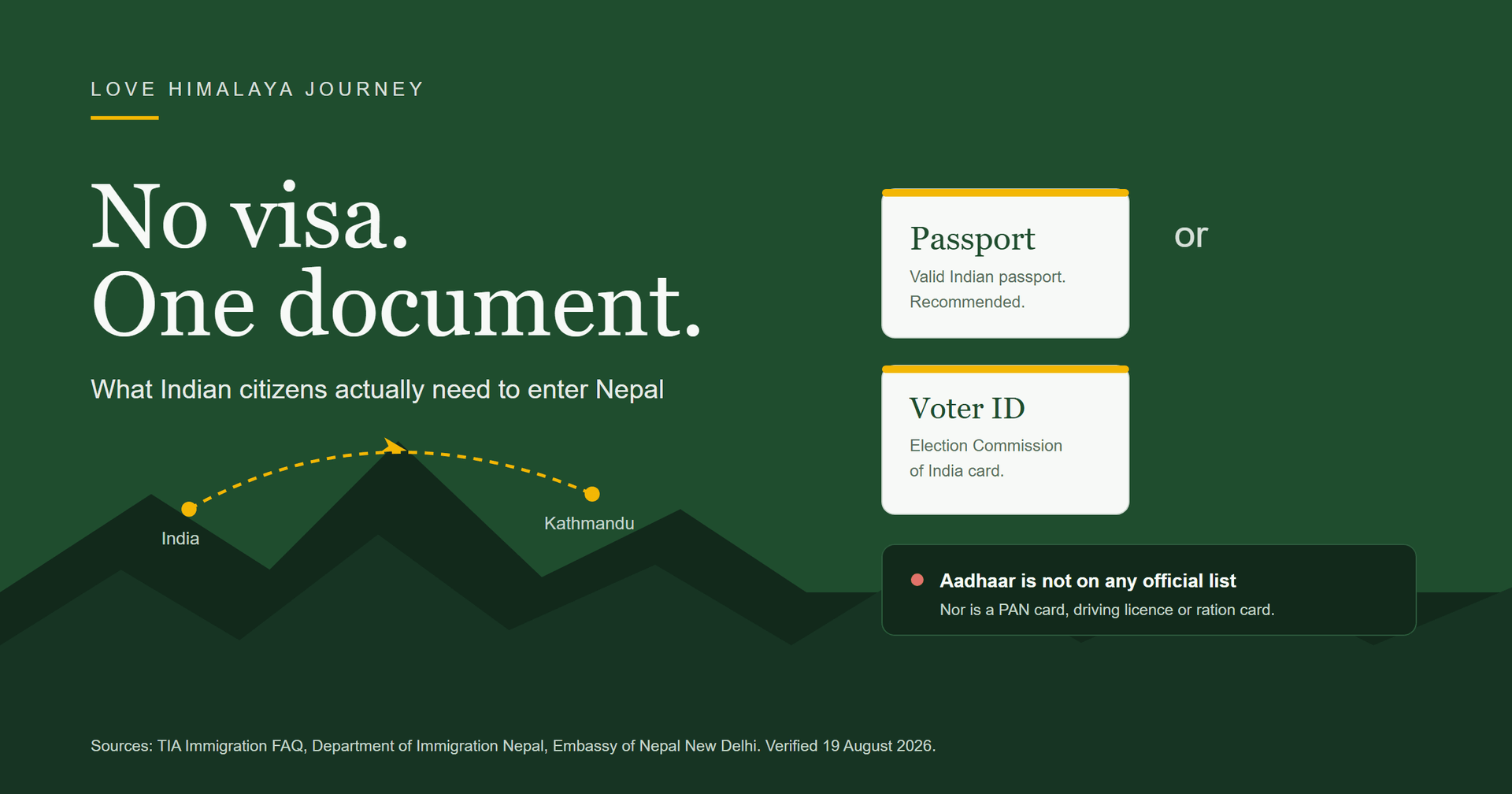
Indian citizens do not need a visa to enter Nepal. Nepal’s Tribhuvan International Airport, the country’s main international gateway and usually shortened to TIA, states it plainly through its immigration service: “Indian citizens can enter Nepal using a valid passport. They do not need a visa to enter Nepal.”
What you do need is one of a small number of accepted identity documents. That list is shorter than most travel blogs suggest, and the document many people assume will work is not on it. Here is what the official pages actually say, with a link beside each one so you can check it yourself before you book.
Do Indian citizens need a visa for Nepal?
No. The India-Nepal arrangement allows Indian citizens to enter Nepal without a visa. The official pages state the rule by nationality and document, and do not distinguish by reason for travelling.
There is no visa fee, no application, and no advance paperwork with an embassy. What immigration asks for at the airport is proof of your identity and nationality, which is why the document you carry matters more than any form you might expect to fill in.
The rule is the same regardless of your reason for travelling. A family flying to Kathmandu for darshan at Pashupatinath and a group flying in to walk to Everest Base Camp face exactly the same requirement at the immigration desk.
The documents that are accepted
Two documents cover almost every adult traveller.
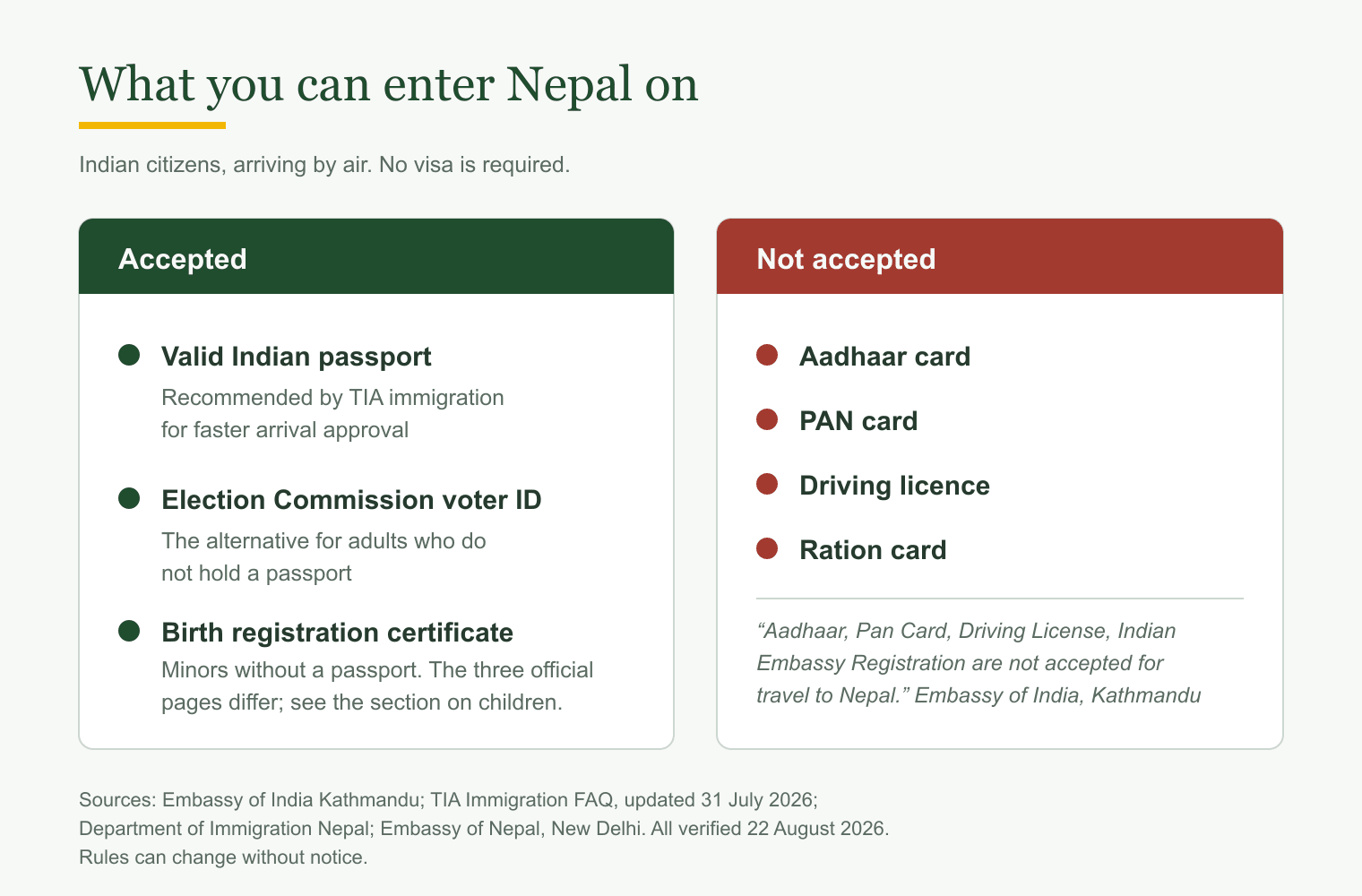
A valid Indian passport. This is the cleanest option and the one Nepali immigration itself recommends. The TIA immigration page states that “all Indian citizens who wish to enter Nepal are encouraged to travel with a passport for quick arrival approval”.
A voter ID issued by the Election Commission of India. This is the alternative for adults who do not hold a passport. Nepal’s Department of Immigration confirms that Indian citizens arriving by air may enter on an Indian passport or an Election Commission voter identity card. The Embassy of Nepal in New Delhi describes the same arrangement, and notes that the requirement applies to Indian citizens over the age of 10 travelling between India and Nepal by air. The embassy records this document requirement as effective from 1 October 2000.
Note the precision here. It is the Election Commission of India voter card specifically, and not any other government-issued photo ID. The card is formally the Elector’s Photo Identity Card, or EPIC, and it is the original card that counts. The Embassy of India in Kathmandu is explicit that a “downloaded or online print Voter ID card containing details is not acceptable as travel document”, so an e-EPIC on your phone or printed at home will not get you through. Carry the physical card.
| Document | Accepted for air travel | Source |
|---|---|---|
| Indian passport, valid | Yes, and recommended | TIA Immigration |
| Election Commission of India voter ID | Yes | TIA Immigration; Department of Immigration |
| Birth registration certificate | For minors without a passport. The three official pages describe the child rule differently, so see the section on children | TIA Immigration |
| Aadhaar card | Not listed as accepted | Absent from all three official lists |
| PAN card, driving licence, ration card | Not listed as accepted | Absent from all three official lists |
Will an Aadhaar card work?
No. India's own embassy in Kathmandu names Aadhaar directly and says it is not accepted for travel to Nepal, alongside the PAN card, the driving licence and Indian Embassy registration. The Nepali side arrives at the same answer from the other direction: Aadhaar appears on none of the accepted-document lists, and the airport immigration page closes its list by saying no other document is permitted.
Both governments say so in their own words. The Embassy of India in Kathmandu lists what is valid and then rules the rest out:
“Other documents (Aadhaar, Pan Card, Driving License, Indian Embassy Registration, etc) are also not accepted for travel to Nepal.”
On the Nepali side, Nepal’s Tribhuvan International Airport immigration page closes its own list the same way:
“Apart from this, Indian citizens are not allowed to enter Nepal from other documents.”
You may well read otherwise on travel forums and operator blogs, and you may even hear of someone who says they got through. What happens at an individual counter is not something we can promise you, and the published rule is what you want on your side if you are turned away at check-in in Delhi with a booked trip behind you.
If the only photo ID you hold is an Aadhaar card, treat getting a passport or a voter ID as a required step in your trip planning, not an optional one.
Children and younger travellers
This is the one part of the rule where the official pages do not line up neatly, so we are going to show you all three rather than tidy them into a single sentence that might be wrong for your situation.
- The Department of Immigration states that minors under 18 accompanying their parents need school identity documentation or a birth registration certificate.
- The TIA immigration page states that Indian minors who do not have a passport can obtain permission to enter Nepal through a birth registration certificate.
- The Embassy of Nepal in New Delhi frames its requirement as applying to Indian citizens over the age of 10, which implies different treatment below that age without spelling it out.
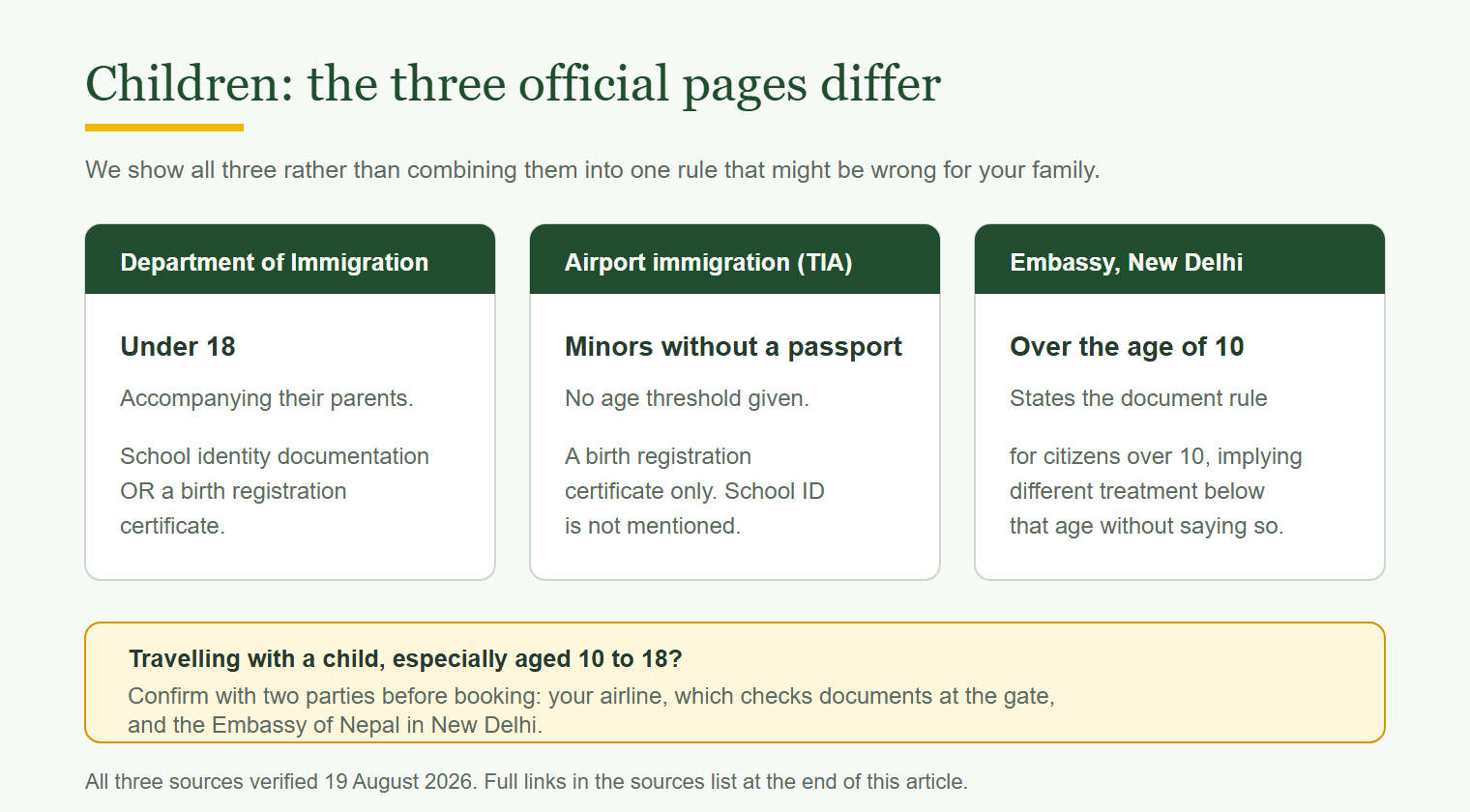
These are three descriptions of the same policy area written by three offices, and they emphasise different things. If you are travelling with a child, particularly one between 10 and 18, confirm the exact requirement with two parties before you book: your airline, which enforces document checks at check-in, and the Embassy of Nepal in New Delhi.
We would rather tell you the sources disagree than invent a clean rule that leaves you arguing at a counter.
How long can you stay?
There is no visa, so there is no visa validity to count down and no extension to apply for. We checked all three official entry pages for a maximum stay applying to Indian citizens. None of them states one. An absence of a published limit is not the same as a written guarantee of unlimited stay, and we will not present it as one.
For an ordinary trip of one or two weeks this is simply not a question you need to manage. The Department of Immigration FAQ sets out durations for marital, relation, study, working and trekking visas, and states the entry-document rule for Indian citizens, but records no time limit attached to it.
One thing these pages do not describe is what, if anything, is recorded at the desk when you arrive, so we cannot tell you whether a dated entry record is made or what it would say. That is a gap in the published record, not something to fill in. If your plans depend on a specific permitted period rather than on an ordinary holiday, treat that as a question for the Department of Immigration rather than something to infer from a travel article.
Leaving is the simpler half. You present the same document you entered on. The one situation that complicates departure is losing it while you are in Nepal, which is the next section.
The practical caveat is about scale rather than paperwork. Staying for months rather than weeks moves you out of ordinary tourism and into questions about residence, work and registration that these pages do not answer. If you are planning a long stay, ask the Embassy of Nepal in New Delhi or the Department of Immigration directly, and do not rely on a travel article, including this one.
If you lose your passport in Nepal
This is the situation the entry rules do not help you with, because by then you are already in the country.
The Embassy of India in Kathmandu issues an Emergency Travel ID for this. Its page states that Indian Nationals in Nepal who do not have valid travel document for air travel to India may approach the Embassy for an Emergency Travel ID. It gets you home. It does not get you in.
| Item | What the embassy page states |
|---|---|
| Who it is for | Indian nationals already in Nepal without a valid travel document for air travel to India |
| What you need | Two recent passport-sized photographs; proof of Indian nationality, which the embassy page lists as your passport number and a copy of your voter ID; and a copy of your flight ticket |
| Fee | NPR 7,300 |
| What it covers | “Valid for single return journey from Nepal” |
| What it does not do | “Embassy cannot facilitate travel from India to Nepal” |
That last line is why an emergency certificate does not appear in the accepted-documents list at the top of this article. If you are in India without a passport or a voter ID, the answer is to obtain one of those before you travel, rather than to plan around an emergency document you would not be eligible for anyway.
Note that the embassy asks for your passport number even though the passport itself is gone, which is exactly why a record of it matters. Keep a photograph of your passport and your voter ID on your phone and in your email. Neither is a legal substitute for the document, but both make replacing it considerably faster.
Why a passport is still the better document to carry
The voter ID route is legitimate, and the official pages put it alongside the passport rather than beneath it. A passport is still worth having, for three practical reasons.
First, immigration itself prefers it. The recommendation to travel with a passport for quick arrival approval comes from the airport authority, not from us.
Second, airlines run their own document checks before you ever reach Nepali immigration. A voter ID is valid for this journey, but a passport is the document international check-in is designed around, so it is the one least likely to need explaining.
Third, a passport is the document that helps you if something goes wrong: a medical evacuation, a lost wallet, an insurance claim, an early flight home. Each of those is easier to resolve with a passport in hand.
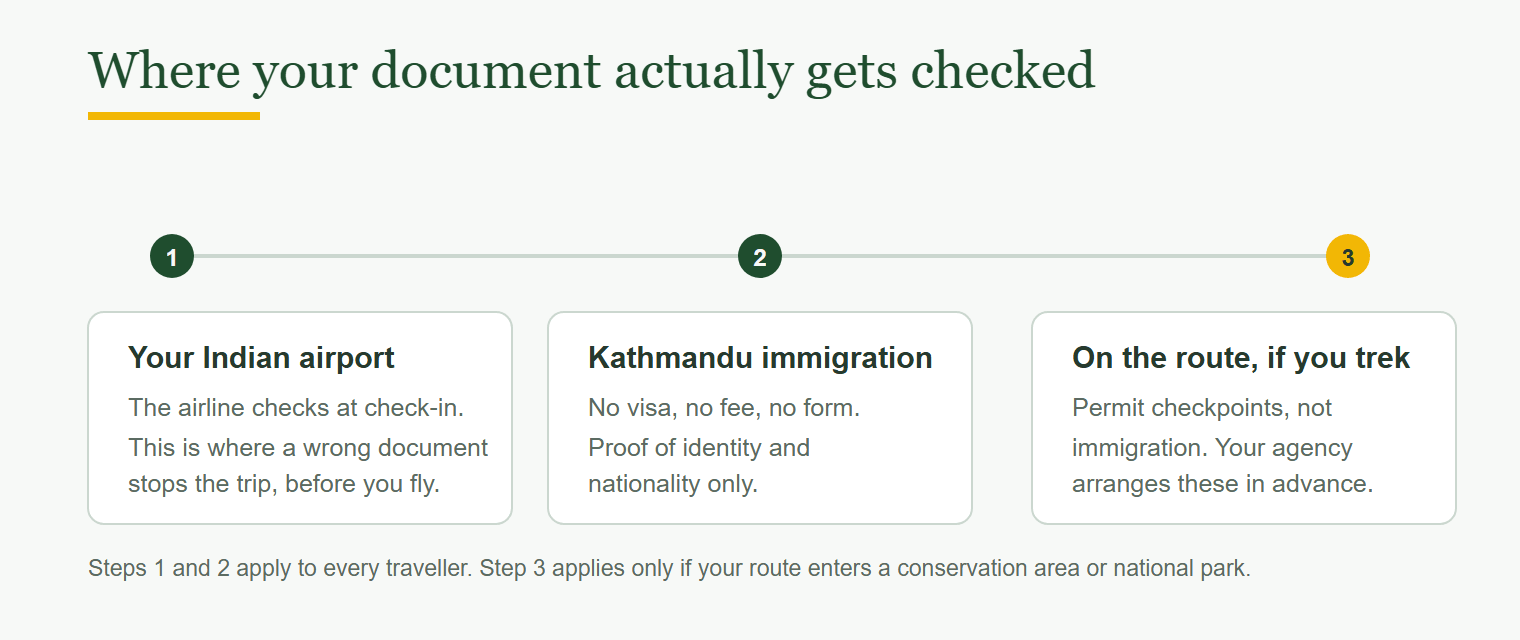
Your document is checked twice, and the first check is the one that matters most. The airline looks at it when you check in at your Indian airport, which is where a wrong document stops the trip before you have flown anywhere. Nepali immigration looks at it again when you land. A third check exists only if you trek, at the permit checkpoints on the route rather than at immigration.
What this article does not cover
Being clear about the edges of our own advice:
- Land border crossings in detail. See the short section below, then our full guide to travelling from India to Nepal by road.
- Travellers who are not Indian citizens. If anyone in your group holds a different passport, including an OCI card holder, nothing above applies to them. An Overseas Citizen of India card, usually called an OCI card, is not Indian citizenship, so they travel under the rules for their own nationality, and this article does not cover those. Check the Department of Immigration pages linked below for their specific case, and do it before you book a shared itinerary.
- Long stays, work, study or residence. This covers ordinary tourist travel only.
- Proof of onward or return travel. Airlines sometimes ask to see a return or onward ticket at check-in as their own commercial policy. None of the official pages we cite makes this an entry requirement for Indian citizens, so we do not list it as one. Ask your airline what it wants to see on the day.
- How much validity your passport needs, and re-entry within one trip. Because no visa is issued to Indian citizens, none of the pages we cite states a minimum passport validity or a re-entry rule. Borrowing a number from the rules for other nationalities would be guesswork. If your passport expires within a few months of travel, renew it or carry your voter ID, and ask the Embassy of Nepal in New Delhi if you plan to leave and re-enter.
- A child travelling without both parents. Single-parent, guardian and unaccompanied-minor travel can attract additional consent or custody paperwork from the airline. None of the pages we cite addresses it, so ask your airline and the Embassy of Nepal in New Delhi directly.
- Money, SIM cards and connectivity. We have not found sources we trust enough to publish on those yet, so we have left them out rather than guess. Ask your bank about card use in Nepal and your mobile provider about roaming before you fly, and ask us on the day if you are travelling with us.
What about crossing by land?
A great many Indian travellers reach Nepal overland through Sunauli, Raxaul, Kakarbhitta and the other road crossings rather than by flying, so it deserves a straight answer rather than silence.
The visa-free position itself is not written as an airport rule. The airport immigration page states without qualifying it by mode that Indian citizens do not need a visa to enter Nepal, and no source we found makes the exemption conditional on flying. What is written specifically for air travel is the document list, not the exemption. Carry exactly what this article recommends, a valid passport or your original Election Commission voter ID, because it costs nothing and it is the proof of nationality every official source names.
Being precise about what is published and what is not. Every official source in this article scopes its document list to air travel. The Tribhuvan International Airport FAQ is written for that airport. The Department of Immigration wording covers Indian citizens arriving by air. The Embassy of Nepal in New Delhi frames its rule around air travel between the two countries. The Embassy of India in Kathmandu opens its list with travelling by air. Four sources, all air-scoped, which is not an oversight in one place.
What follows is narrow but worth saying plainly. An absent land document list is not permission to travel without documents, and it is not a promise that a checkpoint will wave you through. It means the requirement you can verify in writing is the air one, so those are the documents to carry. If your trip turns on a specific answer, ask the Embassy of Nepal in New Delhi before you go. Our dedicated article on India to Nepal by road sets out the distances, the road segments and what each border crossing actually involves.
Permits are a separate question
A visa and a trekking permit are two different things, and sorting the first does not sort the second.
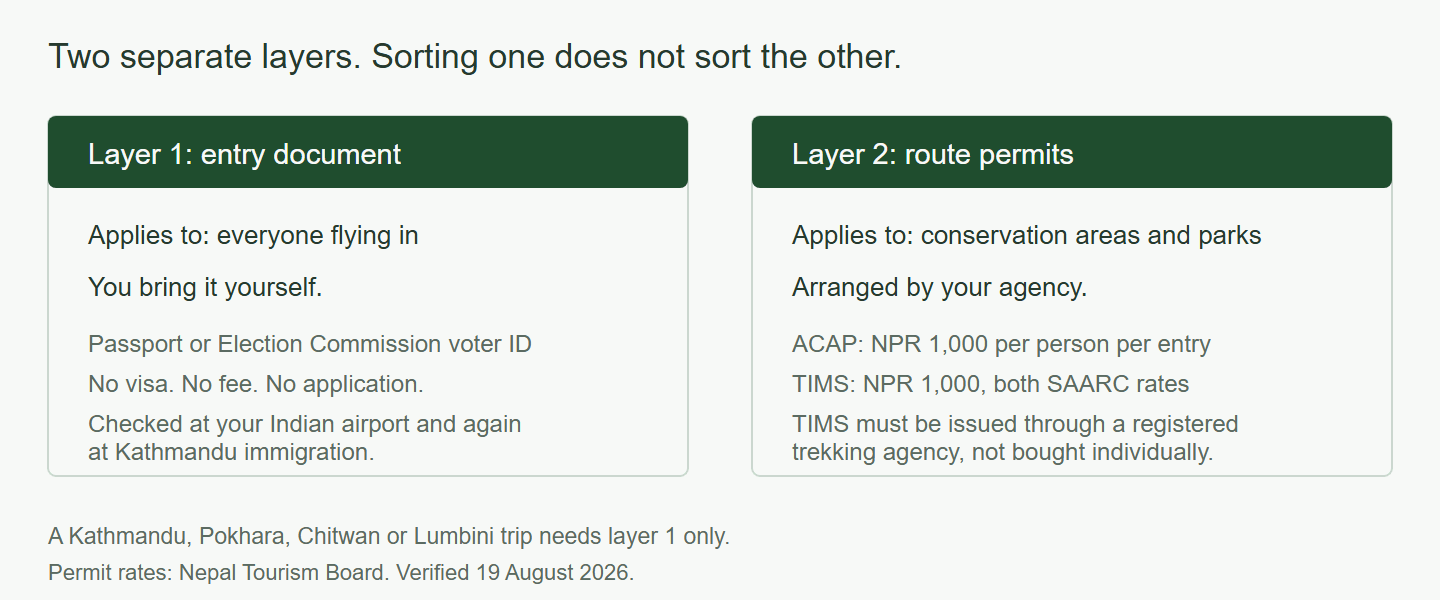
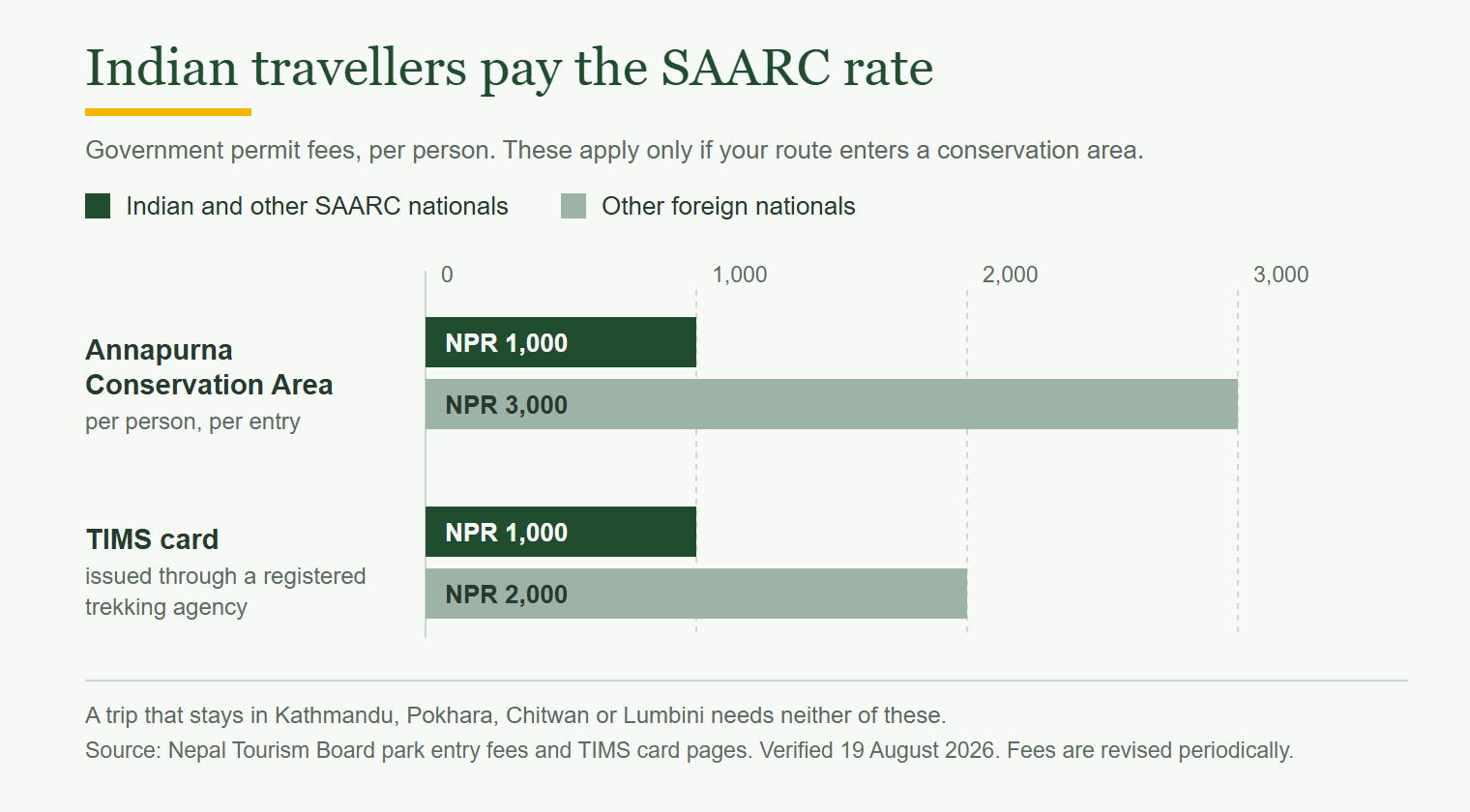
If your trip stays in Kathmandu, Pokhara, Chitwan or Lumbini, entry documents are all you need. If you walk into a conservation area or a national park, that route carries its own permit requirements regardless of your nationality or visa status. The Annapurna Conservation Area Permit, or ACAP, costs NPR 1,000 per person per entry for nationals of SAARC, the South Asian Association for Regional Cooperation, which includes India. NPR is the Nepalese Rupee, not the Indian Rupee. The Trekkers Information Management System card, usually called TIMS, is NPR 1,000 for SAARC nationals and must be issued through a government-registered trekking agency rather than bought individually.
Both figures were checked on 19 August 2026 against the Nepal Tourism Board: the NPR 1,000 per person per entry Annapurna entry fee and the NPR 1,000 SAARC TIMS fee. Other foreign nationals pay NPR 3,000 for the same Annapurna entry and NPR 2,000 for the same TIMS card, so the SAARC rate is a real saving rather than a formality.
Which permits your route actually needs depends on where you walk, and the rules differ meaningfully between regions. We have written that up separately in our guide to Nepal’s trekking permits.
What to check before you book
- Confirm every adult in your group holds a valid passport or an Election Commission voter ID. Check expiry dates now, not the week before.
- If a child is travelling, confirm their documents with your airline and with the Embassy of Nepal in New Delhi.
- Recheck the official pages linked above close to your travel date. Entry rules change without announcement.
- Decide your route, because that determines which permits apply.
- Arrive with a plan for your first few hours in Kathmandu. Our notes on verifying things calmly on arrival cover the taxi, currency and payment situations worth knowing about.
Where people go once the documents are sorted
The paperwork is genuinely the smallest part of a Nepal trip. Once your document is in order, the decision that matters is where you are actually going. These are the routes Indian travellers ask us about most.
- Everest Base Camp. The one most people mean when they say they want to trek in Nepal. Longer and higher than it looks in photographs.
- Annapurna Base Camp. Shorter than Everest Base Camp, reached through villages and rhododendron forest rather than high desert, and the most common first Himalayan trek.
- Gokyo Lakes. The Everest region without the Everest Base Camp crowds, and a set of lakes most people do not expect.
- Jomsom and Muktinath. For travellers who want the Himalaya and Muktinath in one trip.
- Langtang Valley. The closest serious valley to Kathmandu, and the shortest option if your leave is limited.
Give yourself more days than you think you need
Most first Nepal trips from India are built around Kathmandu and Pokhara, and four or five days covers that comfortably. Every route above needs more. Base camp treks run into double-digit days once you count the walk in, the walk out and the acclimatisation nights that make the difference between finishing and turning back.
That is much easier to decide before you book flights than after. If you are weighing a short temple-and-lakes trip against walking to a base camp, work out your available days first, then pick the route that genuinely fits them. A shorter route walked properly is a better trip than a long one compressed into too few days.
What is yours, and what is ours
The document is the only part nobody can do for you. Almost everything else is what you are hiring an agency for.
| You bring | We arrange |
|---|---|
| Your passport or Election Commission voter ID | The permits your route requires, checked against the current rule before each departure |
| Documents for any child travelling with you | Hotels, lodges and the overnight plan |
| Your flights to and from Kathmandu | Your guide and the day-to-day running of the route |
| Your own kit and personal spending | Ground transport, transfers and the schedule between them |
Our displayed trek prices include the permit fees your route requires, so there is no separate permit bill to settle when you arrive. You will not be sent to a government counter on your first morning, and you will not be working out which card applies to which valley. That is the part we do every week.
If you are still deciding, tell us your dates, who is coming and how many days you can take. We will tell you honestly which routes fit and which do not, including when the answer is that this year is not the year for the long one.
Sources
All sources accessed 19 August 2026. External links open in a new tab.
Nepal government and immigration
- Tribhuvan International Airport - Immigration FAQ. Last updated 31 July 2026. Visa exemption for Indian citizens, accepted documents, the closing statement on other documents, and the passport recommendation.
- Department of Immigration, Nepal - FAQ. Accepted documents for Indian citizens arriving by air, and the position on minors under 18.
- Embassy of Nepal, New Delhi - visa information. Accepted travel documents, the age-10 framing, and the 1 October 2000 effective date.
- Embassy of India, Kathmandu - Valid Travel Documents. The two documents valid for Indian nationals, the rejection of downloaded or printed voter ID cards, and the exclusion of Aadhaar, PAN, driving licence and embassy registration.
- Embassy of India, Kathmandu - Emergency Travel ID. Eligibility, required documents, fee and single-journey limitation for the Emergency Travel ID.
Permits and fees
- Nepal Tourism Board - park entry fees. Annapurna Conservation Area entry fee for SAARC nationals.
- Nepal Tourism Board - TIMS card. TIMS fee for SAARC nationals and the registered-agency requirement.
What can change after publication
- Entry-document rules for Indian citizens. Last checked 19 August 2026.
- ACAP and TIMS fees, which are revised periodically. Last checked 19 August 2026.
- The requirement for children, which the three official pages currently describe differently.
- The Emergency Travel ID fee and document list. Last checked 19 August 2026.
- Our own statement that displayed trek prices include the permit fees a route requires. This is an operational commitment rather than a government fact, and it is reviewed on the same schedule as the rest of this page.
Corrections
If any fact here becomes wrong, we will correct it on this page and date the correction. If you were given different information at an airport or an embassy, tell us and we will check it against the official source.
Frequently asked questions
Do Indian citizens need a visa for Nepal?
No. The India-Nepal arrangement allows Indian citizens to enter Nepal without a visa. The official pages state the rule by nationality and document, and do not distinguish by reason for travelling.
Will an Aadhaar card work for entering Nepal?
No. India's own embassy in Kathmandu names Aadhaar directly and says it is not accepted for travel to Nepal, alongside the PAN card, the driving licence and Indian Embassy registration. The Nepali side arrives at the same answer from the other direction: Aadhaar appears on none of the accepted-document lists, and the airport immigration page closes its list by saying no other document is permitted.
How long can an Indian citizen stay in Nepal?
There is no visa, so there is no visa validity to count down and no extension to apply for. We checked all three official entry pages for a maximum stay applying to Indian citizens. None of them states one. An absence of a published limit is not the same as a written guarantee of unlimited stay, and we will not present it as one.
Which permits do Indian citizens need in Nepal, and what do they cost?
If your trip stays in Kathmandu, Pokhara, Chitwan or Lumbini, entry documents are all you need. If you walk into a conservation area or a national park, that route carries its own permit requirements regardless of your nationality or visa status. The Annapurna Conservation Area Permit, or ACAP, costs NPR 1,000 per person per entry for nationals of SAARC, the South Asian Association for Regional Cooperation, which includes India. NPR is the Nepalese Rupee, not the Indian Rupee. The Trekkers Information Management System card, usually called TIMS, is NPR 1,000 for SAARC nationals and must be issued through a government-registered trekking agency rather than bought individually.
What should an Indian citizen do if they lose their passport in Nepal?
The Embassy of India in Kathmandu issues an Emergency Travel ID for this. Its page states that Indian Nationals in Nepal who do not have valid travel document for air travel to India may approach the Embassy for an Emergency Travel ID. It gets you home. It does not get you in.
Do the same rules apply crossing into Nepal by land?
The visa-free position itself is not written as an airport rule. The airport immigration page states without qualifying it by mode that Indian citizens do not need a visa to enter Nepal, and no source we found makes the exemption conditional on flying. What is written specifically for air travel is the document list, not the exemption. Carry exactly what this article recommends, a valid passport or your original Election Commission voter ID, because it costs nothing and it is the proof of nationality every official source names.
Something here out of date or wrong? Tell us and we will check it.