Nepal is not a place where you need to distrust everyone. The UK government describes the rate of serious crime as low, while the US travel advisory says crime is generally low. A better approach is to recognize the moments when a tired or hurried traveler may agree to a price, product, route change, or rescue decision without enough information.
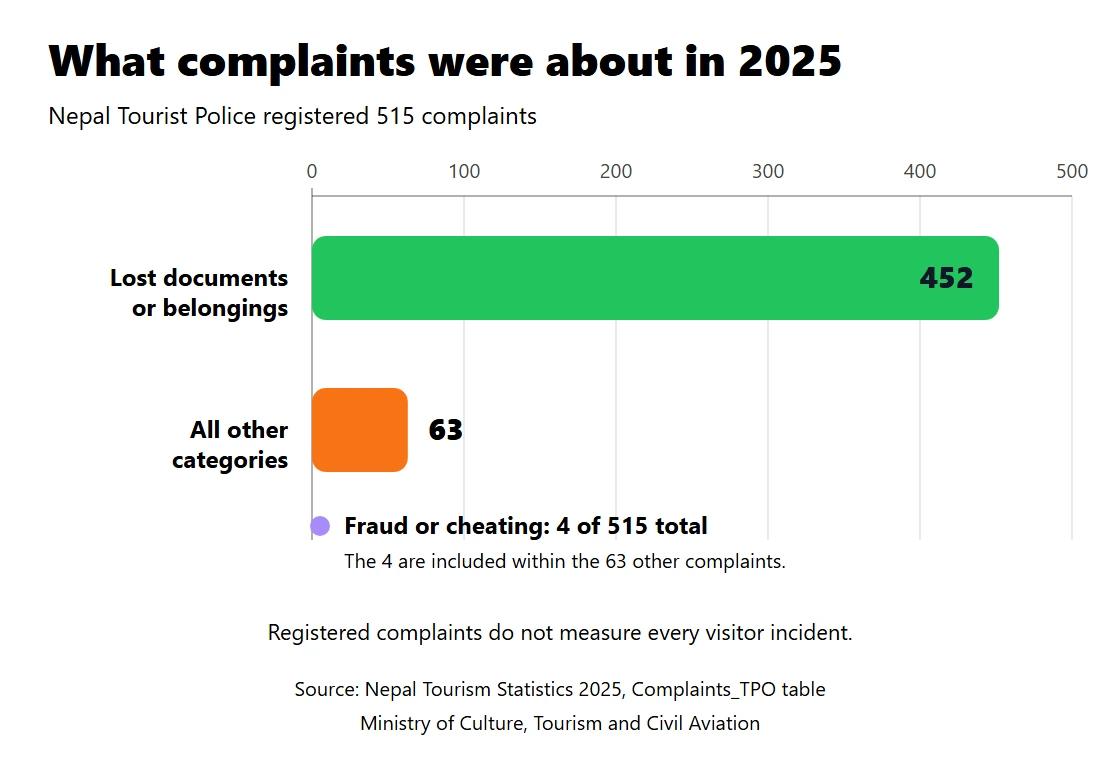
Official context keeps that risk in proportion. Nepal Tourism Statistics 2025 records 515 complaints to Tourist Police. Of those, 452 concerned lost documents or belongings; 4 were classified as fraud or cheating. These figures cover registered complaints, not every visitor experience or a per-visitor risk rate. They show why practical preparation is more useful than fear.
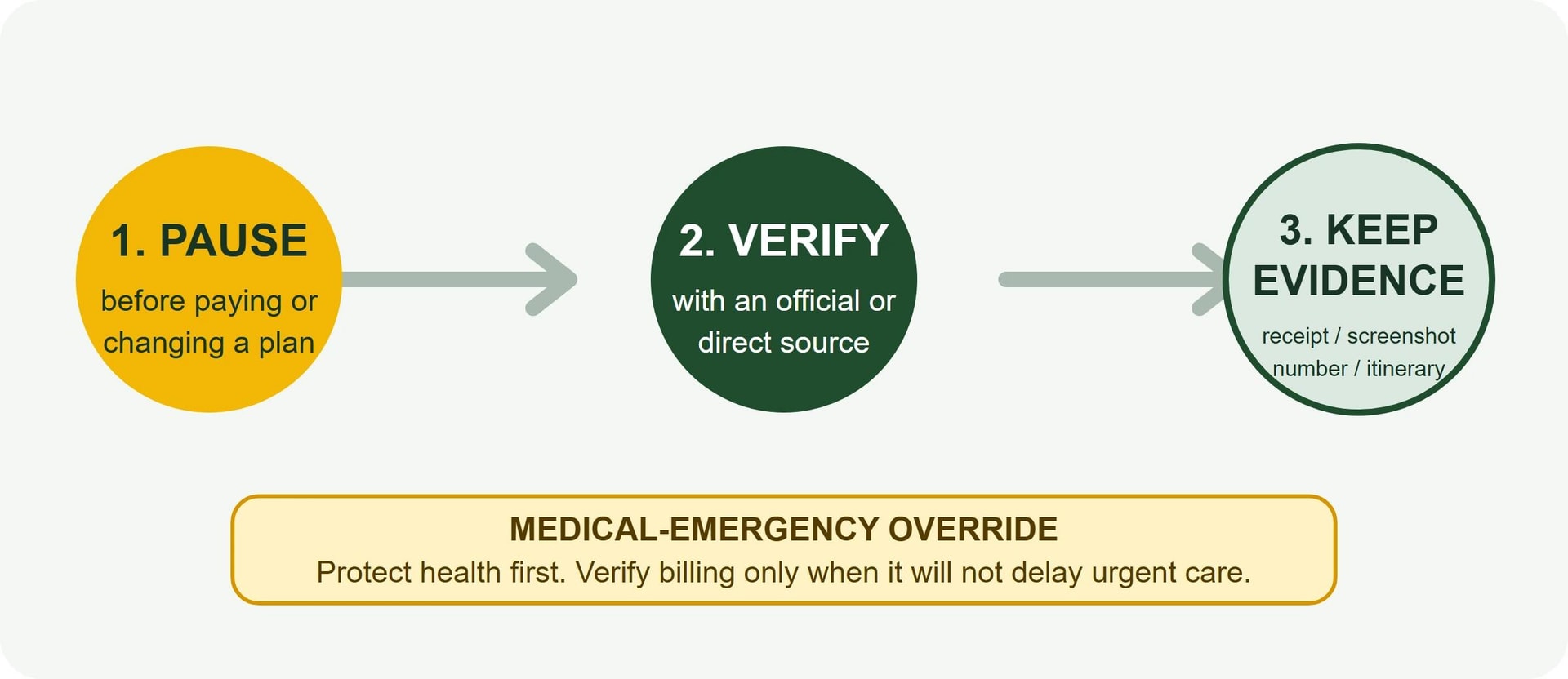
This guide uses one method throughout:
- Pause before paying or changing a non-urgent plan.
- Verify the price, provider, or promise through an official or direct source.
- Keep evidence such as a receipt, screenshot, vehicle number, or written itinerary.
There is one important exception. In a medical emergency, protect health first. Verify billing and paperwork only when doing so will not delay descent, evacuation, or treatment.
Key takeaways
- Use the airport prepaid taxi facility, a quoted app fare, or a price agreed before the vehicle moves.
- Compare SIM and currency offers with a current official page, not a remembered blog price.
- Put trekking inclusions, exclusions, route changes, and emergency responsibilities in writing.
- Treat pressure as a reason to pause, not automatic proof of fraud.
- For help, Tourist Police lists 1144, Nepal Police 100, and Traffic Police 103.
1. Airport taxi pressure and an unclear fare
The moment after an international flight is a poor time to negotiate without a reference. You may be tired, offline, and carrying luggage while several drivers offer help at once.
Tribhuvan International Airport lists a prepaid taxi service outside the arrival gate. You pay in advance, and rates are displayed on a board. That provides a visible starting point. A taxi app with a quoted fare, a hotel transfer confirmed in writing, or a clearly agreed street-taxi price can also reduce ambiguity.
Before the car moves, confirm the destination and total price. If parking, waiting, or a late-night supplement is mentioned, ask whether it is included. Nepal's Tourist Police advises visitors to use authorized tourist vehicles and record the vehicle number.
Pause if: the price changes before departure, the destination is unclear, or you are pressured away from the official desk before you can compare.
Keep: the plate or vehicle number, driver contact, quote screenshot, and receipt if one is issued.
2. SIM-card and data-plan upselling
An airport SIM is not automatically overpriced. The useful question is whether you know the plan's official price, validity, fair-use threshold, and activation status.
As a dated example, Ncell's official tourist-SIM page listed these prices when this guide was checked on 15 August 2026:
| Plan | Validity | Published price | Data and calls |
|---|---|---|---|
| TouristPro Sprinter | 7 days | NPR 595 | Unlimited data and calls; fair-use policy applies |
| TouristPro Explorer | 14 days | NPR 995 | Unlimited data and calls, 100 SMS; speed reduced after 25 GB |
| TouristPro Voyager | 28 days | NPR 1,995 | Unlimited data and calls; fair-use policy applies |
Ncell says an original passport is required for registration and lists TIA, Ncell centres, and authorized retailers as purchase channels. Prices and packages can change, so open the provider's current page at the counter rather than relying on an old article.
Ask the seller to show the exact plan before payment. Check that mobile data works, note the phone number, and keep the activation message or receipt. If “unlimited” is offered, ask what happens after the fair-use threshold.
Pause if: the seller cannot name the plan, will not show the official price, or asks for your passport without a clear registration process.
3. Exchange-rate confusion and hidden fees
A weaker exchange rate is not automatically a scam. Banks and licensed counters can use different spreads, and Nepal Rastra Bank explicitly notes that open-market rates quoted by different banks may differ.
Use the NRB daily rate as a reference, then ask for the amount you will actually receive after any commission or fee. Compare the final NPR amount, not only the large number on the board.
Tourist Police advises exchanging foreign currency through government-authorized financial institutions. Ask for a receipt and count the cash before leaving the counter. If a note is damaged or the total is wrong, raise it immediately while the transaction can still be checked.
Pause if: the arithmetic changes after you hand over money, the fee appears only at the end, or the counter will not provide a receipt.
4. Souvenir and product claims
The official and reputable sources reviewed for this guide do not establish how common false “pashmina,” gemstone, handmade, or branded-product claims are in Nepal. It would be misleading to present those claims as a measured national scam pattern.
The narrower advice is still useful. If authenticity matters, ask the seller to write the material, maker, brand, treatment, return condition, and price on the receipt. A verbal assurance is difficult to use later. For safety-critical trekking gear, appearance is not a performance test; buy from a traceable channel and leave time to test or replace the item before leaving Kathmandu.
Be especially careful with wildlife products. The UK government's Nepal guidance notes that buying, selling, or trading wild animals or their parts without the required licence can lead to a fine or prison sentence.
Pause if: a costly item comes with a strong authenticity claim but no written description, receipt, return condition, or traceable seller, or if a product may contain protected wildlife material.
5. Crowded-place theft and document loss
US travel guidance says pickpocketing and bag-snatching sometimes occur in crowded tourist places. UK guidance specifically tells visitors to watch for pickpockets and bag-snatchers at airports, on buses, and in busy visitor areas.
The official 2025 complaint data also puts document care in perspective: 452 of 515 registered Tourist Police complaints concerned lost documents or belongings. That category combines loss and missing belongings; it does not prove theft or show how many incidents went unreported.
Use a zipped inner pocket or a bag closure you can see. Avoid placing a phone, wallet, or document on the edge of a café table or ticket counter. Keep separate, secure copies of key document details and follow your own government’s passport-carry guidance.
Act quickly if something is missing: lock affected cards or devices, retrace the last confirmed location, and contact Tourist Police. For a lost passport, also contact your embassy or consulate.
6. A very cheap trekking package with missing costs
A low price can reflect a smaller group, simpler accommodation, fewer inclusions, a promotion, or a different service model. It can also conceal costs that appear only after the trek begins. The UK travel advice for Nepal warns travelers to be cautious about trekking deals that look very cheap and may be scams.
The practical defense is a written scope. Before paying a deposit, ask for:
- the day-by-day itinerary and expected sleeping places;
- whether the departure is private or shared, and the expected group size;
- permits, transport, accommodation, meals, guide and porter services that are included;
- personal expenses, equipment, tips, insurance, evacuation, and route-change costs that are excluded;
- cancellation and refund terms;
- the legal company name and a traceable payment record.
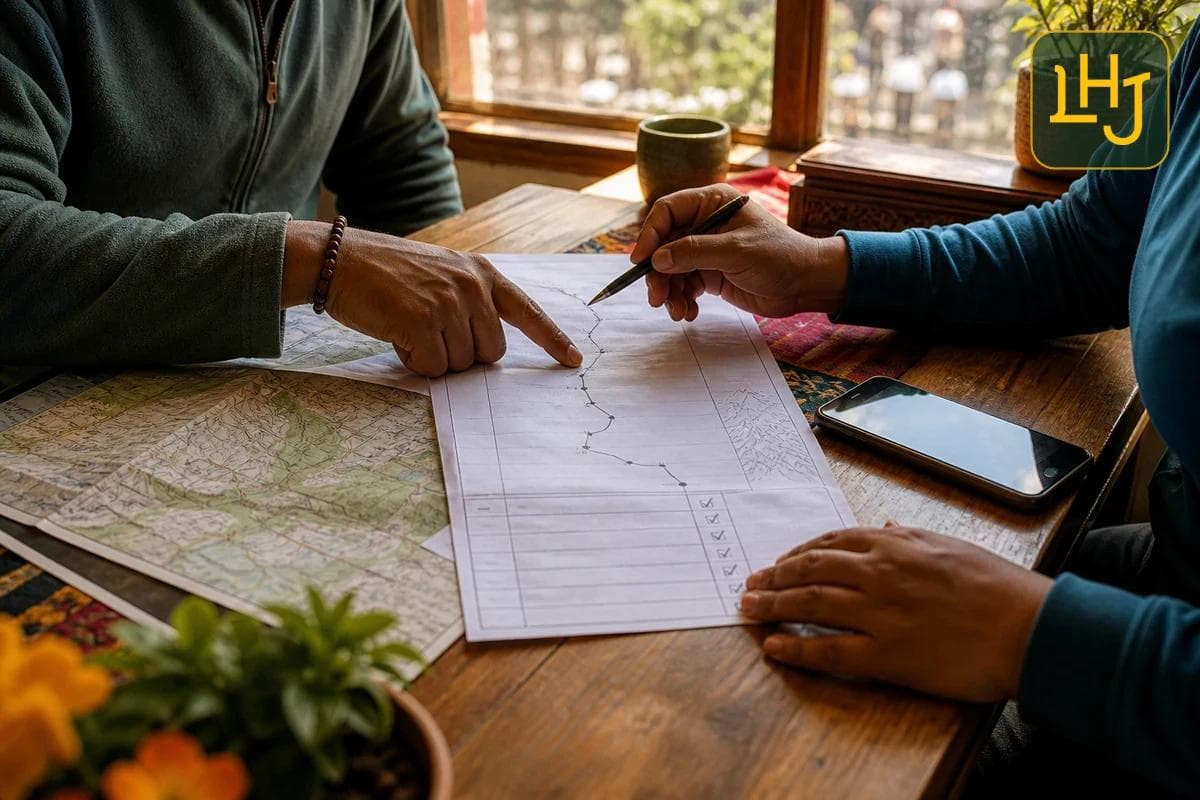
The Tourist Police advises visitors to use government-registered travel, trekking, hotel, and lodge providers. The TAAN member directory can be one cross-check for a trekking agency, but a directory match is not a guarantee of service quality. Compare the legal name across the proposal, invoice, payment account, and any official directory you use.
Pause if: major inclusions or exclusions will not be put in writing, the payment identity does not match the business, or the itinerary changes whenever you ask what the price covers.
7. An itinerary shortcut that increases altitude risk
A route change is not automatically dishonest. Weather, trail damage, illness, transport delays, and lodge availability can all justify a change. What matters is whether the explanation makes sense and whether the new plan respects acclimatization.
Ask what changed, why, and where you will sleep. Compare the new sleeping altitude with the original itinerary. If the shortcut removes an acclimatization night or creates a larger ascent, ask the guide to explain the safety decision before continuing.
Medical rules are more important than the package schedule. The CDC Yellow Book tells travelers never to ascend to sleep higher while experiencing altitude-illness symptoms, no matter how minor they seem, and to descend if symptoms worsen despite rest or treatment at the same elevation.
Do not use this section to self-diagnose severe illness or overrule an urgent descent. Confusion, difficulty walking straight, breathlessness at rest, or other severe symptoms require immediate action and qualified medical guidance.
Pause if: a non-emergency shortcut raises the sleeping altitude, removes acclimatization, and is presented as non-negotiable without a safety explanation.
8. Medical-evacuation fraud and inflated rescue billing
Medical evacuation is a genuine lifesaving service and an area where fraud has been alleged. On 23 March 2026, the Kathmandu Post reported that a case had been filed against 32 people after a Nepal Police Central Investigation Bureau report. The allegations involved staged or inflated rescue claims, forged records, and billing concerns. Charges and allegations are not convictions.
Online claims can go beyond the verified case record. On 3 April 2026, the Central Investigation Bureau published a notice about unverified media reports and misinformation concerning the tourist fake-rescue investigation. Do not repeat viral claims about specific companies, guides, hospitals, poisoning, or individual rescues unless they are established in an official record or reliable, current reporting.
If severe altitude illness or another emergency is suspected, follow qualified medical advice and any emergency plan you agreed with your operator or insurer. Descend or evacuate as medically required. Do not delay care while debating a bill.
When circumstances allow without creating medical delay:
- contact the insurer's emergency-assistance line and request pre-authorization;
- confirm the rescue company, helicopter operator, destination hospital, and expected billing path;
- ask who is authorizing the flight and why ground descent is or is not appropriate;
- keep medical notes, flight details, invoices, and messages;
- never agree to pretend to be ill or change a truthful account for an insurance claim.
The US travel advisory warns that medical-evacuation scams can occur in Nepal and recommends finding out costs beforehand and using a rescue agency registered with TAAN. Treat the directory as a verification step, not a substitute for insurer approval, medical judgment, or emergency action.
Pause if it is medically safe to do so: someone asks you to misstate symptoms, hides the provider identity, or refuses to explain the billing route. If it is not safe to pause, get to safety first and preserve documentation afterward.
Before you pay: a 60-second verification checklist
| Check | Question to ask | Evidence to keep |
|---|---|---|
| Identity | Who is selling or providing this? | Legal name, phone number, vehicle number, business page |
| Scope | Exactly what am I receiving? | Written itinerary, plan name, product description, inclusions |
| Total | What is the final amount after fees? | Quote, tariff photo, app screenshot, invoice |
| Change | What happens if the plan changes? | Cancellation, refund, and additional-cost terms |
| Independent check | Can I confirm this without the seller's link or phone? | Official provider page, airport desk, NRB page, insurer line |
| Record | Can I prove what was agreed? | Receipt, payment record, messages, names and timeline |
Pressure is information. It is a reason to slow the transaction and verify it, not automatic proof that the other person is a scammer.
If something goes wrong
Move to a safe, public place and write down what happened while the details are fresh. Save payment records, screenshots, receipts, names, phone numbers, vehicle numbers, and the sequence of events. If a passport, card, or phone is missing, contact the appropriate issuer or service promptly.
Nepal Police lists these contacts:
- Tourist Police: 1144
- Nepal Police: 100
- Traffic Police: 103
Tourist Police says it registers complaints, conducts preliminary investigations, assists with lost goods and documents, and can provide a police report for lost documents. For a lost passport, contact your embassy or consulate as well. For a disputed card transaction, contact the card issuer. For medical or evacuation billing, contact the insurer's emergency-assistance team.
Frequently asked questions
Is Nepal safe for tourists?
Current UK and US travel advice describes serious or general crime levels as low while still recommending precautions against pickpocketing, bag-snatching, and specific scams. Stay alert in crowded areas, protect documents, and verify important transactions rather than assuming every unfamiliar offer is fraudulent.
How do I avoid taxi overcharging at Kathmandu airport?
Use TIA's prepaid taxi facility, a quoted taxi app, or a transfer confirmed in writing. Confirm the destination and total price before the vehicle moves, and record the vehicle number. Do not rely on a universal fare copied from an old article because destinations and published rates can change.
How can I verify a trekking agency?
Match the legal company name across its proposal, invoice, payment details, and relevant official or association directory. Ask for inclusions, exclusions, itinerary, change terms, and emergency responsibilities in writing. A directory listing is one cross-check, not a quality guarantee.
What should I do if I suspect a rescue scam?
Do not delay urgent descent, evacuation, or treatment. When it is medically safe, call the insurer, confirm the providers and billing route, keep medical and flight documentation, and give only a truthful account of symptoms and events. Report suspected fraud after immediate safety needs are handled.
Sources
- Nepal Police - Tourist Police, rechecked 2026-08-15.
- Ministry of Culture, Tourism and Civil Aviation - Nepal Tourism Statistics 2025, official workbook, rechecked 2026-08-15.
- Tribhuvan International Airport - Arrival Information, rechecked 2026-08-15.
- Ncell - TouristPro tourist SIM plans, rechecked 2026-08-15.
- Nepal Rastra Bank - Foreign Exchange Rates, rechecked 2026-08-15.
- Trekking Agencies' Association of Nepal - Member Directory, rechecked 2026-08-15.
- CDC Yellow Book - High-Altitude Travel and Altitude Illness, rechecked 2026-08-15.
- US Department of State - Nepal Travel Advisory, rechecked 2026-08-15.
- UK FCDO - Nepal Safety and Security, rechecked 2026-08-15.
- Nepal Police CIB - Public Notice on Unverified Fake-Rescue Reporting, published 2026-04-03, rechecked 2026-08-15.
- Kathmandu Post - Nepal Charges 32 in Fake Rescue Case, published 2026-03-23, rechecked 2026-08-15.
Something here out of date or wrong? Tell us and we will check it.