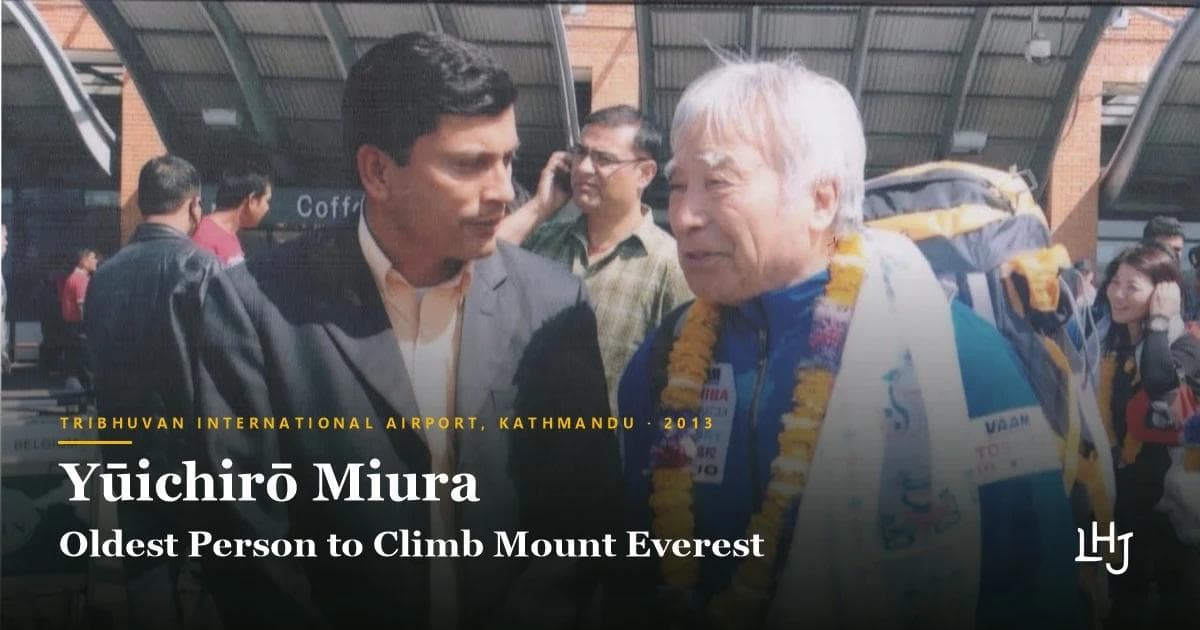
The oldest person to reach the summit of Mount Everest is Yūichirō Miura of Japan. He was 80 years and 223 days old on 23 May 2013, and Guinness World Records lists him under the title oldest person to climb Everest (male). Guinness gives his date of birth as 12 October 1932.
Miura is alive. He was 93 when this article was written, and in 2023, at 90, he reached the summit of Mount Fuji in a mountaineering wheelchair. That is worth stating plainly, because inaccurate reports of his death circulate online.
Before Miura took the record in 2013, it belonged to a Nepali climber.
Min Bahadur Sherchan held the record for five years
Min Bahadur Sherchan was a Nepali climber and a former British Gurkha soldier.
On 25 May 2008, aged 76, he reached the summit and became the oldest person to have climbed Everest. Miura summited the next day at 75. Sherchan held the record until Miura's 2013 climb, five years in all.
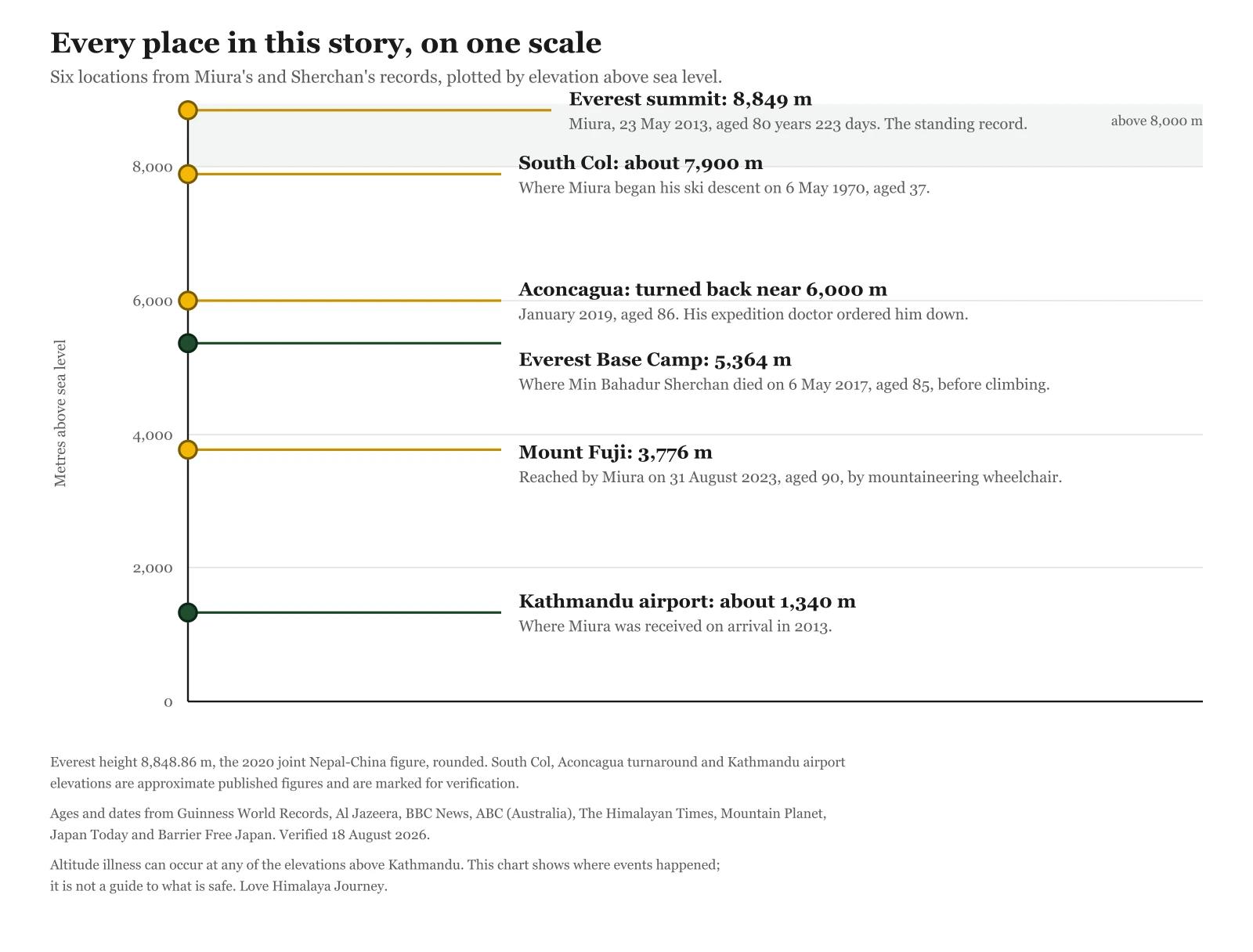
He went back to reclaim it. He died at Everest Base Camp on 6 May 2017, aged 85, before an attempt. A mountaineering official at Base Camp, Gyanendra Shrestha, told reporters the cause was likely cardiac arrest. Some reports at the time gave his age as 86.
Some accounts confuse the two men and attribute Sherchan's death to Miura. It was Sherchan's own attempt, on his own record, and it should be recorded as his.
Who held the title, and when
Guinness World Records' description of Miura's record says he "previously reached the highest point on Earth as the world's oldest summiteer in 2003 and again at 2008". That is accurate for 2003 and loose for 2008. Contemporaneous reporting is clear that Sherchan, at 76, summited a day before Miura, at 75.
| Period | Oldest person to have summited Everest |
|---|---|
| From 22 May 2003 | Yūichirō Miura, aged 70 |
| From 25 May 2008 | Min Bahadur Sherchan, aged 76 |
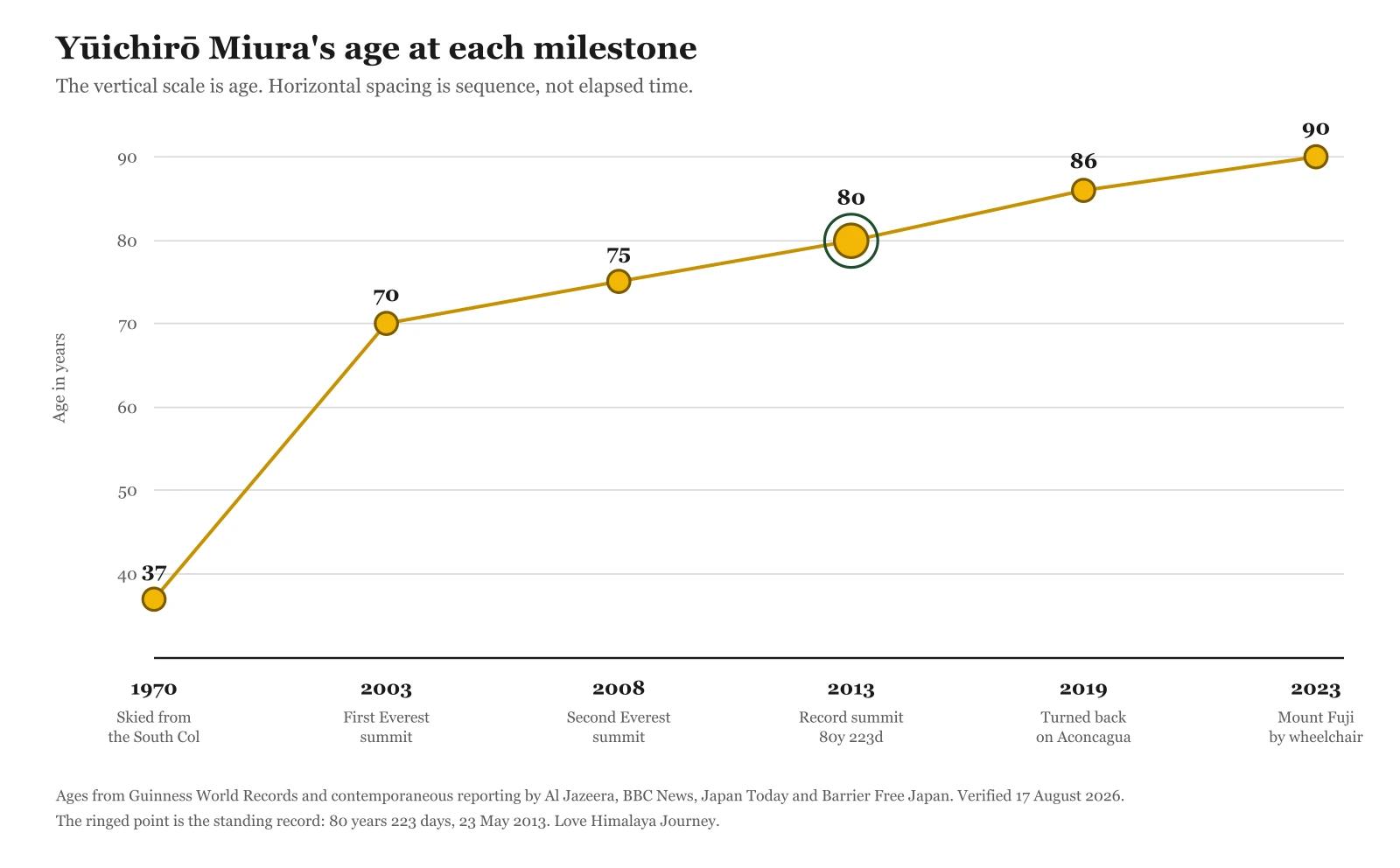
| From 23 May 2013 | Yūichirō Miura, aged 80 years 223 days |
What the 2013 climb took
By the time Miura left for Everest in 2013 he had undergone four heart operations since 2007. The most recent was in January of that year, four months before the climb, for an arrhythmia, an irregular heartbeat. In 2009 he had fractured his pelvis and his left thighbone in a skiing accident.
He climbed the southeast ridge, the route Edmund Hillary and Tenzing Norgay used in 1953 and the line that still defines climbing in the Everest region. His team included three other Japanese climbers, one of them his son, and six Nepali Sherpas. Expedition climbing at this altitude is built on that kind of professional Nepali staffing, not on individual endurance alone.
Reports from the summit quote him as saying: "I made it! this is the world's best feeling, although I'm totally exhausted."
Three summits at 70, 75 and 80
Miura first summited Everest on 22 May 2003, aged 70. He summited again in 2008, aged 75. His third and record climb was 23 May 2013.
1970: skiing the South Col
Miura was a professional speed skier before he was an Everest summiteer, and the thing he is still best known for in Japan happened forty-three years before his record.
On 6 May 1970 he skied down from high on Everest, from near the South Col, the saddle at roughly 7,900 m between Everest and Lhotse where climbers make their final camp. He used a large parachute as a brake. He lost control and fell, and he survived.
He did not summit Everest in 1970, and he did not ski from the summit. His first summit came thirty-three years later, in 2003.
The descent was filmed and released in 1975 as The Man Who Skied Down Everest, directed by F. R. Crawley and Bruce Nyznik. It won the Academy Award for Best Documentary Feature.
Published accounts of the descent disagree on how far he skied and on the exact distances of his fall, so this article does not give figures for either. What is consistent across them is the date, the starting point high on the mountain, the parachute, the fall, and that he lived.
Kathmandu airport, 2013
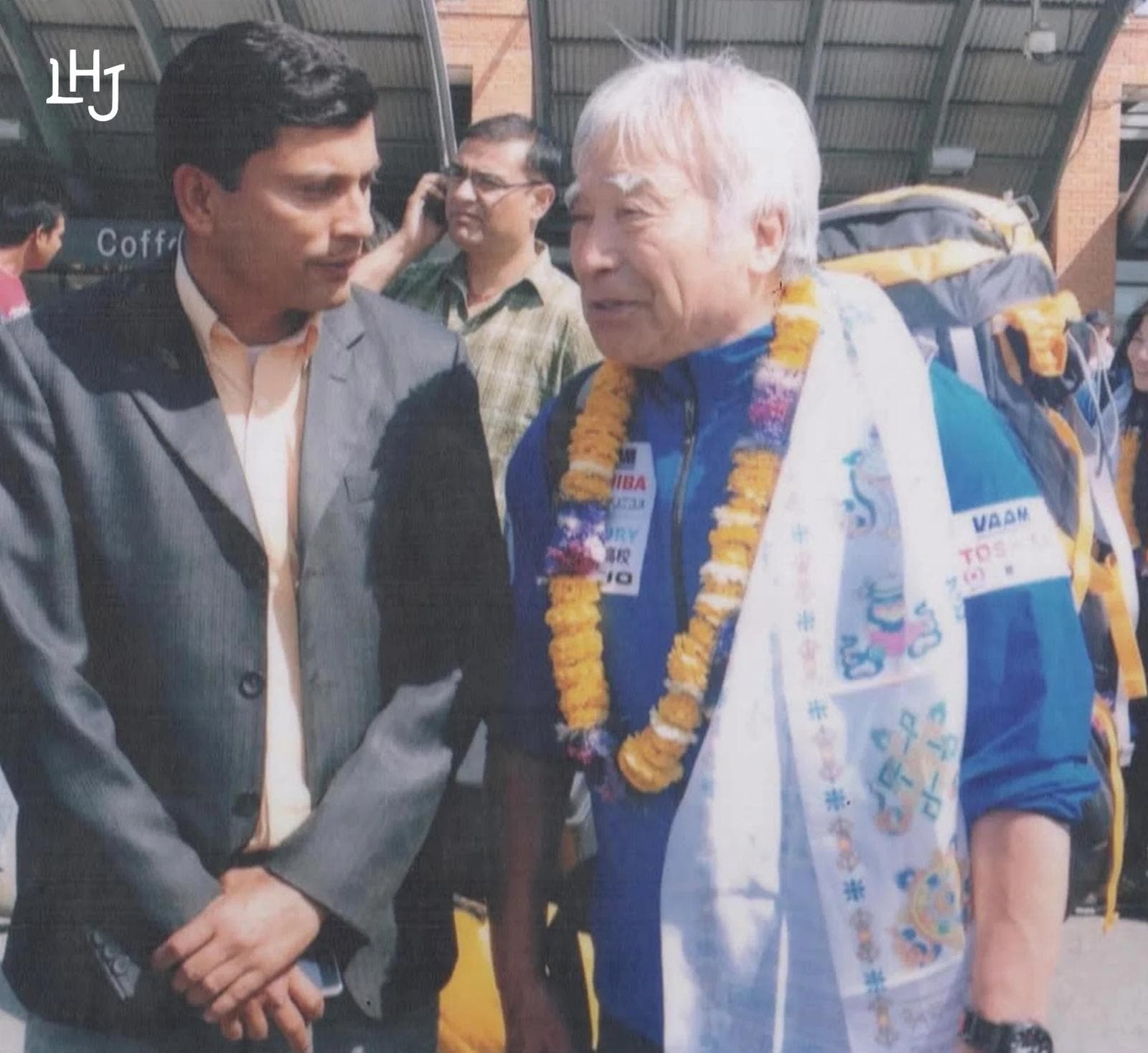
Miura was not an unknown arrival. By 2013 the Oscar-winning film of his ski descent was nearly forty years old, and he had already summited Everest twice, at 70 and at 75. When he landed in Kathmandu for the record attempt, he was met the way a well-known climber is met.
I went out to Tribhuvan International Airport to receive him, not for Love Himalaya Journey, which did not exist yet, but for another Nepali trekking company I was working for at the time. We talked about mountaineering and about the environment. The photograph above is from that day, taken by a friend who was with me.
One clarification, because this is the kind of detail that gets garbled in retelling. Love Himalaya Journey had no involvement in Miura's 2013 expedition, or in any of his climbs, and he has no association with this company. What the photograph shows is a brief professional courtesy at an airport, years before Love Himalaya Journey existed.
After the record: Aconcagua and Fuji
In January 2019, aged 86, Miura attempted Aconcagua in Argentina, the 6,962 m peak that is the highest mountain outside Asia. He did not reach the summit. He had climbed as far as the Plaza Cólera camp at about 6,000 m when his expedition doctor, Kazue Oshiro, judged that the long hours at that altitude had begun to tax him physically, and that going higher could trigger heart failure. Oshiro's reported words were direct: "I made the decision to order him to descend the mountain so that he can return home alive." Miura descended in good health.
In June 2020 he was hospitalised for around eight months with a spontaneous spinal epidural haematoma, bleeding that compresses the nerves in the neck and, in his case, paralysed his hands and feet.
On 31 August 2023, at 90, he reached the summit of Mount Fuji at about 7:20 a.m., using a specially designed mountaineering wheelchair over a three-day ascent, with family and friends. He had set it as a rehabilitation goal.
One mountain abandoned on a doctor's order, one reached with a great deal of help. That is the honest shape of his last decade, and it matters more to an ordinary reader than the record does.
Six things people get wrong about this record
| Commonly claimed | What the sources show |
|---|---|
| Miura died in 2019 | He is alive. He was 93 when this article was written and reached the summit of Mount Fuji at 90 in 2023. |
| Miura died at Everest Base Camp | Min Bahadur Sherchan died at Base Camp on 6 May 2017, aged 85. Not Miura. |
| Miura summited Everest in 1970 | He skied from below the South Col in 1970. His first summit was 22 May 2003. |
| Miura has held the record continuously since 2003 | Min Bahadur Sherchan held it from May 2008 until May 2013. |
| He climbed Aconcagua at 86 in 2019 | He attempted it and was ordered down by his expedition doctor near 6,000 m. |
| Love Himalaya Journey, or its chief executive, was involved in Miura's Everest climbs | No. Love Himalaya Journey did not exist in 2013. Deepak Rimal received Miura at Kathmandu airport while working for a different company, and had no role in any of Miura's climbs. Miura has no association with Love Himalaya Journey. |
What this does not mean for your trek
It is tempting to read Miura's record as permission. It is not.
Consider what the 2013 climb rested on: a dedicated expedition organised around one climber, six Nepali Sherpas supporting a four-person party, decades of high-altitude experience, four heart operations behind him, and a support system most trekkers will never have.
Then consider what happened six years later. The same man, on a lower mountain, was turned around near 6,000 m by a doctor who had travelled with him and who judged that going higher risked heart failure. Experience and a record did not change that assessment. Having a doctor there is what made the decision possible.
Acute mountain sickness, and its severe forms affecting the lungs and the brain, can develop in fit people, young people, and people who have been high before without trouble. Age adds cardiac and other considerations that belong with a doctor who has your history in front of them, not with a trekking company and not with an article.
No itinerary, no guide, and no operator removes altitude risk. What good planning changes is how quickly a problem is recognised and how fast you can descend, which is why our altitude and safety protocol is built on daily SpO₂ monitoring and defined descent thresholds rather than on reassurance. That is a real difference, and it is a smaller claim than the one people usually take from a story like this.
Trekkers reach Everest Base Camp at 5,364 m, the same elevation where Sherchan died, and high enough that altitude illness is a normal planning concern rather than a remote one.
If you are over 60, or living with a heart, lung, or blood-pressure condition, and you are considering going high in Nepal, the useful next step is a conversation with your own doctor about your specific plan and altitude profile before you book anything. If you are still deciding where to walk at all, which Himalayan trek suits you is a better starting point than a record, and Nepal's 2026 permit rules will apply whichever route you choose.
Sources
All sources accessed 17–18 August 2026. External links open in a new tab.
The record
- Guinness World Records - Oldest person to climb Everest (male). Record title, holder, birth date 12 October 1932, 80 years 223 days, 23 May 2013.
- Guinness World Records - Japanese skier went on incredible journey to become oldest man to climb Everest.
The 2013 climb
- Al Jazeera, 23 May 2013 - Japanese octogenarian breaks Everest record. Route, team, four heart operations, January 2013 arrhythmia surgery, 2009 fractures, summit quote.
- BBC News, 23 May 2013 - Japanese 80-year-old claims Everest record.
- ABC News - Japanese octogenarian becomes oldest man to reach summit of Mount Everest.
The 1970 ski descent
- Roger Ebert - review of The Man Who Skied Down Everest. 1975 release and the Academy Award for Best Documentary Feature.
- IMDb - The Man Who Skied Down Everest (1975). Directors F. R. Crawley and Bruce Nyznik.
- Smithsonian Magazine - The Godfather of Extreme Skiing.
- The National Interest - 50 years ago, Yuichiro Miura skied down Mount Everest. Date of 6 May 1970; gives the shorter distance figure.
Min Bahadur Sherchan
- ABC News (Australia) - Nepali climber Min Bahadur Sherchan dies at 85 while trying to reclaim Everest age record.
- The Himalayan Times - Mountaineer Min Bahadur Sherchan perishes on Mt Everest.
- NBC News - Nepal man dies trying to become the oldest Mount Everest climber at 85.
- Malay Mail / AFP - Ex-Gurkha bids to reclaim "oldest on Everest" title. Gurkha service and the 2017 attempt.
Aconcagua 2019
- Mountain Planet - Yuichiro Miura, 86, aborts climb of Mt. Aconcagua. Doctor Kazue Oshiro, the quoted decision, the 6,000 m assessment, the Plaza Cólera camp, and his safe descent.
- Nippon.com / Jiji Press - 86-year-old Miura gives up on Mount Aconcagua summit. Corroborating report.
Mount Fuji 2023
- Japan Today - 90-year-old Japanese alpinist summits Mt Fuji in wheelchair.
- Barrier Free Japan - 90-year-old Japanese alpinist summits Mount Fuji in wheelchair. Summit around 7:20 a.m., three-day ascent, June 2020 hospitalisation and spinal epidural haematoma.
First-hand
- Account of Deepak Rimal, recorded 17–18 August 2026. Kathmandu airport, 2013.
Not used as evidence
Competitor trekking-operator blogs, content-farm pages, AI-generated encyclopedia pages and search-engine summaries were excluded. One search summary consulted during research asserted that Miura died in October 2019, that he summited Everest in 1970, and that he skied from the summit in 1973. All three are false, and none is repeated here.
Verification notes
- Guinness World Records states on its own pages that records change daily and are not published online immediately. This article reflects the record as listed on 18 August 2026.
- Miura's living status was checked on 18 August 2026 and must be rechecked immediately before publication.
Corrections policy
If any fact here is wrong, we want to fix it rather than leave it standing. This article concerns two named people, one of them living, and it will be corrected on the record if any detail is shown to be inaccurate.
Frequently asked questions
Who is the oldest person to climb Mount Everest?
Yūichirō Miura of Japan. He reached the summit on 23 May 2013 at 80 years and 223 days. Guinness World Records lists the title as oldest person to climb Everest (male); the women's record is a separate category.
Is Yūichirō Miura still alive?
Yes. He was 93 when this article was written, and he reached the summit of Mount Fuji at 90 on 31 August 2023 using a mountaineering wheelchair. Reports of his death in 2019 are false.
Who died at Everest Base Camp trying to become the oldest climber?
Min Bahadur Sherchan of Nepal. He died at Everest Base Camp on 6 May 2017, aged 85, before an attempt to reclaim the record he had held from 2008 to 2013. He is sometimes wrongly confused with Miura.
How many times has Yūichirō Miura climbed Everest?
Three times: on 22 May 2003 at 70, in 2008 at 75, and on 23 May 2013 at 80.
Did Yūichirō Miura ski down Mount Everest?
He skied from near the South Col, at roughly 7,900 m, on 6 May 1970, using a parachute as a brake. He did not ski from the summit and he did not summit that year. The descent was filmed as The Man Who Skied Down Everest, which won the 1975 Academy Award for Best Documentary Feature.
Was Love Himalaya Journey involved in Yūichirō Miura's Everest climbs?
No. Love Himalaya Journey did not exist in 2013, the year of his record climb. Deepak Rimal, now the company's chief executive, received Miura at Tribhuvan International Airport that year while working for a different Nepali trekking company, and had no role in any of Miura's climbs. Miura has no association with Love Himalaya Journey and does not endorse it.
Does an 80-year-old summit mean older trekkers can safely go high?
No. Miura climbed with a dedicated expedition, six Nepali Sherpas, decades of experience and four heart operations behind him. Six years later, at 86, his own expedition doctor ordered him down from Aconcagua near 6,000 m because of heart-failure risk. Altitude decisions belong with a doctor who knows your history.
Something here out of date or wrong? Tell us and we will check it.