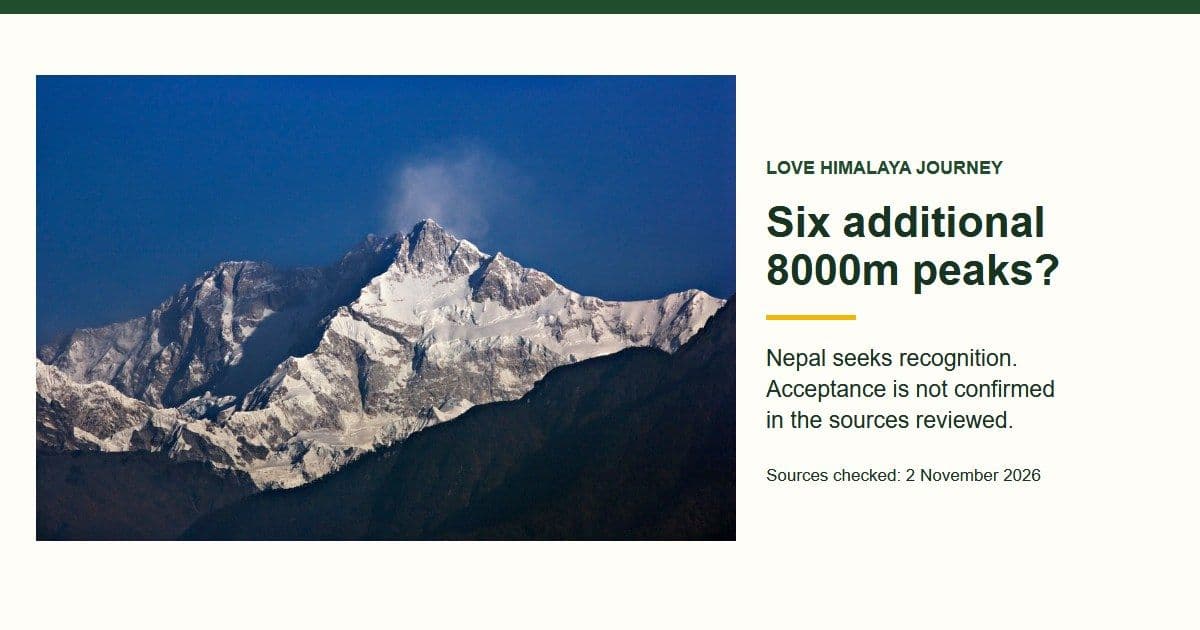
Nepal is seeking separate international recognition for six additional summits above 8,000 metres. This is a proposal, not a confirmed expansion of the internationally accepted list. The government already records the six, but a domestic listing does not establish international recognition.
The latest push was reported during the October 2026 general assembly of the International Climbing and Mountaineering Federation, known as the UIAA, in Kathmandu. The Kathmandu Post's 30 October report describes a government-backed request for assessment and recognition.
Key takeaways
The six are existing summits in the Kanchenjunga and Lhotse massifs, not newly discovered mountains.
All heights in the table below come from Nepal's Department of Tourism.
The UIAA's published position retains the classic 14 eight-thousanders worldwide.
As of 2 November 2026, the official UIAA material reviewed does not confirm acceptance of the six.
What Nepal is proposing
Nepal wants the six summits assessed as independent mountains within the internationally recognised eight-thousander list. According to the Post's report, Tourism Minister Khadak Raj Paudel and Nepal Mountaineering Association president Fur Gelje Sherpa presented the case at the assembly.
The NMA argues that the summits have their own identities and separate climbing routes. That is the association's case for recognition, rather than an announced international decision. Reports also describe an expert presentation supporting the request; the underlying technical submission was not available in the sources reviewed.
The distinction explains why headlines can sound different. Nepal can record a summit for its own administrative purposes while international mountaineering bodies continue to treat it as part of a larger mountain.
The six peaks and their government-listed heights
The following figures are reproduced from the Department of Tourism's Mountaineering in Nepal: Facts and Figures 2026, published in July 2026. Section 6.1 lists peaks opened for mountaineering and managed by the department. The publication is available through its official government page.
| Proposed summit | Massif | Height listed by the government | Printed page and row |
|---|---|---|---|
| Yalung Khang | Kanchenjunga | 8,505 m | p.264, row 423 |
| Kanchenjunga South | Kanchenjunga | 8,476 m | p.251, row 166 |
| Kanchenjunga Central | Kanchenjunga | 8,476 m | p.251, row 164 |
| Lhotse Middle | Lhotse | 8,413 m | p.254, row 232 |
| Lhotse Shar | Lhotse | 8,400 m | p.254, row 233 |
| Yalung Khang West | Kanchenjunga | 8,077 m | p.264, row 424 |
Source: Department of Tourism, Facts and Figures 2026, section 6.1, checked 2 November 2026. Names are normalised for readability; the government writes the Lhotse entries as Lho Tse.
Why some heights look different from news reports: this table follows the government publication throughout. It lists both Kanchenjunga Central and South at 8,476 m, and Lhotse Middle at 8,413 m. Those entries have been retained as printed. They are not LHJ measurements or a resolution of differing published figures.
Four candidates belong to the Kanchenjunga massif and two to the Lhotse massif. A massif is a connected mountain group. For geographical context on the latter, see our Everest-region overview.
Why a summit above 8000m is not automatically a separate mountain
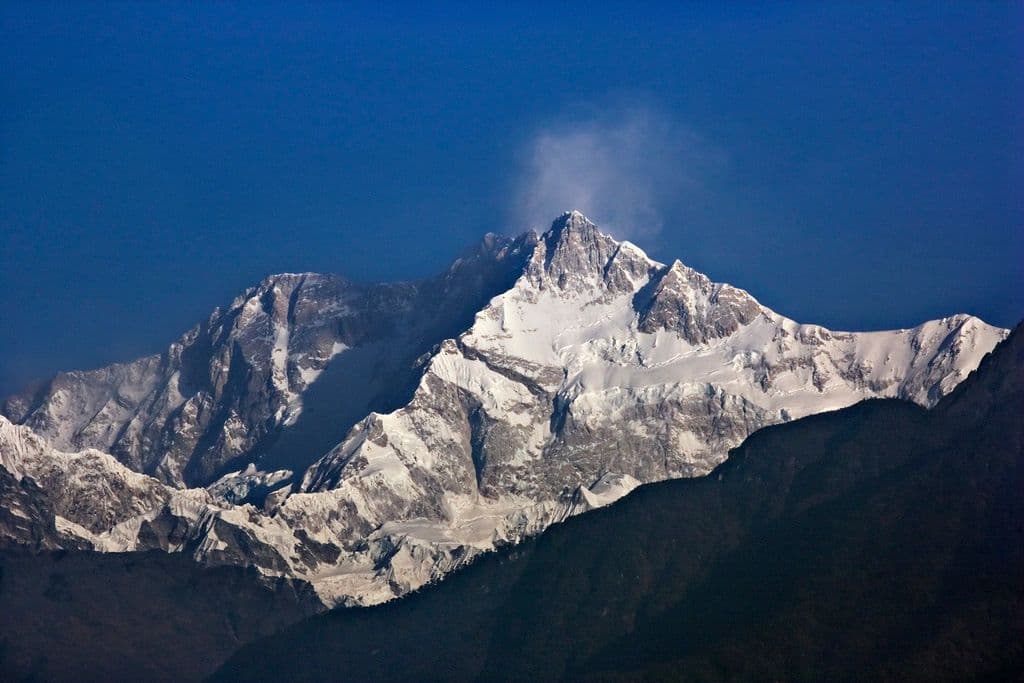
The debate concerns independence, not simply elevation. A high point may exceed 8,000 m while still being regarded as a subsidiary summit of a larger mountain.
The UIAA Mountaineering Commission's statement of 27 February 2024 discusses these additional summits and supports retaining the classic 14 worldwide. It considers geography, mountaineering history and local perspectives, and describes the difficulty of establishing one common definition of a mountain.
The same statement acknowledges Nepal's ability to recognise additional summits for administrative purposes. That makes two different records possible without either being a new discovery: a national list that includes more summits, and the traditional international list of independent eight-thousanders.
Height alone therefore cannot settle the proposal. A photograph of a distinct summit, a separate name or a government table entry does not by itself demonstrate that international acceptance has followed.

What has changed, and what has not
The recent development is Nepal's renewed international recognition request. The summits were already being discussed in the UIAA's 2024 statement, and they appear in the government's July 2026 publication.

If all six were added to the classic international list, the worldwide count would rise from 14 to 20 and Nepal's count from eight to 14. These are conditional totals, as described in the current reporting. They should not be presented as an already accepted new classification.
Has the UIAA accepted the six?
Acceptance is not confirmed in the official material reviewed as of 2 November 2026. The UIAA's 31 October assembly review confirms the Kathmandu meeting concluded and summarises key decisions. It does not announce recognition of the six.
That omission is not proof of rejection. The review says fuller coverage will follow, so the appropriate description remains a proposal awaiting confirmed international acceptance.
The Department of Tourism publication is an official administrative record. It is not, by itself, a signed final recognition notice or an international adoption resolution. No such final instrument was located in this research.
What to watch next
The next meaningful development would be an explicit assessment or recognition decision identifying the six summits and explaining its status. A newly shared headline, a reposted photograph or another reference to the national list would not establish that outcome.
For now, Nepal's initiative can be described clearly: the government supports recognition of six additional eight-thousander summits, while separate international acceptance has not been verified.
If you share the story, keep that qualification with the headline. It is the difference between reporting Nepal's proposal and announcing a decision that the available evidence does not establish.
Something here out of date or wrong? Tell us and we will check it.