If you feel unwell after gaining height on a Nepal trek, tell your guide or trekking companion and stop ascending. Do not move to a higher sleeping place while altitude-illness symptoms persist. If symptoms worsen at the same height, descent is needed. These are the central traveler rules in the CDC Yellow Book's altitude guidance.
Confusion, loss of coordination, difficulty waking or breathlessness at rest need urgent medical help and assisted descent as conditions permit. Do not wait for a low oxygen reading, a full set of symptoms or the next morning. If descent is unsafe or impossible, seek emergency medical and evacuation support immediately. Do not send the ill person downhill alone. The Wilderness Medical Society guideline explains the urgency of serious altitude illness and the clinical support needed when descent is delayed.
This is general safety education for trekkers and companions. It cannot determine what is making an individual ill or replace assessment by a qualified medical professional.
Whether you are walking the Everest Base Camp Trek or approaching a pass on the Annapurna Circuit Trek, feeling unwell changes the next decision. The itinerary needs to respond to the person's condition. The medical principles below do not establish what equipment, staff or evacuation service a particular trip provides.
What might you notice first?
A headache, poor appetite or unusual tiredness can be easy to dismiss after a walking day. Acute mountain sickness, usually shortened to AMS, commonly causes headache with nausea, dizziness, fatigue or appetite loss after ascent. Symptoms often appear later that day or during the first night. They do not always begin while you are climbing. Occasionally AMS occurs without headache, according to the CDC's description of AMS.
Report a change even if you are unsure what it means. Describe what you feel, when it began and whether it is getting worse. You do not need to identify a medical condition before asking for help.
Does poor sleep mean altitude sickness?
Poor sleep can occur at altitude without AMS. It is worth reporting, especially alongside other changes, but it cannot establish the diagnosis on its own. The Wilderness Medical Society's diagnosis guidance places less diagnostic weight on sleep disruption than older symptom lists did.
Other problems can resemble altitude illness, including dehydration, exhaustion and some infections. A trekker cannot reliably settle that distinction with a symptom checklist. The CDC describes several alternative causes that a clinician may need to consider. Uncertainty about the cause is a reason to seek assessment, not a reason to continue higher.
What should change as soon as you feel unwell?
Tell the person responsible for the group before it moves again. If you are walking without a guide, tell your companion and seek appropriate medical advice. Stop ascending while the illness is assessed. The Nepal Tourism Board's mountain-safety guidance also advises against going higher with AMS symptoms and calls for descent with a companion if they worsen.
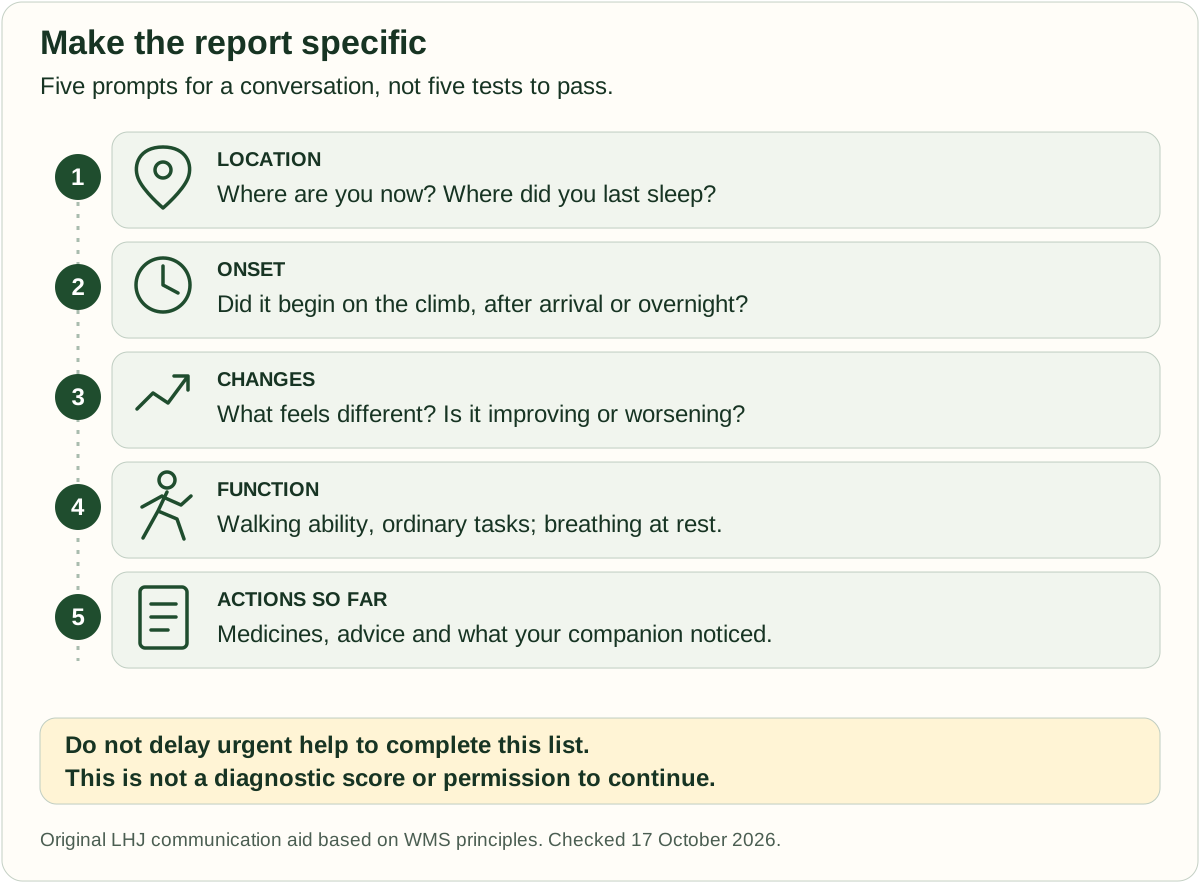
Make the report specific. Saying that you feel "a bit off" leaves the listener to guess whether you mean sore legs, nausea or trouble breathing.

It does not show treatment or establish that resting is sufficient; the response depends on the symptoms.
What should you tell your guide?
Use these prompts to describe the situation. They are a communication aid, not a diagnostic score:
- Where you are: your current location and the last place you slept.
- When it started: whether the change began during ascent, after arrival or overnight.
- What has changed: headache, appetite, nausea, vomiting, dizziness or unusual fatigue, and whether each is improving or worsening.
- What you can do: whether you can walk normally and manage ordinary tasks; whether breathing is difficult even at rest.
- What has already happened: medicines taken, any medical advice received, and symptoms that a companion noticed.
The observations relate to the symptom, function and ascent-history assessment described by the Wilderness Medical Society. Do not delay urgent help to complete the list.
When does this need urgent descent and medical help?
Severe or worsening illness needs escalation. Confusion and loss of coordination can signal a serious brain condition called high-altitude cerebral edema, or HACE. Breathlessness at rest can signal a serious lung condition called high-altitude pulmonary edema, or HAPE. Both require urgent action. These are warning signs, not diagnoses a companion is expected to make. The CDC explains the different presentations.
| What is happening | What needs to change | What must not be assumed |
|---|---|---|
| Mild symptoms after ascent, without emergency signs | Stop ascent, report them, seek advice and arrange close observation at the same height if appropriate | A mild beginning does not guarantee that illness will stay mild |
| Symptoms become worse, or illness is severe | Arrange descent and prompt medical assessment; support the person | Do not wait out an arbitrary observation period |
| Confusion, difficulty walking normally, unusual difficulty waking or breathlessness at rest | Seek urgent medical help and assisted descent or evacuation as conditions permit | A reassuring oxygen reading does not cancel these signs |
Source: WMS assessment and treatment guidance, with patient-language warning signs cross-checked against the NHS altitude-sickness page. The rows are recognition prompts, not a self-triage test. An absent sign does not rule out serious illness.
HAPE can develop without preceding AMS. Do not wait for a headache or for someone to cough up blood before taking serious breathing trouble at rest seriously. Early changes can include chest congestion, a new cough, unusually difficult breathing while walking or a marked drop in how much walking you can manage. Report these changes promptly; do not wait for breathlessness at rest. The CDC describes these early HAPE signs. A cough alone does not establish HAPE either; the WMS guideline describes the clinical context and alternative causes.
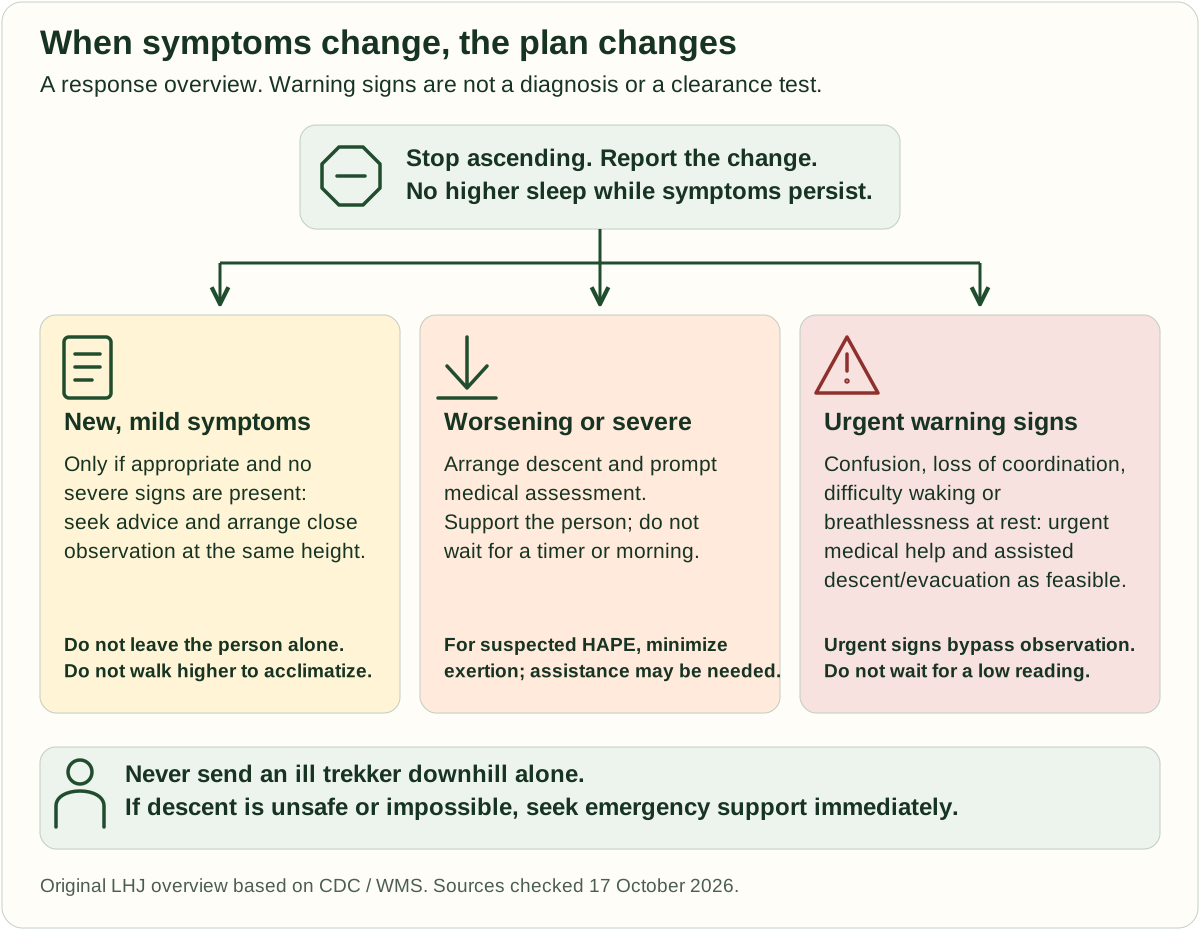
An ill trekker needs company and support during descent. In suspected HAPE, exertion should be kept as low as possible; assisted transport may be needed. "Descend" must not become an instruction for a severely ill person to walk hard downhill with a pack. The WMS descent recommendations distinguish clinical urgency from how descent can be carried out.
If terrain, weather or the person's condition makes descent impossible, get emergency medical and evacuation support immediately. Trained providers may use medical oxygen, medicines or a portable hyperbaric chamber while arranging further care. Availability and proper use cannot be assumed. These options do not justify delaying a feasible, necessary descent, as the WMS guideline makes clear.
Can you stay at the same height or continue later?
Mild illness may be observed at the same height with close monitoring, provided there are no signs of severe illness. That is a conditional approach. It is not permission to leave someone alone or to continue an acclimatization walk higher. The WMS approach to AMS requires watching for progression and descending when illness worsens or is severe.
Avoid promises such as "a rest day will fix it" or "we can decide tomorrow." Worsening symptoms change the decision immediately. If symptoms are not improving, seek medical advice about further management and descent rather than extending observation on your own.
Further ascent should wait until symptoms have resolved. Even then, the next plan needs to account for the illness, the route and any medical advice.
After serious altitude illness, a decision about returning higher belongs with an appropriately qualified clinician. The WMS guideline advises avoiding re-ascent during the same trip after HACE. It treats return after HAPE differently, requiring complete recovery and clinical assessment of oxygenation before further ascent is considered. These are clinical decisions, not a self-clearance checklist. A person briefly feeling better after oxygen or symptom-relieving medicine does not establish readiness to continue. The WMS guidance on further ascent and serious illness sets important limits on restarting.
Can an oxygen reading or medicine clear you to continue?
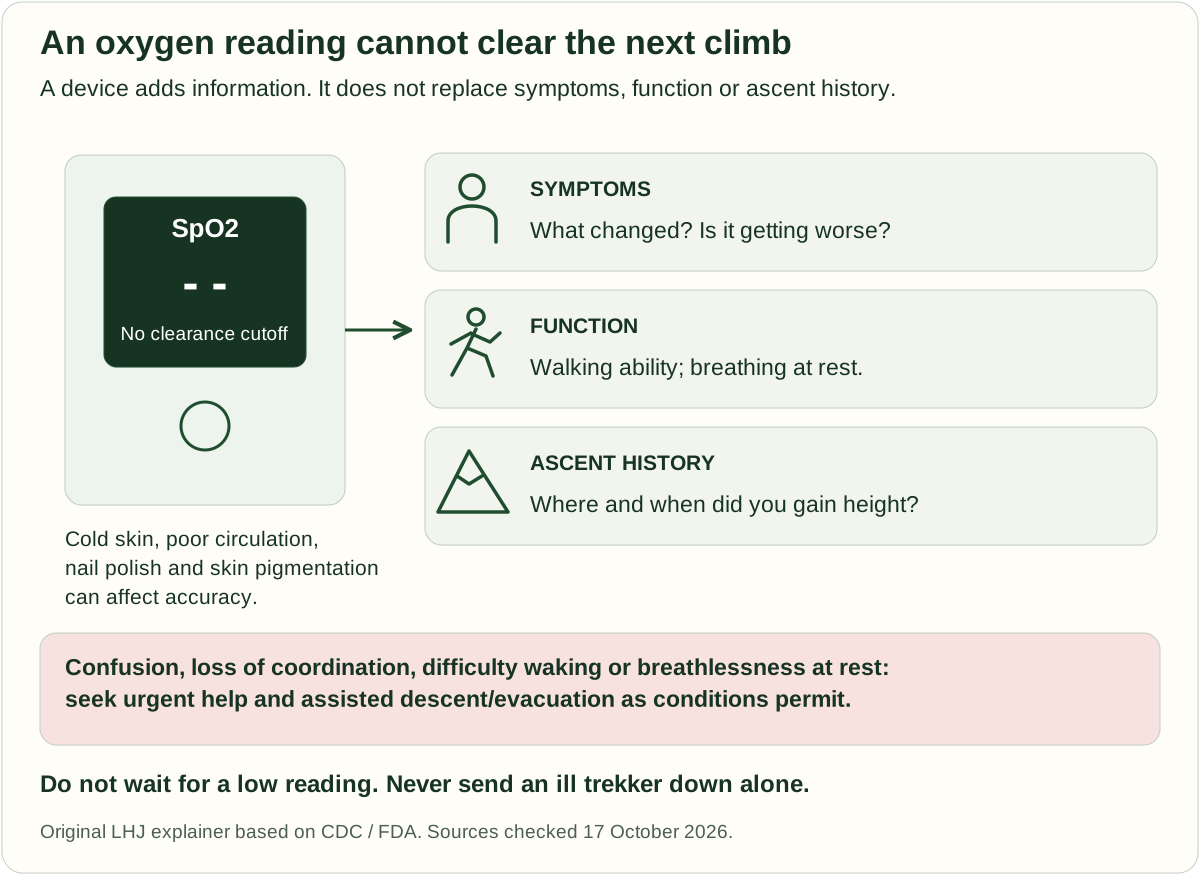
A pulse oximeter estimates the oxygen saturation in your blood. It can add useful information, but it cannot settle whether you are well enough to climb. The CDC notes that AMS can occur with a reading within the expected range for the altitude.
The measurement itself also has limits. Cold skin, poor circulation, nail polish and differences in skin pigmentation can affect accuracy. Readings need to be considered alongside symptoms and other information, according to the FDA's Pulse Oximeter Basics. A single universal mountain cutoff would hide that context.
| Information you have | What still matters | What it cannot establish |
|---|---|---|
| An expected-looking oxygen reading | Symptoms, ordinary function and recent ascent | That AMS is excluded or that going higher is acceptable |
| Symptoms that are getting worse | Descent and prompt medical assessment | That waiting for a device cutoff is appropriate |
| Confusion, loss of coordination, difficulty waking or breathlessness at rest | Urgent medical help and assisted descent or evacuation as conditions permit | That a reassuring number cancels an urgent warning sign |
Source: the CDC's altitude-illness guidance, the FDA's measurement limitations and the WMS assessment and treatment guideline. This table is a reading aid, not a diagnostic tool. Do not descend alone.
Acetazolamide, often sold as Diamox, has an established role in altitude medicine. Whether it is appropriate for you needs a clinician's advice before travel, including a plan for what to do if you become ill. Taking it does not make continued ascent through symptoms acceptable. The WMS recommendations discuss medication alongside ascent planning and response to illness, not as a replacement for those decisions.
Medical oxygen and small consumer oxygen cans are also different. Sustained oxygen has legitimate clinical uses, particularly when descent is delayed or in a medical facility. Small handheld cans cannot be relied on to manage serious altitude illness. The CDC's treatment discussion explains why brief relief does not amount to sustained support. This article gives no medication doses, oxygen flow settings or instructions for treating yourself.
What happens to the rest of the trek?
The next stage may need to be postponed, shortened or abandoned. Ask how the affected person will be supported, who will remain with them and how the rest of the group will be managed. Do not assume that the original route remains practical simply because bookings have been made.
Where can you get help in Nepal?
The Himalayan Rescue Association has established aid posts at Manang and Pheriche. Its volunteer information describes seasonal operation. Those locations are useful when planning an Annapurna or Everest-region trip, but they do not establish that a clinic is open, staffed or reachable when you need it. Confirm current availability for your route and dates. Do not climb higher or cross a pass to reach a named facility when urgent descent is needed.
Other routes need their own assistance plan. The presence of an aid post in another valley does not provide a response plan for the Manaslu Circuit Trek.
Will a helicopter come?
A helicopter cannot be the only contingency. The UK government's Nepal health guidance warns that rapid helicopter evacuation from remote areas may be difficult. An aircraft, suitable conditions and a feasible pickup all matter. No article can guarantee a dispatch or collection time.
Arrange appropriate medical and evacuation insurance before travel, and check the actual activity, altitude and assistance terms with the insurer. Coverage and payment arrangements vary. During serious illness, seeking urgent medical help and organizing feasible descent take priority. Insurance communication should support care, not become a reason to wait for the next step. The FCDO's planning guidance is context, not confirmation that a particular policy will pay.
Extra nights, changed transport and whether you can rejoin the group depend on the situation and agreed trip terms. Ask about them before departure. Do not infer a refund, free support or guaranteed rejoining arrangement from a general safety explanation.
What can you settle before departure?
Check the progression of sleeping places, time available to adjust to height, and what happens if someone needs to stop. Gradual ascent reduces risk, but individual responses vary. Training and a successful previous trip do not make you immune. These points are supported by the CDC's risk and acclimatization guidance.
Why does height change the air you breathe?
Lower air pressure reduces the pressure of oxygen in inspired air. The CDC's introduction gives one comparison: at around 3,050 m, inspired oxygen pressure is 69% of its sea-level value. That is an environmental comparison, not a blood oxygen reading or an illness forecast.

| Environment | Inspired oxygen pressure relative to sea level | Interpretation |
|---|---|---|
| Sea-level reference | 100% | A normalized comparison baseline, not a pulse-oximeter result |
| Around 3,050 m | 69% | CDC's inspired-air example, not an expected individual blood oxygen reading |
The table repeats the chart's data for reference. It cannot predict a trekker's symptoms, establish a safe height or clear anyone to continue. Keep the response to illness ahead of any number.
What should your departure support plan explain?
| Ask before you leave | What a useful answer needs to explain |
|---|---|
| What changes if I report symptoms? | Who makes the next decision, seeks medical advice and stays with the affected person |
| How would assisted descent work here? | Route-specific access and alternatives if the person cannot walk safely |
| What communication actually works? | The planned means of contact and the fallback if it fails |
| What equipment and trained support are arranged? | The actual departure's provision, not an assumed universal kit |
| What should I check with my clinician and insurer? | Personal suitability and medicines advice; the policy's activity, altitude and assistance conditions |
This is a planning checklist. It does not describe a verified company protocol or establish that a service is included. Bring questions about health conditions, previous altitude illness and medicines to a qualified clinician familiar with altitude medicine.
Drink enough to avoid dehydration, but do not force water as an altitude treatment. Overhydration has no demonstrated preventive benefit and can be harmful, according to the WMS review of preventive measures. Food, fluids and rest must not postpone assessment when symptoms worsen.
For wider trip preparation, the Nepal travel preparation guide covers the arrangements to settle before you fly. Discuss the actual route and departure support with the operator, and personal medical questions with your clinician. If someone is already ill on the trail, use the urgent-help guidance at the start of this page.
Frequently asked questions
Do people get altitude sickness in Nepal?
Yes. Risk depends on ascent, altitude and individual susceptibility. Fitness and previous success do not remove it. The route name alone cannot tell you whether you will become ill.
What should I do if I feel altitude sick while hiking?
Tell your guide or companion and stop ascending. Do not sleep higher while symptoms persist. Worsening or severe illness needs descent and medical assessment. Confusion, loss of coordination, difficulty waking or breathlessness at rest need urgent medical help and assisted descent or evacuation as conditions permit. Do not descend alone.
At what altitude should I worry about altitude sickness?
There is no universal height below which concerning symptoms can be ignored. Altitude and ascent history inform the assessment, but a number on a map cannot rule out illness. Report symptoms and seek appropriate medical advice.
Can I continue if my oxygen reading looks normal?
An expected-looking reading does not exclude AMS or clear you to continue. Symptoms, function and ascent history matter, and the measurement has limitations. Urgent warning signs require action regardless of the reading.
Does taking Diamox mean I can keep going?
No. Medication does not make it acceptable to ascend through ongoing symptoms. Discuss personal use and an illness plan with a qualified clinician before the trek; do not use this page to choose a drug or dose.
Will I need a helicopter or be able to rejoin later?
That depends on your condition, medical advice, access and the trip arrangements. Neither aircraft availability nor a return to the itinerary can be guaranteed. Seek urgent help and arrange feasible supported descent when needed; do not wait for an aircraft promise or paperwork.
Sources
Sources checked 26 October 2026. The 2026 CDC edition's chapter is dated April 2025; the WMS guideline is the 2024 update, first published online in December 2023. NHS's page displays a review date of July 2023 and a review-due date of July 2026; it is used to cross-check plain-language warning signs, alongside CDC and WMS. HRA and NTB information does not confirm present opening hours. Changes in medical guidance, local access and actual trip support require a fresh check.
- CDC Yellow Book: High-Altitude Travel and Altitude Illness.
- Wilderness Medical Society: Acute Altitude Illness, 2024 Update.
- FDA: Pulse Oximeter Basics.
- NHS: Altitude sickness.
- Nepal Tourism Board: Safety in the mountains.
- Himalayan Rescue Association: Potential Volunteers.
- FCDO: Nepal travel advice, Health.
Something here out of date or wrong? Tell us and we will check it.